A Discerning Buyer's Guide to Mattress Firmness

Before you can discover the right mattress, we must clarify the single greatest point of confusion in our industry: the difference between firmness and support. They are not the same. In fact, most large-scale retailers use the terms interchangeably, which is a disservice to anyone seeking a better night’s sleep.
Understanding this one distinction is the first true step toward investing in a sleep system that genuinely restores your body.
The Foundation of Restorative Sleep
When you first lie down on a mattress, that initial feeling—whether it’s a plush, sinking hug or a buoyant, on-top-of-it sensation—is its firmness. This is the role of the upper comfort layers, crafted from materials like natural latex or wool. They are designed to cushion your body and relieve pressure on your hips and shoulders. Think of firmness as the "welcoming handshake."
Support, on the other hand, is the workhorse beneath the surface. It’s the structural integrity of the mattress core, whether that’s a sophisticated, hand-assembled coil system or a dense layer of natural latex. Its sole purpose is to hold your spine in a straight, neutral line all night. This is what prevents the dreaded sagging that leads to morning aches. A mattress can feel incredibly soft on top and still provide uncompromising support underneath. This is the hallmark of superior craftsmanship.
Why This Distinction Matters for the North County Lifestyle
For those leading active lives in communities like Carlsbad and Rancho Santa Fe, deep sleep is not a luxury—it's essential for recovery and performance. But if you choose a mattress based on a simple "soft" or "firm" label, you're ignoring the actual mechanics of healthy sleep posture. You might be drawn to the feel of a soft mattress, but if its core cannot support your body type, your spine pays the price.
Conversely, a mattress that is too hard may offer support but create painful pressure points because the comfort layers are insufficient. The goal isn't to pick one over the other. It is to find the perfect, engineered harmony between them.
A truly luxurious mattress doesn't force you to choose between comfort and alignment. It masterfully integrates both, creating a personalized environment where your muscles can fully relax and your body can truly recover.
At our private Carlsbad showroom, we move beyond subjective feelings. We focus on identifying the exact combination of surface comfort and foundational support your body needs for optimal rest. You can learn more about how a truly supportive mattress helps your back in our detailed article on the true benefits of a firm mattress for spinal health. It’s a scientific approach ensuring your investment is based on your unique physiology, not marketing jargon.
How to Navigate the Mattress Firmness Scale
To bring some order to the personal world of mattress comfort, the industry developed a 1-to-10 scale. However, a number on a website cannot tell you how a mattress will feel on your lower back after a long day.
Think of the firmness scale as a map, not the final destination. It provides a general direction, but your body is the ultimate compass. Let's translate those abstract numbers into what they mean for your sleep.
The first step is understanding what you are trying to solve. Is it the initial "ahh, that feels wonderful" moment, or is it waking up free from aches and pains? This decision tree illustrates the two paths: immediate feel (firmness) versus the deeper job of spinal alignment (support).
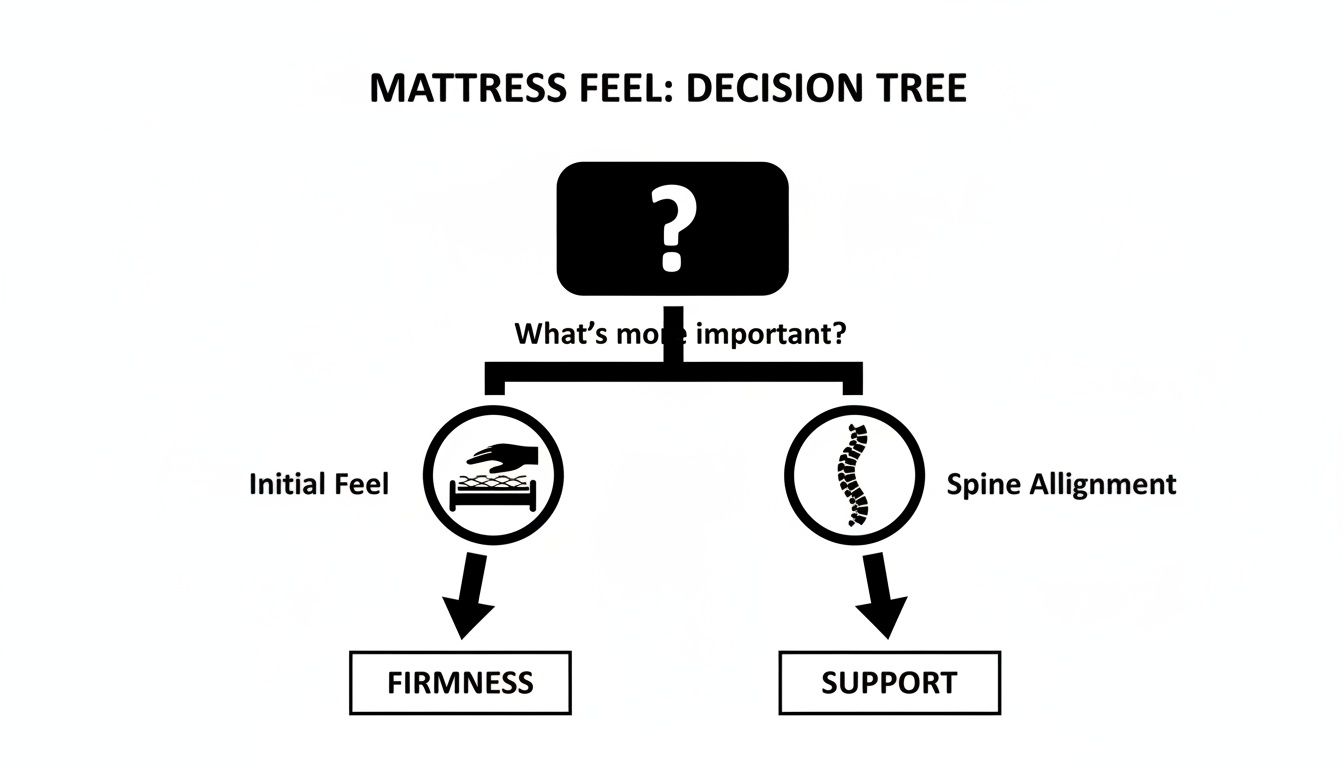
This is a critical distinction. The most restorative sleep occurs when a mattress masters both—a concept we explore in our guide to the differences between firm and plush mattresses.
Decoding the Firmness Levels
Each number range on the scale delivers a different sensation, engineered for different bodies and sleeping styles. Knowing the basics will make your private fitting far more productive.
Here is a simple guide matching the scale to real-world sleeper profiles.
Mattress Firmness Scale and Sleeper Profiles
Firmness Level (1-10) | Feel Description | Best For Sleep Position | Ideal Body Weight |
|---|---|---|---|
1–3 (Soft) | A deep, enveloping hug; you sleep in the mattress. | Strict Side Sleepers | Lighter frames (under 130 lbs) |
4–6 (Medium) | Balanced contour and support; cushions without major sinkage. | Back Sleepers, Combination Sleepers, Couples | Average weight (130-230 lbs) |
7–10 (Firm) | You float on top of the surface with minimal give. | Stomach Sleepers, Back Sleepers | Heavier frames (over 230 lbs) |
Ultimately, this table is a starting point. Your personal preference and specific pressure points will fine-tune the recommendation.
Beyond the Numbers
Here is where nuance is key. A "medium-firm" rating can feel entirely different depending on the materials used. A memory foam medium-firm will slowly contour and absorb pressure, while a natural latex medium-firm feels more buoyant and responsive.
This is why comparing models is so important. For example, the Chorus Cushion Firm Mattress provides a tangible feel for a specific point on the scale, but it will not feel the same as another brand with the same rating.
The term 'medium-firm' is often called the universal sweet spot, but your body is the ultimate authority. True luxury is not about finding a one-size-fits-all solution, but about discovering the precise combination of materials and construction that serves your unique physiology.
These ratings are merely the prelude to the real evaluation. You must feel it for yourself in a setting designed for careful assessment, allowing your body to communicate its needs. This is what we facilitate in our Carlsbad showroom—we move past generic labels and use tools like pressure mapping to find your perfect match.
How Your Body and Sleep Style Define Your Needs
Finding the right mattress firmness is not about what you like; it is about what your body needs. This isn't guesswork. It's about matching a mattress to your unique biomechanics, and the two most significant factors are your preferred sleeping position and your body weight.
Once you understand how these two elements interact, you can move past marketing hype and make a truly informed decision for your health.
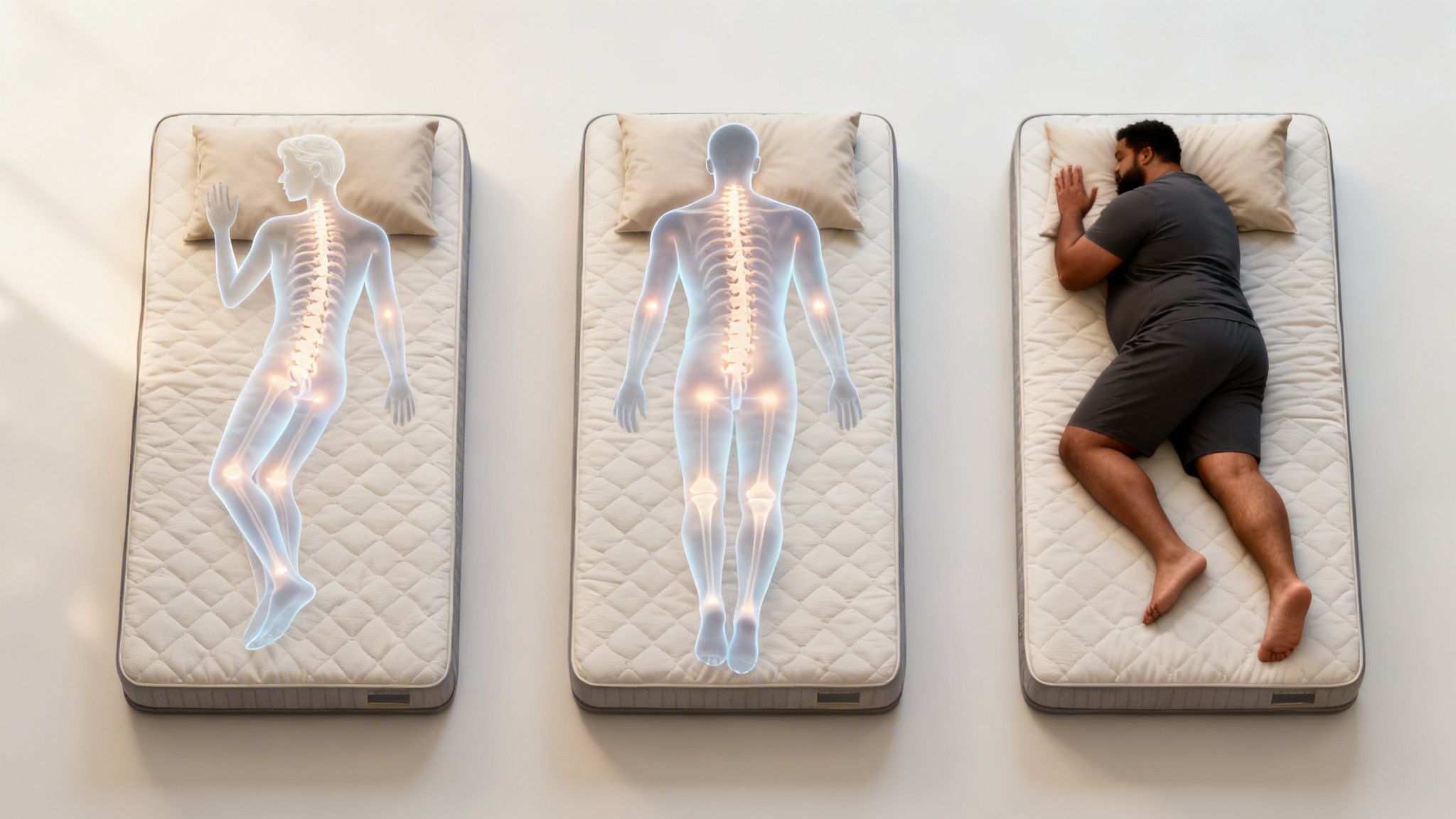
Think of your mattress as a partner that works all night to keep you in a healthy posture. For that partnership to succeed, the surface must adapt perfectly to the way you sleep.
The Role of Your Sleep Position
How you sleep determines where your body exerts the most pressure on the mattress. The right firmness will cradle those pressure points while keeping your spine in a straight, neutral line from your neck to your hips. The wrong firmness forces your body into unnatural angles, leading to stiffness and pain.
Side Sleepers: This common position creates significant pressure points on the hips and shoulders. A mattress that’s too firm will not allow these joints to sink in, pushing your spine out of alignment. Side sleepers almost always require a softer to medium-firm mattress that contours to their curves, cushioning these high-pressure zones.
Back Sleepers: Sleeping on your back distributes weight more evenly. The primary goal is to support the natural S-curve of your spine, especially the lower back. If the mattress is too soft, your hips will sink too low, creating a "hammock" effect that strains your lumbar region. A medium-firm to firm mattress is typically ideal, providing the support needed to keep the spine properly aligned.
Stomach Sleepers: This position can place the most stress on your spine. On a soft mattress, your midsection will dip, arching your back and creating tension. Stomach sleepers need a firm surface to keep their hips elevated and aligned with their shoulders, which prevents that all-too-common lower back pain.
How Body Weight Changes Everything
Your body weight determines how much force you exert on the mattress, which directly changes how firm it feels to you. A mattress does not have one universal feel; its sensation is entirely relative to the person on it.
A lighter person (under 130 lbs) puts less pressure on the surface and might find a standard medium-firm mattress feels unyielding. They often need a softer feel to achieve sufficient contouring and pressure relief.
Conversely, a heavier person (over 230 lbs) exerts more force and will sink much deeper. A soft mattress will completely fail to support them, leading to poor spinal alignment. They typically need a firmer, more robust mattress to distribute their weight evenly without bottoming out.
Choosing the right firmness is a science of balance. It's about finding that precise level of give that cushions your pressure points while providing the unyielding support needed to maintain a healthy, neutral spine all night.
This is a significant factor in the global mattress market, which was valued at USD 46.48 billion in 2024. Industry data consistently points to an optimal firmness of around 6.5 out of 10 for most adults, as this level promotes neutral spine positioning and can reduce back pain by up to 55%. With North America holding a 34% market share, it is clear that homeowners from Carlsbad to Encinitas are getting serious about finding personalized sleep solutions.
If your current mattress feels too firm and you are waking up sore, you might find relief by exploring mattress topper solutions for hard mattresses to adjust your surface feel.
And if you’re a side sleeper struggling with hip pain, we have written a guide just for you on finding your ideal mattress firmness as a side sleeper.
How Premium Materials Shape the Feel of a Mattress
A mattress’s firmness number tells you part of the story, but not the whole thing. The true character and performance—that truly luxurious feel—is born from the materials inside. At our Carlsbad showroom, we help clients see beyond simple ratings to understand the craftsmanship that separates a mass-produced product from a restorative sleep surface.
Think of it like a high-performance sports car versus a standard sedan. Both can achieve the same speed, but the experience of driving—the responsiveness, the connection to the road—is worlds apart. The same is true with mattresses. The materials dictate the experience.
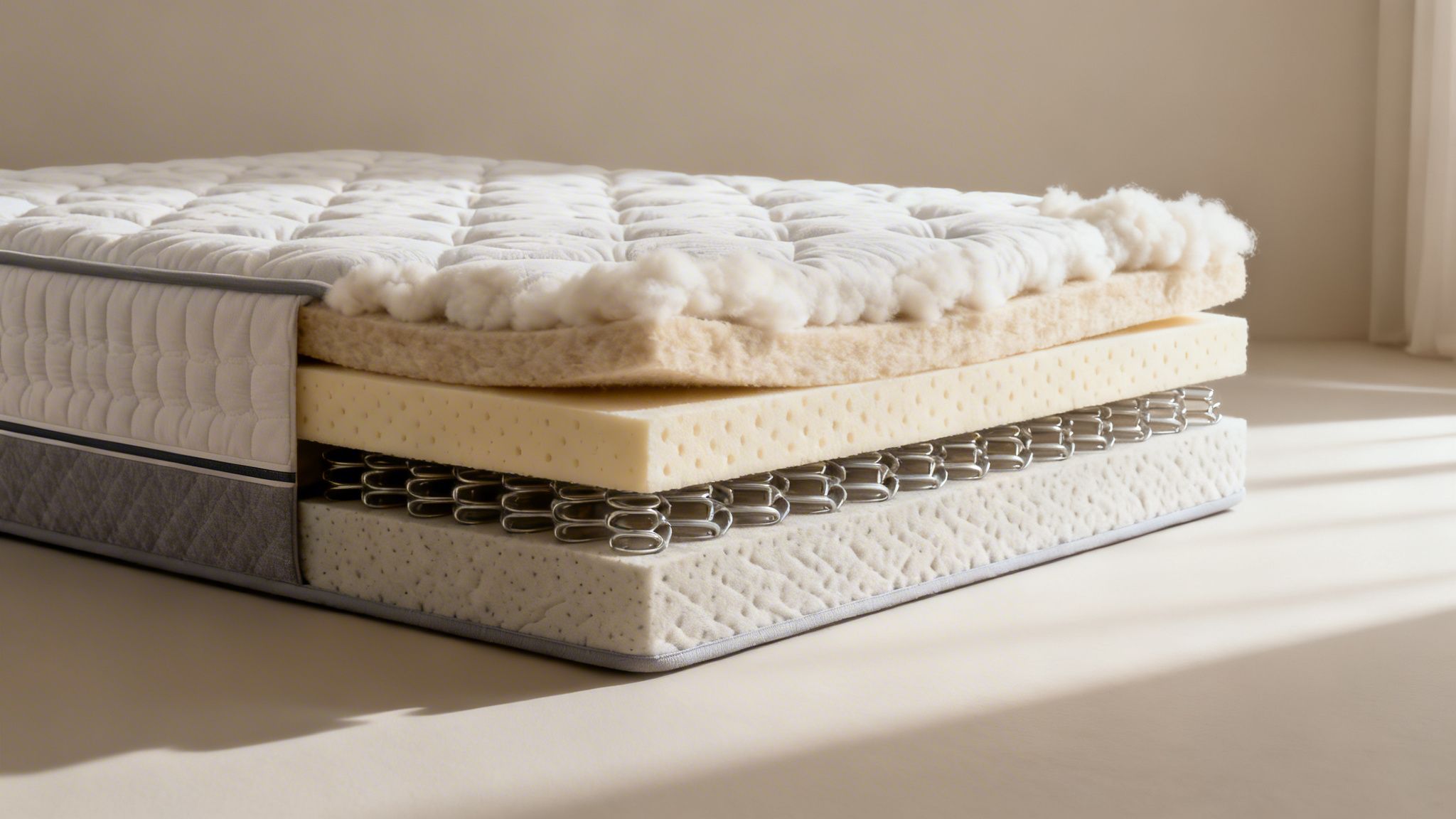
Natural Latex: The Buoyant and Breathable Choice
Natural latex, derived from the sap of rubber trees, has a uniquely buoyant and responsive feel. Unlike memory foam that slowly absorbs pressure, latex provides an almost immediate lift. It eliminates the "stuck" feeling some dislike and makes it much easier to change positions at night.
Its open-cell structure also promotes incredible airflow, making it one of the coolest, most breathable materials available. For anyone in La Costa or Encinitas who sleeps warm, this is a game-changer.
Talalay Latex: This type undergoes an extra flash-freezing step, creating a lighter, more consistent feel that is fantastic for pressure relief.
Dunlop Latex: Processed more simply, Dunlop is denser and often used in support cores because it is exceptionally durable and robust.
High-Density Memory Foam: The Contouring Specialist
High-density memory foam is engineered for one purpose: deep, pressure-relieving contouring. When you lie down, it uses your body heat to soften and mold precisely to your shape, delivering a cradling sensation that is brilliant at soothing sharp pressure points.
But not all memory foam is created equal. In the luxury market, foams feature advanced open-cell designs or gel infusions to combat the heat retention that plagues lower-quality versions. The key is density—higher-density foams last longer and provide more nuanced support.
Luxury Hybrids: The Best of Both Worlds
Luxury hybrid mattresses beautifully combine the best features of foam and innerspring systems. They pair the responsive support of a sophisticated coil system with the targeted pressure relief of premium comfort layers, like natural latex or high-density foams.
A well-designed hybrid doesn't just stack layers; it orchestrates them. The goal is to get buoyant support from the coils while the top layers provide precise, gentle cushioning exactly where your body needs it.
Many advanced hybrids also feature zoned coil systems. This means the springs are firmer in the center third of the mattress to support the hips and lumbar area, and softer at the shoulders for side sleepers. That level of engineering is critical for proper spinal alignment.
The Finishing Touch: Natural Fibers & Hand-Tufting
The final elements defining a premium mattress are the use of natural, breathable fibers like organic wool and cotton, and artisanal construction methods. These are not merely fillers; they are functional components of a high-performance sleep system.
Organic Wool: As a natural regulator, wool is extraordinary. It wicks away moisture and helps maintain a stable temperature, creating a dry, comfortable microclimate that keeps you cool in summer and warm in winter.
Hand-Tufting: This artisanal technique involves passing durable tapes through every layer of the mattress and securing them. It eliminates the need for chemical glues and prevents layers from shifting, ensuring consistent comfort and longevity. A hand-tufted mattress is often two-sided, allowing you to flip and rotate it to dramatically extend its life, a feature absent in mass-market beds.
The wellness bed market is shifting toward these superior materials. While traditional spring mattresses still account for the most sales, natural latex is growing rapidly, with a projected 9.87% compound annual growth rate through 2031, largely because it can provide zoned firmness. This trend is significant in North America, where eco-materials like wool are favored in 80% of natural mattress preferences for their superior ventilation. You can learn more about these mattress market trends and material insights on gminsights.com.
Building Your Complete Sleep System
A luxury mattress is the heart of your sleep environment, but it never works alone. To realize the full benefit of your investment, you must see it as the foundation of a complete sleep system. Even the most perfectly crafted mattress can be compromised by the wrong pillow or an unsupportive base.
Buying a great mattress is a fantastic first step for your health. But achieving truly restorative sleep happens when every element of your bed works in harmony. Understanding how your pillow and base support your mattress is transformative—you're no longer just buying products; you're engineering a personalized sleep solution.
The Critical Role of Your Pillow
Many people invest in a premium mattress to address back pain, only to wake up with a stiff neck or sore shoulders. Nine times out of ten, the culprit is a mismatched pillow. An ill-fitting pillow can completely negate the benefits of your mattress by wrenching your head and neck out of alignment.
Your mattress is responsible for aligning your body from the shoulders down. Your pillow takes over from the shoulders up. Together, their job is to create a perfectly straight line along your entire spine.
Side Sleepers: You need a thicker, firmer pillow to fill the space between your ear and the mattress. If your pillow is too thin, your head will droop all night, straining your neck.
Back Sleepers: A thinner pillow that cradles the natural curve of your neck is key. Avoid anything that pushes your head too far forward.
Stomach Sleepers: The best choice is a very thin pillow or no pillow at all. This prevents your neck from arching backward into an unnatural, painful position.
During a professional pillow fitting at our Carlsbad showroom, we don't guess. We pair the right pillow loft and density with your mattress and sleep style to ensure the entire system supports a healthy, neutral posture all night long.
The Adjustable Base as a Wellness Tool
An adjustable base is more than a luxury; it’s a powerful tool for wellness. By allowing you to elevate your head and feet, it delivers therapeutic benefits that a flat foundation cannot provide.
Raising the head of the bed a few inches can use gravity to your advantage, helping to quiet snoring or ease acid reflux. For anyone with lower back pain, elevating the legs slightly can take a significant amount of pressure off the lumbar spine, offering instant relief so your muscles can finally relax.
A complete sleep system is an ecosystem where each component enhances the others. The mattress provides core support, the pillow delivers precise neck alignment, and the adjustable base offers therapeutic positioning for deeper, more restorative rest.
When you bring these three elements together—mattress, pillow, and base—you create a personalized environment built for your body’s unique needs. It is this holistic approach that unlocks the profound sleep that fuels your days and protects your long-term health.
Finding Your Perfect Firmness with Expert Guidance
Reading about firmness is one thing. Experiencing how a mattress responds to your unique body shape and weight is another entirely. This is where theory meets reality.
Our private, by-appointment fittings in Carlsbad are designed to remove the guesswork from this critical decision. Instead of speculating, we use real data to ensure your investment is right for you.
A Data-Driven Approach to Comfort
Guided by a Certified Sleep Coach, we use advanced pressure-mapping technology to create a literal blueprint of your body’s support needs. This is not a sales pitch; it's a visual, data-driven look at exactly where your spine needs more support and where your hips and shoulders need more cushioning to relieve pressure.
It’s a calm, educational process—a world away from the overwhelming experience of a typical mattress store. We focus on objective insights that empower you to make the right choice.
For instance, data shows that a mattress with the right adjustable firmness can reduce sleep disturbances by up to 40%. That is the power of tailoring a sleep system for optimal recovery. You can discover more insights about smart mattress technology and how it’s changing sleep for the better.
A personalized fitting bridges the gap between knowing your ideal firmness and truly feeling it. It's an investment in waking up revitalized, not just for a few nights, but for years to come.
This meticulous method is a game-changer, especially for couples with different comfort needs or for anyone struggling with chronic pain. By analyzing the pressure maps for each person, we can recommend solutions like dual-firmness designs that deliver personalized comfort without compromise.
Common Questions About Mattress Firmness
When you are looking for a truly great mattress, the right questions always surface. Here in our Carlsbad showroom, we have found that an informed choice is always the best one. These are a few of the most common topics we discuss with clients during our private fittings.
Can a Mattress Be Both Soft and Supportive?
Yes, absolutely. This is the secret to a masterfully designed mattress and what separates true luxury craftsmanship from mass-produced beds.
Think of it this way: “softness” is the initial welcoming feel from the top comfort layers—like plush natural latex or wool—that cradle your body and relieve pressure points. But “support” comes from the core, the powerful system of coils or high-density latex that works beneath to keep your spine perfectly straight. A premium mattress excels at both: an indulgent surface with an unwavering support system. Our private fittings are dedicated to finding that perfect balance for you.
What If My Partner and I Disagree on Firmness?
This is incredibly common and one of the biggest reasons one-size-fits-all mattresses fail so many couples. Fortunately, excellent solutions exist. The most popular is a split-king setup, which consists of two separate Twin XL mattresses on a single king frame.
This allows each of you to have the exact firmness and feel you want, without compromise. Some of our queen and king mattresses can even be crafted with different firmness levels on each side. During a concierge fitting, we can analyze pressure maps for both of you to determine which solution will bring comfort and harmony back to your bedroom.
How Do I Know If My Current Mattress Is Wrong for Me?
Your body is likely already telling you. Waking up with a nagging lower backache, feeling stiff, or experiencing numbness in your arms and shoulders are classic signs that your mattress is no longer supporting you properly.
Another clue: if you consistently sleep better in a high-end hotel bed, it’s a sign your mattress at home is falling short. Other indicators include feeling like you’re sinking into a crater or feeling sharp pressure on your hips and shoulders when you lie on your side. A brief, professional sleep consultation can help pinpoint if the wrong firmness is the root cause.
How Long Does It Take to Adjust to a New Mattress?
You should anticipate a short adjustment period, typically about two to four weeks. Your body has spent years adapting to your old sleep surface, even if it held your spine in a poor position.
A new, correctly supportive mattress essentially retrains your muscles and posture to relax in a healthier, more natural alignment. This initial transition is actually a good sign—it means your body is adapting to better support. We remain in contact with our clients through this period to ensure the adjustment is smooth and that you achieve truly restorative sleep.
At Golden Dreams Mattress in Carlsbad, every guest enjoys a private concierge fitting with a Certified Sleep Coach. Book a free 20-minute virtual sleep consultation with a Certified Sleep Coach. and discover what luxury sleep really feels like.

Comments