Unlocking the True Benefits of a Firm Mattress for Spinal Health
- Design Scout
- Feb 8
- 14 min read

For decades, the conventional wisdom for an aching back was simple: find the firmest mattress available, even if it felt like sleeping on a hardwood floor.
This well-intentioned but outdated advice has led countless people to invest in beds that are more like planks of wood, only to trade their back pain for new aches in their shoulders and hips. The truth is, the real benefits of a firm mattress don’t come from sheer hardness—they come from intelligent, responsive support.
Debunking the Myth of the Rock-Hard Mattress
So many of our clients from Carlsbad and Rancho Santa Fe visit our private showroom with the same story. They’ve been diligently sleeping on an ultra-firm mattress, hoping it would resolve their morning stiffness, but instead find themselves tossing and turning all night.
This happens because a mattress that’s too hard simply cannot accommodate your body’s natural curves. Instead of supporting the spine, it creates intense pressure points and leaves the lower back entirely unsupported. Your muscles are then forced to work overtime all night just to maintain alignment.
The goal isn't rigidity; it's a neutral spine. A truly restorative mattress is sophisticated enough to yield to your shoulders and hips while simultaneously uplifting your waist and lower back. That elegant balance is where genuine comfort and recovery begin.
The Science of Supportive Firmness
The old "harder is better" idea was officially challenged by science years ago. A landmark 2003 study in The Lancet examined 313 adults with chronic low-back pain.
After 90 days, the group sleeping on medium-firm mattresses reported significantly less pain and disability than the group on very firm surfaces. This research confirmed what sleep experts understand today: support is about balance, not brute force. You can dive deeper into how a mattress impacts sleep quality and pain levels here.
This principle guides our entire concierge fitting process. We evaluate how a complete sleep system—the mattress, the pillow, and the base—works in harmony with your unique physiology. A high-quality, responsive mattress accomplishes two critical tasks:
It contours to your shape, filling the crucial gap under your lumbar spine.
It provides foundational uplift, preventing your heavier hips from sinking and pulling your back out of alignment.
Moving from Firmness to a Personalized Fit
Instead of asking, "How firm should my mattress be?" the more insightful question is, "What level of support does my body need?"
The answer is different for everyone. Your body weight, sleep position, and specific pain points all play a role. A stomach sleeper, for instance, generally needs a firmer feel to keep their hips from dipping. A side sleeper, conversely, requires more cushion to relieve pressure.
This is precisely why a generic "bed-in-a-box" so often fails to deliver lasting results. True restorative sleep isn’t one-size-fits-all; it’s the result of a precise, personalized fitting. Once you understand the nuanced relationship between firmness, support, and your own body, you can finally move past the myth of the rock-hard mattress and discover what deeply refreshing sleep actually feels like.
How Proper Firmness Achieves Perfect Spinal Alignment
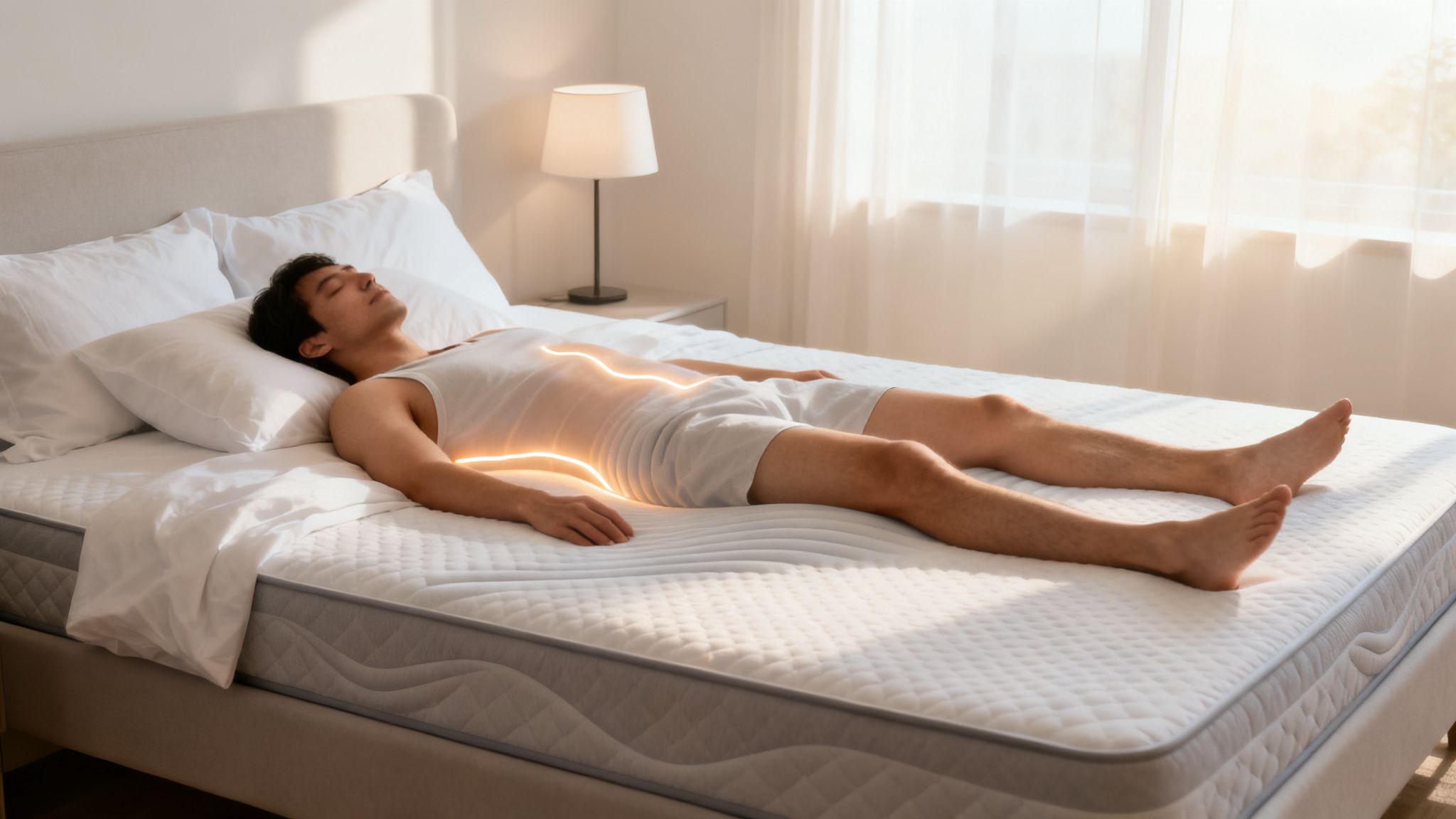
The single most important job of your mattress is to maintain your spine in a neutral position all night long. Think of your spine as a finely tuned instrument—it has a natural, gentle “S” curve that needs to be supported, not forced flat or allowed to sag.
A mattress that’s too soft is a recipe for trouble. It allows the heaviest parts of your body, like your hips and shoulders, to sink too far down. This creates a hammock effect, placing significant strain on your lower back and forcing your muscles to work overtime to keep you stable. A mattress with the right amount of firmness, on the other hand, acts as a perfect support system. It holds you in place, contouring just enough for comfort while preventing any part of your body from bottoming out.
This effortless support is where truly restorative sleep begins.
The Biomechanics of Sleep Posture
When you lie down, gravity continues to exert force on your body. A supportive mattress is engineered to counteract that force, distributing your weight evenly to keep your spine, hips, and shoulders properly aligned.
On a Mattress That's Too Soft: Your hips, being the heaviest part of your torso, will inevitably sink the deepest. This creates that dreaded hammock shape, pulling your lumbar spine into a strained, unnatural curve. This is a common cause of morning backaches.
On a Mattress That's Too Hard: An overly rigid surface creates the opposite problem. It fails to yield to your body’s curves, leaving a significant gap under your lower back. This forces those muscles to remain tense all night, robbing them of the chance to relax and recover.
The goal is to find that ideal balance—a mattress that feels as though it’s both holding you up and embracing you at the same time.
Why Sleep Position Dictates Firmness Needs
The way you sleep dramatically changes how your body interacts with the mattress. This is precisely why a one-size-fits-all approach to firmness almost never works.
A great mattress doesn't just support your weight; it supports your posture. By maintaining a neutral spine, it allows your muscles to fully release, your discs to rehydrate, and your body to enter a state of deep, uninterrupted recovery.
Different positions demand different kinds of support to maintain that all-important neutral alignment. For example:
Back Sleepers: Usually fare best on a medium-firm to firm surface. This provides enough support to keep their hips from sinking while preserving the natural curve of their lower back.
Stomach Sleepers: Require a firm to extra-firm surface. Anything softer allows their hips and abdomen to bow downwards, a fast track to significant lower back pain.
Side Sleepers: Tend to need a slightly softer, more contouring surface—often in the medium-firm range. This cushions the pressure points at the shoulders and hips while still supporting the waist. An overly firm mattress can feel unforgiving for a side sleeper.
Understanding this interplay is the first step. If you’re waking up sore, it’s worth looking into common spinal misalignment symptoms that can arise from the wrong mattress.
Aligning the Entire Sleep System
Achieving perfect spinal alignment isn’t just about the mattress. You must think of it as a complete sleep system, where every component works in harmony. Your pillow, for instance, is just as critical as your mattress for keeping your spine aligned from your neck down to your pelvis.
A pillow that is too high or too flat for your sleep style can completely undo the good work your mattress is doing by cranking your neck into an awkward position. This is why a private pillow fitting in our Carlsbad studio is an essential part of our process. Our Certified Sleep Coaches ensure your pillow is the perfect partner for your mattress and sleeping habits.
Ultimately, the right mattress is the foundation of this system. When paired with the right pillow and base, it becomes more than just a bed—it’s a personalized wellness tool, engineered to deliver pain-free mornings and the deepest sleep possible. You can learn more about how to align your spine while sleeping in our guide right here.
Understanding the Craftsmanship of Superior Support
The word "firm" describes how a mattress feels on the surface, but it reveals very little about its true quality. A genuinely supportive mattress is the result of exceptional materials and meticulous construction—a world away from the mass-produced beds found in chain stores.
When our clients in Encinitas and La Costa ask what separates a premium mattress from the rest, the answer is craftsmanship. It’s the difference between a mattress that simply resists your weight and one that actively works to restore your body night after night.
The Role of Natural Materials in Supportive Firmness
What’s inside your mattress directly impacts its performance, longevity, and even your health. While many brands rely on synthetic petrochemical foams that can trap heat and off-gas, artisanal mattresses use nature's most resilient and breathable materials to build a better sleep environment.
These materials are selected for their inherent ability to support and comfort.
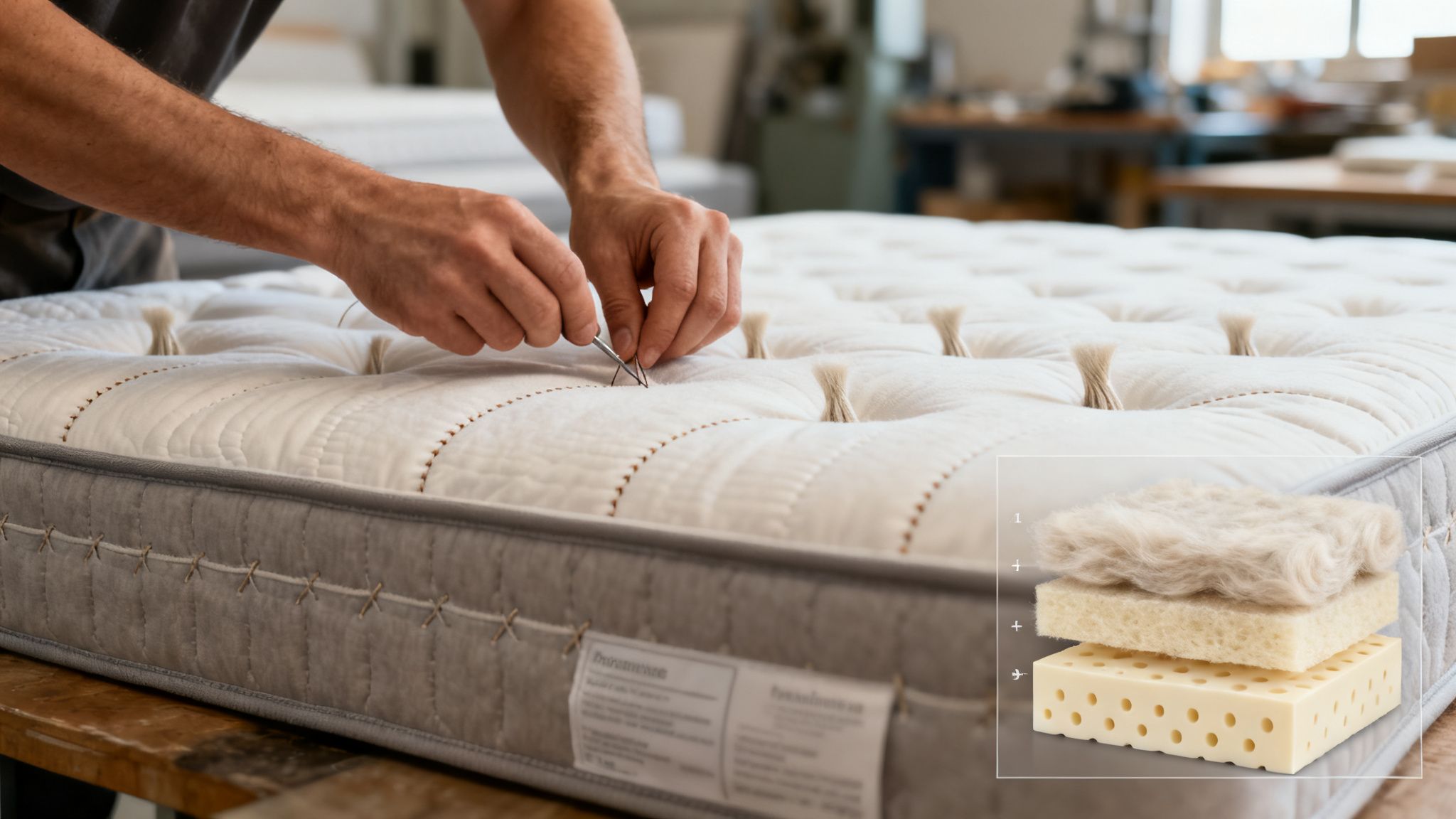
Natural Latex: Harvested from rubber trees, natural latex offers a uniquely responsive, buoyant support. It contours to your body but also lifts, instantly adapting as you move rather than creating the slow-sinking feeling of memory foam.
Joma Wool & Alpaca: These fibers are nature’s climate-control system. They create a breathable layer that wicks away moisture, keeping you cool in the summer and warm in the winter for deeper, uninterrupted sleep.
Organic Cotton: Used for the mattress cover, organic cotton is soft, durable, and free from harsh chemicals, ensuring the surface you're sleeping on is pure and breathable.
Unlike synthetic foams, these components work together to provide a clean, temperature-regulated, and dynamically supportive experience.
How Premium Materials Create Supportive Firmness
Material | Key Support Characteristic | Primary Benefit | Ideal For Sleepers Who Value |
|---|---|---|---|
Natural Latex | Buoyant and responsive uplift | Instant pressure relief without "sinking" | Natural materials, breathability, and quick response to movement. |
Pocketed Coils | Independent, targeted support | Reduced motion transfer and precise spinal alignment | A traditional spring feel combined with modern, contouring support. |
Joma Wool | Natural loft and resilience | Temperature regulation and moisture-wicking | A clean, dry, and hypoallergenic sleep surface. |
Organic Cotton | Softness and breathability | A pure, chemical-free sleep surface | Durability and a healthy, non-toxic environment. |
These aren't just features; they're the building blocks of restorative sleep. By choosing mattresses made with these high-quality components, you're investing in a system designed for longevity and wellness.
Hand-Tufting: The Mark of Lasting Quality
One of the most telling signs of a luxury mattress is a technique called hand-tufting. If you look closely at a high-end bed, you’ll often see wool or cotton rosettes across its surface. These aren't merely decorative.
Hand-tufting is a time-honored method where a craftsman passes thick ribbons through every single layer of the mattress—from the top cover straight through to the bottom—and secures them tightly.
This process physically binds the internal layers of wool, cotton, and latex together with the innerspring core. It completely eliminates the need for toxic glues and prevents materials from shifting, clumping, or developing body impressions over time.
This meticulous, labor-intensive process is the antithesis of the glued, one-sided construction found in most mass-market mattresses. Glued layers eventually break down and create uneven surfaces, but a hand-tufted mattress maintains its integrity and consistent support for a decade or more.
Why a Two-Sided Design Matters for Durability
In an effort to reduce costs, the vast majority of modern mattresses are now one-sided—meaning you can only sleep on the top. This design concentrates all nightly wear and tear onto a single surface, drastically shortening the mattress's effective lifespan.
A truly premium mattress is almost always two-sided and flippable. This simple but profound design feature allows you to rotate and flip it regularly, distributing wear evenly across both sleeping surfaces. This gives the internal materials time to recover, preserving the mattress's support and comfort for many additional years.
It’s an investment in durability that pays you back with lasting performance. When you choose a sleep system built with these principles, you’re choosing more than just a firm feel—you’re choosing superior materials, artisanal construction, and a design philosophy focused on delivering restorative sleep for the long haul.
When a Firmer Mattress Might Not Be the Right Choice
While a firm mattress can be a game-changer for spinal health, our role as your sleep coach isn’t to sell you a firm bed—it’s to find the right bed for you. Real luxury isn’t about forcing a solution; it’s about a personalized fit that respects your unique body.
At our Carlsbad mattress showroom, we often meet clients who are surprised to learn that their body type or sleep style is actually better suited for a more forgiving surface. A commitment to honest guidance means addressing when firm is the wrong choice.
Lightweight Individuals
Physics is a significant factor in how a mattress feels and performs. If you weigh under 130 pounds, you may not have enough mass to properly engage the support layers of a very firm mattress.
Instead of your curves being gently cradled, the surface remains flat and rigid. This can leave your lower back completely unsupported and create sharp pressure points on your hips and shoulders. For these sleepers, a surface with more contouring comfort layers is essential for achieving proper alignment.
Dedicated Side Sleepers
Side sleeping is the most common position, but it also places the most direct pressure on your hips and shoulders. A mattress that's too firm won't allow those joints to sink in, forcing your spine to curve sideways—the exact opposite of the alignment we aim to achieve.
Over time, this can lead to waking up with numb arms, sore hips, or shoulder pain. For side sleepers, a surface with more give is non-negotiable. This usually means a medium-firm core with plusher comfort layers on top. You can learn more in our detailed guide on finding your ideal mattress firmness as a side sleeper.
A mattress should yield to your body's contours, not force your body to conform to its surface. For side sleepers and those with sensitive joints, this principle is non-negotiable for restorative sleep.
Sleepers with Specific Health Conditions
Certain health conditions demand a gentler approach to sleep support. An overly firm mattress can exacerbate pain for people dealing with arthritis, fibromyalgia, or sciatica.
Arthritis: Inflamed joints need gentle cushioning, not hard resistance. A firm surface can intensify pain at the hips, knees, and shoulders.
Fibromyalgia: This condition creates widespread musculoskeletal pain and extreme sensitivity. A mattress must offer deep, pressure-relieving contouring to avoid triggering pain points.
Sciatica: While good spinal support is key, a surface that’s too hard can put direct pressure on the sciatic nerve itself, worsening radiating leg pain.
In these cases, the goal is to find a sleep system that cradles the body and minimizes stress on sensitive areas. We've found that materials like natural latex are exceptional here, offering buoyant support that relieves pressure without the "stuck" feeling of some memory foams. It provides the best of both worlds: the spine stays supported while sensitive joints are protected.
Finding Your Ideal Support with Pressure Mapping Technology
Reading about mattress benefits is one thing; experiencing the perfect fit is something else entirely. In a world of online guesswork and overwhelming choices, how can you be certain you’re selecting the right support for your body?
At our private Carlsbad showroom, we remove the ambiguity from the process. We use a scientific, data-driven approach to mattress fitting that goes far beyond subjective terms like "firm" and "soft."
We use advanced pressure mapping technology to create a detailed, color-coded blueprint of your body's unique pressure profile. As you lie down, the system shows us precisely where you exert the most force—usually the shoulders and hips—and, more importantly, where you need more support, like your lower back.
It’s the difference between guessing which mattress feels right for a few minutes and knowing which one is engineered to support your spine correctly for eight hours a night.
Translating Data into Restorative Sleep
A pressure map is a powerful tool, but its real value is unlocked when a Certified Sleep Coach helps you interpret it. Your private fitting is a collaborative process. We’ll walk you through your results, explaining what the data means for your specific sleep needs and wellness goals.
We can see in real-time how different mattress constructions—from responsive natural latex to articulating pocketed coils—alleviate high-pressure zones and create a more uniform, supportive surface. The goal is simple: find the mattress that produces the most balanced map, showing even weight distribution and a perfectly neutral spine.
The flowchart below illustrates how we consider key factors that might make an ultra-firm mattress a poor choice, guiding us toward a more personalized solution.
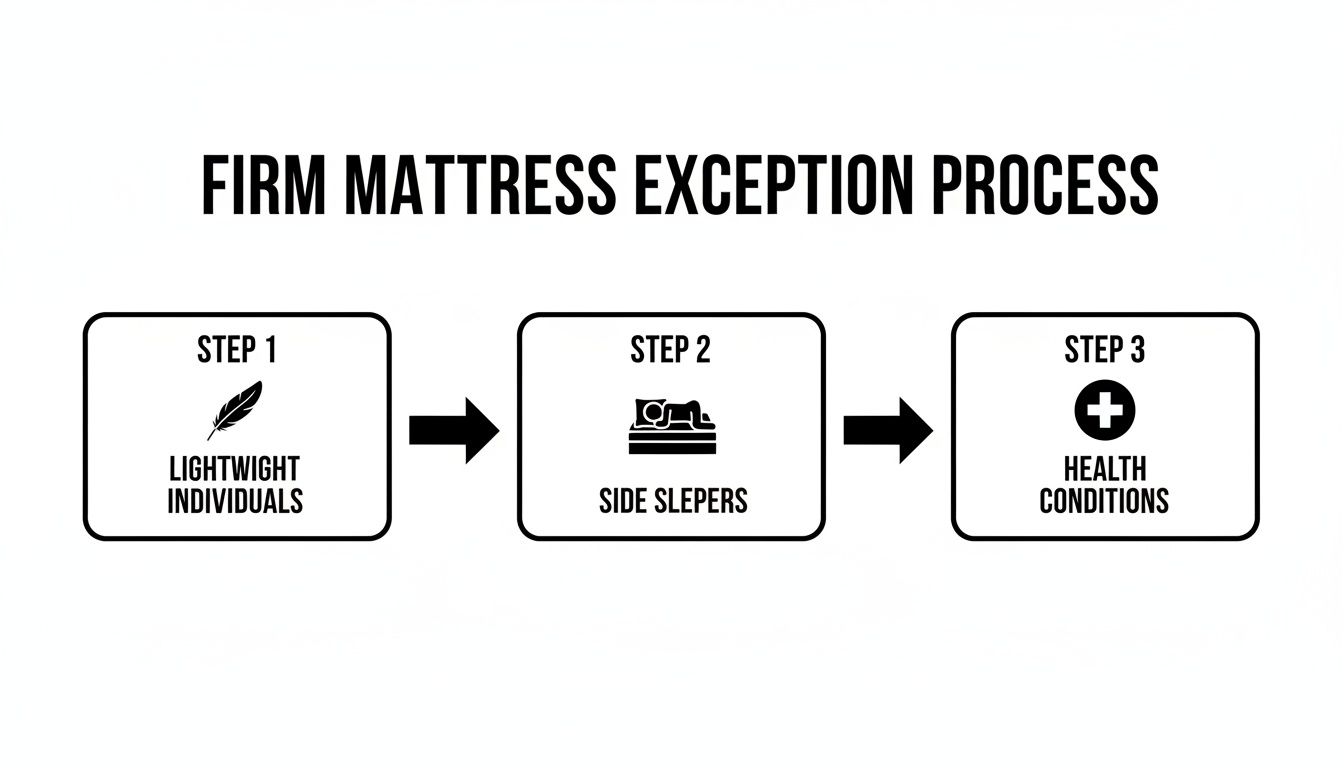
This process shows how we tailor recommendations for lightweight individuals, side sleepers, and those with specific health considerations to ensure optimal pressure relief.
Crafting Your Complete Sleep System
This data-driven insight allows us to move beyond just the mattress and design a complete, harmonized sleep system. Your pressure map informs not only the mattress choice but also the ideal pillow and adjustable base settings.
Pillow Fitting: We ensure your pillow has the correct loft and support to maintain neutral neck alignment, complementing the work of the mattress.
Adjustable Base Integration: We can demonstrate how an adjustable base can further reduce pressure on the lower back or improve circulation, dialing in your comfort even more.
A 2010 chiropractic study powerfully illustrates this impact. Participants tracked their pain and poor sleep days for three weeks on their old beds, then switched to a medium-firm mattress tailored to their profile. The results were remarkable: significant reductions in pain and sleep issues by week four, with continued improvement over 12 weeks. This proves a correctly fitted mattress can fundamentally reprogram chronic pain cycles.
Our concierge fitting process, which combines pressure mapping with expert coaching, is designed to deliver this exact level of result. For a deeper dive, check out our guide on finding the best pressure relief mattress in Carlsbad.
Your Path to Deeply Restorative Sleep
Throughout this guide, we’ve moved past the myth that a harder mattress is automatically better. Real, lasting comfort isn’t about sleeping on a rigid plank; it’s about a sleep system that intelligently adapts to you.
The benefit of a truly great firm mattress is its ability to deliver unwavering spinal alignment, night after night. It’s about achieving that ideal balance where your spine stays neutral, allowing your muscles to fully release so your body can focus on deep, restorative healing. That’s the foundation for waking up refreshed and pain-free.
An Investment in Your Well-Being
Choosing the right mattress is one of the most powerful investments you can make in your long-term health. When you have superior support, born from artisanal craftsmanship and premium natural materials like latex and wool, you get more than just comfort—you get better daily energy, sharper focus, and an overall enhancement in your quality of life.
A meticulously built, two-sided mattress isn't a temporary fix. It's a wellness tool designed to perform for a decade or more. It’s a commitment to your sleep and, by extension, your vitality.
True luxury in sleep is not about a brand name or a high price tag. It is the profound, tangible result of a perfectly fitted sleep system that allows your body to achieve its deepest state of rest and recovery.
Your Personalized Sleep Consultation
At Golden Dreams Mattress in Carlsbad, every guest enjoys a private concierge fitting with a Certified Sleep Coach. We use real data from pressure mapping and our deep knowledge of sleep science to build a system that’s right for your body—and no one else’s.
Book a free 20-minute virtual sleep consultation with a Certified Sleep Coach. Discover what luxury sleep really feels like.
Frequently Asked Questions About Firm Mattresses
When you’re exploring high-quality mattresses, a few excellent questions always arise. Our Certified Sleep Coaches in Carlsbad hear them often, so we’ve provided some straightforward answers to help you understand what real support feels like.
What’s the difference between a “firm” and a “supportive” mattress?
This is the most important distinction in finding the right bed.
Firmness is simply the initial feel on the surface—how hard or soft the mattress is when you first lie down. Support, however, is what the mattress does next. It’s the bed’s ability to hold your spine in a neutral, healthy line by conforming to your curves while providing proper uplift.
A mattress can feel rock-hard but offer poor support, creating pressure points at your shoulders and hips while leaving a gap under your lower back. The goal is to find a mattress that is deeply supportive first, and then fine-tune the firmness to a level that feels comfortable for your sleep style.
How do I know if my mattress is no longer supportive?
Your body will usually tell you. The classic signs are waking up with new or worsening lower back pain, feeling like you’re sinking into a “hammock,” or seeing a permanent body impression where you sleep.
Here is a quick test: lie on your back. If you can slide your whole hand easily through the gap under your lower back, your mattress may be too firm or failing to conform. If you can't slide your hand under at all, it’s likely too soft and sagging.
All mattresses lose support over time, but those built with premium materials like natural latex and pocketed coils maintain their integrity and strength for far longer.
Can a mattress topper fix a mattress that’s too soft?
While a topper can adjust the surface comfort, it cannot fix a failing, unsupportive mattress core. Think of it as putting a fresh coat of paint on a crumbling wall—it doesn't address the foundational issue.
If your mattress is already sagging, a firm topper will simply follow the dips, offering a temporary illusion of firmness that won't last. Real, lasting support comes from the mattress's internal layers. It’s always a better investment to get a mattress with the right foundational support from the start.
Do high-quality firm mattresses get softer over time?
Every new mattress will soften slightly during the first few weeks as the materials settle. In a luxury mattress, however, this change is minimal and expected.
Beds built with high-density natural latex, premium tempered coils, and traditional hand-tufted construction are engineered to resist softening and body impressions. Unlike mass-produced foam beds that can develop deep ruts within a few years, these superior materials are incredibly resilient.
Furthermore, high-end mattresses are often two-sided, allowing you to flip and rotate them. This simple practice distributes wear evenly, preserving the mattress's intended support and comfort for a decade or more—a true hallmark of quality craftsmanship.
At Golden Dreams Mattress, we believe a fitting is better than a guess. Every guest gets a private appointment with a Certified Sleep Coach to find their perfect match.
Comments