Why Does My Mattress Sag in the Middle? A Guide for Discerning Sleepers

That frustrating dip in your mattress isn’t just an annoyance; it's a clear signal your sleep system is failing. The most common reason a mattress sags in the middle is simply material fatigue—the foams and springs can no longer bounce back after years of nightly pressure. This breakdown happens much faster with inferior materials and a weak foundation, completely undermining the support your body needs to truly rest.
The Anatomy of an Unsupportive Bed
Waking up with a stiff back in a bed that feels more like a hammock than a sanctuary is a familiar story we hear from clients across Carlsbad and Rancho Santa Fe. That crater in the middle forces your spine into an unnatural curve, leading to constant discomfort and restless nights.
Understanding why this happens is the first step toward finding a solution that provides lasting support.
At its core, a sagging mattress is a sign of structural failure. The materials in the center—which bear the most weight from your hips and torso—have lost their resilience. While every mattress will eventually show some wear, premature sagging is almost always caused by a few key culprits working against you.
Common Causes of Premature Sagging
Think of your bed not just as a mattress, but as a complete sleep system. Every component must work in harmony. When one part fails, the whole structure suffers.
The primary culprits behind that unwanted dip often include:
Low-Quality Materials: Many mass-produced mattresses use low-density foams and flimsy steel coils that compress quickly and stay that way. They simply lack the durability to withstand years of nightly use.
Inadequate Foundation: Placing a beautiful new mattress on a weak or old box spring is like building a custom home on crumbling ground. An unsupportive base allows the mattress to bow in the middle, creating a sag where one shouldn't exist.
One-Sided Design: Many modern mattresses are designed to be "no-flip," which sounds convenient but concentrates all wear and tear onto a single surface. Without the ability to rotate and flip the mattress, body impressions quickly deepen into permanent sags.
A truly supportive mattress is the foundation of wellness, directly influencing everything from spinal health to mental clarity. When that foundation fails, so does the quality of your rest.
Ultimately, sagging is more than an inconvenience; it’s a direct threat to your health. It disrupts your sleep cycles, contributes to chronic pain, and undermines the very reason you invested in a quality bed.
The solution isn't a temporary fix like a mattress topper. It’s an investment in a properly designed sleep system built with superior materials and tailored to your unique body.
At Golden Dreams Mattress in Carlsbad, every guest enjoys a private concierge fitting with a Certified Sleep Coach. Book a free 20-minute virtual sleep consultation today and discover what luxury sleep really feels like.
Anatomy of a Sagging Mattress: From Materials to Craftsmanship
To understand why your mattress has developed that dreaded dip, we must look past the quilted top and into its internal architecture. The difference between a mattress that holds its shape for a decade and one that forms a trough in a few years comes down to two things: the quality of its components and the skill of its construction.
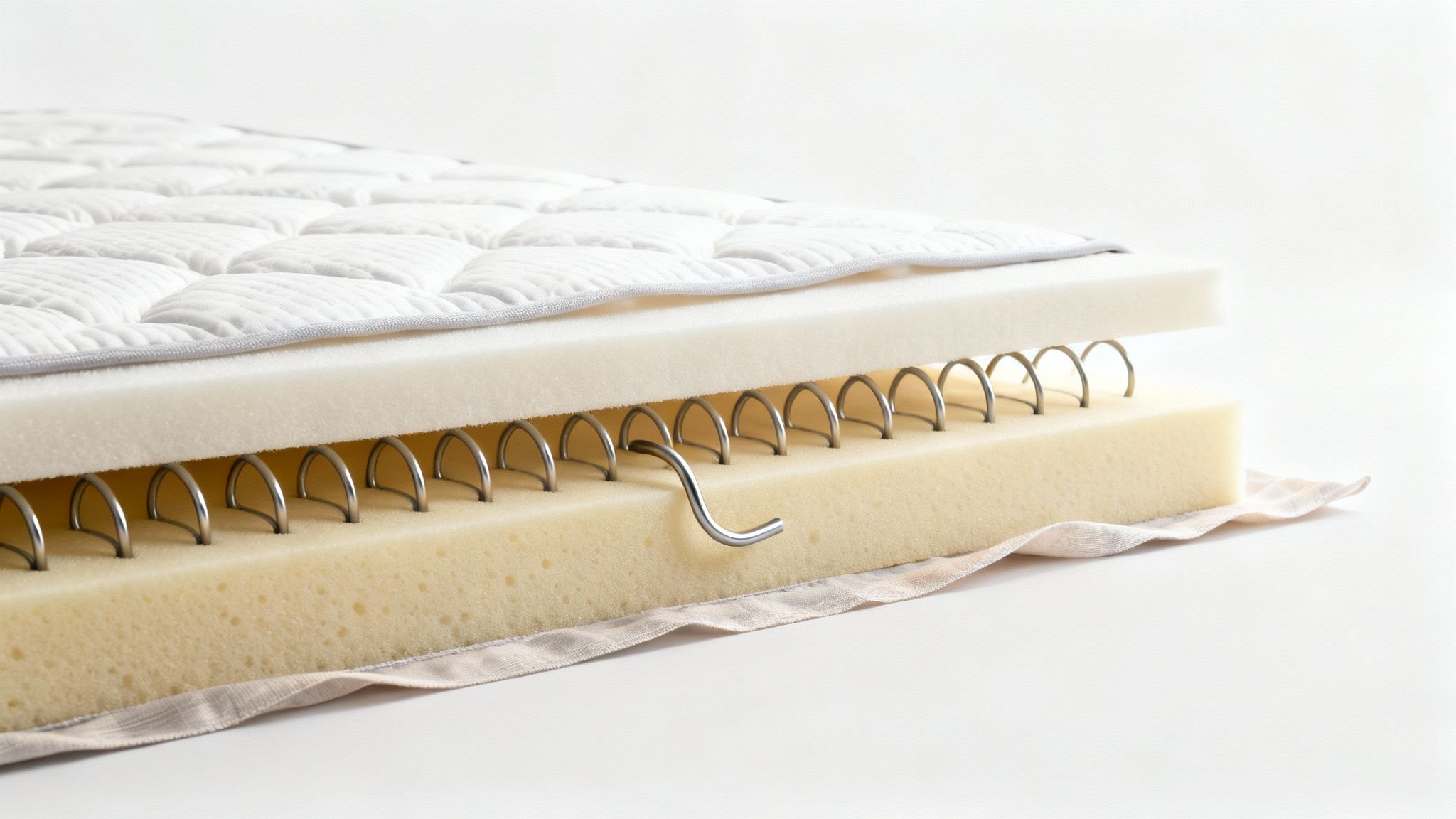
Unfortunately, many mass-produced mattresses—especially those stacked high in big-box stores—are built with materials chosen for low cost, not longevity. These components simply aren't engineered to handle the nightly pressure of a sleeping body, year after year.
The Breakdown of Common Materials
At the core of most sagging issues, you’ll find low-density polyurethane foams and flimsy tempered steel coils. Polyurethane foam, particularly in lower densities, is filled with large air pockets. At first, this makes the mattress feel soft and inviting, but under your body's consistent weight, those air pockets collapse and eventually stop bouncing back.
This material fatigue is the primary cause of the notorious center sag. The part of the mattress under your hips and torso carries the most weight, so the foam cells there break down much faster than anywhere else. This creates an unsupportive hammock that throws your spine completely out of alignment.
The innerspring systems in many conventional mattresses are another major point of failure. These systems often lead to central dips of two to four inches within just eight years—a disaster for professionals in Carlsbad dealing with the best mattress for side sleepers with hip pain.
The Resilience of Artisanal Craftsmanship
In stark contrast, a luxury mattress is built with an entirely different philosophy: resilience, breathability, and support that lasts. Instead of using materials that quickly break down, artisanal beds feature components known for their natural durability and high performance.
A luxury mattress is not merely assembled; it is thoughtfully constructed. Every layer, stitch, and fiber is chosen for its ability to provide consistent support and comfort over its entire lifespan.
This commitment to quality is evident in the materials used:
High-Density Natural Latex: Sourced from the sap of rubber trees, natural latex offers a buoyant, responsive support that is incredibly durable. Unlike synthetic foams, its dense, open-cell structure resists compression and body impressions, holding its shape for decades.
Breathable Wool and Cotton: These natural fibers serve as exceptional comfort layers and temperature regulators. Wool’s natural crimp creates a springy padding that resists packing down, while organic cotton offers a soft yet durable surface.
These premium materials work in harmony to create a sleep surface that actively supports you, distributing your weight evenly and preventing the pressure points that lead to sagging. To see how these elements create a far superior sleep environment, explore our guide to natural mattress materials and the foundation of luxury sleep.
Construction That Extends Lifespan
Beyond the materials, the construction techniques used in a luxury mattress are critical for preventing sags. Two methods, in particular, set them apart from their mass-market counterparts.
Hand-Tufting: This is a time-honored technique where a craftsman passes thick ribbons through every layer of the mattress—from top to bottom—and secures them with tufts on the surface. This process compresses all the layers, locking everything into place. Hand-tufting prevents internal materials from shifting or bunching, a common cause of the lumps and dips found in non-tufted beds.
Two-Sided, Flippable Design: Many modern mattresses are built one-sided to cut manufacturing costs. The problem? This forces all wear and tear onto a single surface. A true luxury mattress is often two-sided, designed to be flipped and rotated regularly. This simple act allows the comfort layers on each side to recover, effectively doubling the mattress's lifespan by spreading the wear evenly. It’s a thoughtful design detail that shows the bed was built to last.
The Foundation: The Unsung Hero of Your Sleep System
You can have the most luxurious, perfectly crafted mattress in the world, but it will fail without the right partner underneath it. I've seen it time and again: the culprit behind a mattress sagging in the middle isn't always the mattress itself. It's the foundation.
Think of it like building a custom home here in La Costa. You wouldn't pour a shoddy, uneven slab and expect the walls to stay straight. The same logic applies to your bed.
Your bed’s foundation is the unsung hero of your sleep system. Its sole job is to provide unwavering, even support so your mattress can do its job. It must bear the weight of the mattress plus everyone in it, without bending, flexing, or giving way. When the foundation fails, the mattress is forced to bridge gaps or sink into weak spots, creating the very sag it was built to prevent.
The Critical Role of Proper Support
A solid foundation is everything. I often find that worn-out box springs or broken slats are the root cause of a sagging mattress. People get excited about their beautiful new mattress but place it on an old, tired foundation from their last bed, accidentally sabotaging their investment from day one.
That old box spring has likely lost its structural integrity in the exact same spot your old mattress did—right in the middle. Putting a brand-new, high-performance mattress on that weakened surface is like parking a luxury car on a crumbling driveway. The support simply isn’t there, and damage is inevitable.
Your foundation isn't just a platform; it's an active, essential part of your sleep system. Its quality directly impacts the lifespan and performance of your mattress, protecting your investment in better sleep.
This is especially true for today's advanced mattresses made with materials like natural latex or sophisticated hybrid coil systems. These heavy, high-performance materials demand a solid, rigid base to function as designed. Without one, they will start to bow and develop a preventable sag.
Choosing the Right Partner for Your Mattress
So, what kind of foundation do you need? It depends entirely on the mattress you choose. A heavy, conforming natural latex mattress requires a completely different kind of support than a traditional innerspring model.
Understanding the main options is key to building a sleep system that lasts.
Platform Beds & Solid Foundations: These provide a rigid, flat surface, making them a fantastic choice for memory foam and latex mattresses. They give you consistent, edge-to-edge support that stops the mattress from dipping between slats. If you choose a slatted platform, ensure the slats are no more than 2.75 inches apart. Any wider, and the foam can start to push through the gaps.
Modern Adjustable Bases: For the ultimate in personalized comfort, an adjustable base allows you to raise your head and feet to relieve pressure points and improve circulation. They work with most modern mattresses (especially latex and foam) and are the pinnacle of a customized sleep setup.
Traditional Box Springs: A true box spring has actual springs inside and is designed to act as a shock absorber for an innerspring mattress. However, they are a terrible match for foam or latex mattresses because they don't provide the solid, rigid surface those heavier materials need.
For a deeper dive into how these choices affect your comfort and the life of your mattress, read our guide on adjustable bases versus box springs.
Common Foundation Mistakes to Avoid
Before you conclude that your mattress is defective, take a hard look at what’s underneath it. A quick inspection often reveals the true source of the sag and can save you from repeating the same mistake.
Check if your bed frame has proper center support. For any queen or king-size bed, that means at least one—and preferably two—center legs that touch the floor. Without them, the frame itself will bow over time, and your mattress will have no choice but to follow. A new mattress deserves a new, appropriate foundation. It’s a non-negotiable part of creating a sleep environment that will support you for years to come.
Body Impressions Versus True Sagging: How to Tell the Difference
Not every dip in your mattress signals a catastrophic failure. In fact, some shallow contours are perfectly normal—they’re a sign the mattress is doing its job. The key is knowing how to spot the difference between a healthy body impression and a genuine structural sag. This tells you whether your bed is simply breaking in or actually breaking down.
A body impression is when the comfort materials—the wool, cotton, or plush latex right under the surface—settle and conform to your unique shape. It’s like a fine pair of leather shoes molding to your feet. These slight dips show the mattress is adapting to relieve your pressure points, which is exactly what it is designed to do.
Structural sagging, on the other hand, is a much larger problem. This happens deep inside the mattress’s support core. The steel coils have lost their spring, or the dense support foams have given way, creating a hammock your spine sinks into. A body impression is the cushion breaking in; a structural sag is the frame failing.
Identifying Your Mattress Issue: Body Impression vs. Structural Sag
Before you start measuring, it helps to know what you're looking for. This table breaks down the key differences between a normal impression and a support-killing sag.
Characteristic | Normal Body Impression | Structural Sagging |
|---|---|---|
Location | Only in the top comfort layers where you sleep | Deep depression affecting the mattress core |
Feel | A gentle contour; the mattress still feels supportive | A noticeable dip or "hammock" with a loss of support |
Depth | Typically less than 1.5 inches deep | Often 1.5 inches or deeper, compromising alignment |
When It Appears | Gradually develops over the first few months | Can appear suddenly or worsen over time as materials fail |
Essentially, if the dip feels more cosmetic than structural and your back still feels supported, you are likely dealing with a normal body impression. If you feel like you're sinking into a hole, it's time to investigate further.
Measuring the Dip: The String Test
How do you know for sure which one you have? There's a simple, objective test that mattress companies use for warranty claims. It takes the guesswork out of the equation and gives you hard data.
All you need is a piece of string long enough to stretch across your mattress and a ruler.
Strip the Bed: Remove everything from the mattress—sheets, blankets, protectors. You need a clear, bare surface for an accurate measurement.
Stretch the String Tightly: Pull the string taut across the widest part of the dip, running from one edge of the mattress to the other. Ensure the string is hovering over the indentation like a tightrope, not sinking into it.
Measure the Gap: Take your ruler and measure the vertical distance from the bottom of the string down to the lowest point of the dip.
Guideline: Most high-quality mattress warranties activate when a dip measures 1.5 inches or more. Anything less is almost always considered a normal body impression.
Interpreting Your Results
If your measurement is less than an inch and a half, the mattress itself probably isn’t failing. The lack of support you feel could be coming from somewhere else. Perhaps your pillow has flattened out, requiring a proper pillow fitting, or more commonly, your foundation or box spring has a weak spot right in the middle.
This flowchart shows the first step in troubleshooting a saggy-feeling bed.
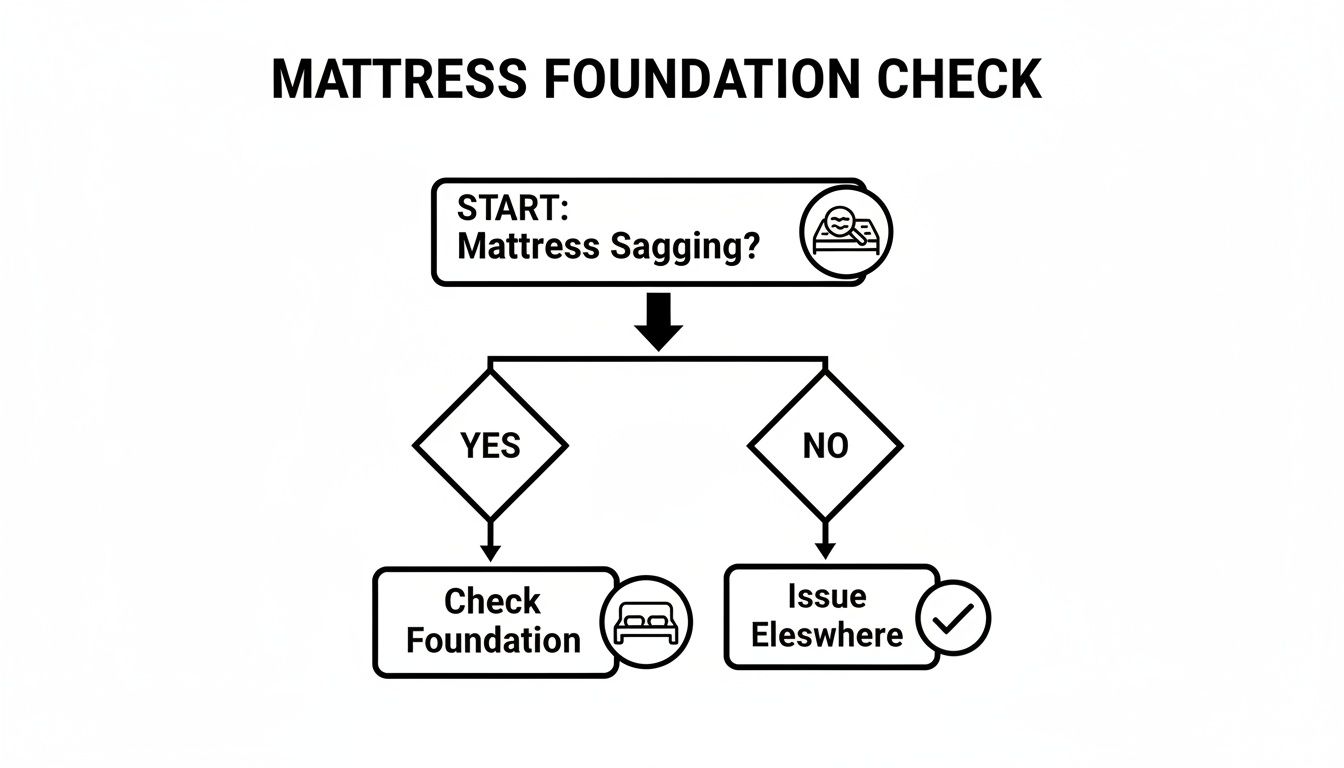
As you can see, the foundation is always the first thing to check. A faulty base can make even the best mattress feel like it's sagging.
But if your ruler shows a dip deeper than 1.5 inches, you're looking at a true structural sag. The support system is compromised, and your spinal alignment is paying the price. At this stage, no mattress topper can fix the underlying issue. It’s time to look at your warranty or consider a replacement.
Finding a Lasting Solution with a Personalized Fitting
How do you prevent that dreaded sag from happening all over again? It isn’t about chasing a "perfect" mattress from an advertisement; it's about finding the perfect mattress for you. While temporary fixes can buy time, a real solution gets to the root cause: the mismatch between your body, how you sleep, and the mattress itself. This is where a personalized, data-driven fitting makes all the difference.
True durability comes from a sleep system built around your unique body. The goal is to distribute your weight so evenly that no single area is overburdened night after night. That is how you invest in restorative sleep and prevent premature sagging for good.
Beyond the Showroom: A Concierge Fitting Process
A frustration we often hear from clients in Encinitas and Carlsbad is that the mattress they loved in the store failed them at home. It’s a common story. Lying on a bed for five minutes under bright showroom lights tells you almost nothing about how it will support you for eight hours every night.
That's why our private Carlsbad studio is different. A Certified Sleep Coach guides you through a process that’s less like shopping and more like a wellness consultation. We dig deep to understand your unique sleep profile.
This includes:
Your primary sleep position: Whether you’re a side, back, or stomach sleeper completely changes where your body needs support and cushioning.
Your body composition: Your height, weight, and shoulder-to-hip ratio dictate the ideal firmness and how materials should respond to you.
Any existing pain points: We get specific, addressing chronic lower back pain, shoulder discomfort, or other issues right from the start.
The Power of Pressure Mapping
To move past guesswork, we use advanced tools like pressure-mapping technology. This allows us to see, in real-time, exactly how your body interacts with a mattress. As you lie down, a sensor map creates a color-coded image of your pressure points—red for high-pressure zones and blue for areas with low pressure.
This data is invaluable. It shows us precisely where your body needs more cushioning (like at the shoulders and hips for a side sleeper) and where it needs more robust support to keep your spine perfectly aligned. Armed with this visual map, your Sleep Coach can instantly eliminate unsuitable mattresses and curate a short list of options built for your body's architecture.
A pressure map provides the objective data needed to craft a subjective feeling of perfect comfort. It is the bridge between the science of support and the art of restorative sleep.
This process is a game-changer for couples. One of the biggest reasons mattresses sag in the middle is the combined weight of two people. Our Certified Sleep Coaches use pressure mapping to pinpoint these hotspots and recommend luxury mattresses in Carlsbad with hybrid or organic latex systems designed to distribute that combined weight evenly.
Matching You with the Right Materials
With your pressure map as our guide, the final step is pairing you with the right combination of materials and support systems.
For someone with sharp pressure points at the hips, a responsive layer of natural latex might be the perfect fit for its buoyant support. For another person who sleeps hot, a breathable comfort layer made of wool and horsehair could be the solution they've been searching for. It's all about what your body needs.
This careful matching process ensures your mattress doesn't just feel good for a few weeks but performs for years. By creating even weight distribution, we prevent the concentrated wear that leads to sagging. While you can explore general tips on how to fix a sagging mattress, a customized approach is the only way to build a sleep system that will support your wellness for a decade or more.
At Golden Dreams Mattress in Carlsbad, every guest enjoys a private concierge fitting with a Certified Sleep Coach. Book your complimentary 20-minute virtual consultation today and discover what true luxury sleep really feels like.
Protecting Your Investment with Proper Mattress Care
A fine mattress is a serious investment in your well-being. And just like any other high-performance asset, it needs thoughtful care to continue delivering night after night. Protecting its support systems and natural materials from premature wear is the secret to years of restorative sleep.
The best part? It doesn’t take much. A few simple habits can preserve that “just right” feeling and prevent the frustrating middle sag.
The Power of a Simple Turn
The most effective thing you can do for your mattress is also the easiest: rotate it regularly. If it’s a two-sided mattress, you will flip it, too. This single action dramatically extends its lifespan.
Think of it like rotating the tires on your car to ensure they wear evenly. Most of us sleep in the same spot every night, which concentrates our body weight in the center third of the bed. Over time, that constant pressure causes materials to break down, leading to that dreaded dip.
By rotating your mattress 180 degrees every three to six months, you give the materials a chance to recover. It promotes a much more even settling process across the entire surface. For a detailed schedule, review our mattress longevity checklist for Carlsbad residents.
For the artisanal, two-sided mattresses we often recommend, this maintenance goes a step further.
Flipping a two-sided mattress isn’t just an old-fashioned feature; it’s a core part of its design. You’re effectively doubling its functional lifespan by allowing each side to fully rest and rebound.
This time-honored construction, combined with regular rotation, is one of the most powerful strategies for preventing sagging.
Shield Your Mattress from a Hidden Threat
Beyond rotating and flipping, the second pillar of mattress care is protecting it from moisture. It’s an invisible enemy, but perspiration, humidity, and spills introduce moisture that degrades even the finest materials over time. Natural fibers like wool and cotton can compress, and high-performance foams can lose their supportive bounce when exposed to dampness.
A high-quality, breathable mattress protector is non-negotiable. Forget old, crinkly plastic covers. Modern protectors use advanced materials that stop liquids while still allowing air to circulate, preventing a hot, sticky feeling. This simple layer acts as an insurance policy, safeguarding the internal components so they can continue providing the support your body needs.
Common Questions We Hear in the Showroom
When people visit our Carlsbad studio, they’re often wrestling with a mattress that has failed them. They have excellent questions, and after years of fittings, we have heard most of them. Here are a few of the most common ones—and our direct answers.
Can I Just Use a Mattress Topper?
A good topper can mask a minor dip and buy you a little time. Think of it as putting a plush rug over a warped floorboard—it feels better underfoot, but the structural problem remains.
The real issue is that the support core of your mattress has given way. That is the part responsible for holding your spine in a healthy, neutral line. A topper cannot fix that. It's a temporary patch, not a cure. For truly restorative sleep, you must address the collapsed support system underneath.
Does My Weight Make It Sag Faster?
Yes, it does. It’s simple physics—more weight means more pressure. This is especially true in the center third of the mattress, where our hips and torso concentrate most of our body weight.
This is precisely why a one-size-fits-all mattress is such a gamble. Heavier individuals and couples require a more robust support system with higher-density foams and stronger coils to prevent premature breakdown. A personalized fitting isn't a luxury; it ensures the mattress is engineered to handle your specific needs, promoting even wear for years to come.
A mattress isn’t just soft or firm; it’s a piece of performance equipment. Matching its engineering to your body’s specific support needs is the key to preventing structural breakdown.
Will My Warranty Cover the Sag?
Most warranties do cover sagging, but there are always conditions. First, the dip usually needs to be significant, often 1.5 inches or more, and you must measure it correctly with no weight on the bed.
Second, the warranty only covers manufacturing defects. If you used the mattress on an old, unsupportive box spring or a flimsy bed frame, the manufacturer will likely deny your claim. An improper foundation is one of the fastest ways to void a warranty. Always read the fine print before you start a claim.
At Golden Dreams Mattress, we believe a lasting solution starts with a personalized approach. Our private fittings and pressure mapping technology help us design a sleep system perfectly suited to your body, ensuring years of unwavering support.
Book a free 20-minute virtual sleep consultation with a Certified Sleep Coach.

Comments