The Discerning Side Sleeper’s Guide to Mattress Firmness

For most side sleepers, the ideal mattress firmness lies within the medium-soft to medium-firm range. On the standard 1-10 scale, where 1 is cloud-like and 10 is the floor, this translates to a 4 to 7.
Why this specific range? It is a matter of physics and physiology. The right mattress must provide a delicate balance: enough softness to cushion the shoulders and hips, yet enough resilient support to maintain a perfectly straight, neutral spine. Achieving this harmony is the key to waking refreshed and free from pain.
Why Side Sleepers Require a Specific Form of Support
If you sleep on your side, you are in good company—it is the most common sleep position. However, it presents a unique ergonomic challenge. When you lie on your side, your body’s widest points—the shoulders and hips—exert significant force on the mattress, creating areas of high pressure. The purpose of a well-designed sleep surface is to accommodate these curves flawlessly.
Imagine proper spinal alignment as a straight, horizontal line from your neck to your tailbone. A mattress that is too firm will not allow your shoulders and hips to sink in sufficiently. This resistance forces your spine to bow upwards, creating the very pressure points you want to avoid.
Conversely, a mattress that is too soft allows your heaviest parts to sink too deeply. Your spine then sags into a hammock-like curve, a common cause of lower back strain and discomfort.
The Balance of Comfort and Alignment
The art of luxury mattress design is striking this delicate balance. It requires a sophisticated support system that is both yielding and resilient, which is where the quality of materials and construction becomes paramount. Handcrafted mattresses made with natural materials like Talalay latex, for instance, offer a uniquely buoyant feel that cradles the body without the “quicksand” sensation of lesser foams.
Getting this right is what we specialize in at our Carlsbad showroom. It is not about selecting a number from a generic chart; it is about understanding the physics of your body and how it will interact with a sleep surface.
A truly premium mattress acts like a bespoke suspension system for your body. It must be soft enough to absorb the pressure from your curves but strong enough to maintain perfect structural integrity, ensuring your spine rests in a state of neutral alignment all night.
The Role of Pressure Relief
For side sleepers, pressure relief is not a luxury—it is a necessity. Without adequate cushioning, you may experience issues ranging from numb arms to chronic joint pain. Superior materials and craftsmanship ensure the mattress provides targeted relief exactly where you need it most.
A professional fitting helps us pinpoint these needs with incredible precision. We move past guesswork to provide a data-informed solution that addresses your unique body and sleep style. For a deeper dive into finding the best mattress for side sleepers, this guide is an excellent resource.
Ultimately, achieving restorative sleep as a side sleeper is a science. It demands a surface intelligently designed to work with your body, not against it. By prioritizing both cushioning and support, you invest in more than just a mattress—you invest in your long-term wellness.
Decoding The Mattress Firmness Scale
The mattress industry’s 1-to-10 firmness scale can feel abstract, much like choosing a paint color from a small online swatch. To make it meaningful, one must translate those numbers into what they actually feel like for your body—especially as a side sleeper.
Let's explore what these levels mean for achieving a truly restorative night's sleep.
A mattress at the lowest end of the scale (1-3, or "Soft") might feel invitingly plush for a moment, but it almost always lacks the structural integrity your spine requires. For side sleepers, this is a recipe for misalignment. Your hips and shoulders, as the widest points of your body, will sink too deep, creating a "hammock" effect that places significant strain on your lower back.
Conversely, a mattress at the high end (8-10, or "Firm") creates the opposite problem. It is so resistant to contouring that it feels more like sleeping on a hard floor. This lack of give generates intense pressure points on your hips and shoulders, forcing your spine into an unnatural upward curve that often leads to waking up stiff and sore.
Finding The Side Sleeper Sweet Spot
This is precisely why the sweet spot for most side sleepers is right in the middle of the spectrum. The medium-soft to medium-firm range (typically a 4 to a 7) delivers that perfect blend of pressure-relieving cushion and foundational support. A mattress in this zone is engineered to cradle your curves while pushing back just enough to keep your spine perfectly aligned.
The data supports this conclusion. Side sleepers, who comprise roughly 70% of Americans, overwhelmingly fare best on mattresses rated medium to medium-firm—usually a 5-6 on the 10-point scale. Rigorous lab tests show that this specific firmness level maintains spinal alignment within millimeters of a perfectly neutral horizontal line for people of average weight. You can see how lab testing validates this on Naplab.com.
Your ideal mattress should feel as if it was sculpted just for you. It must have enough softness to yield to your body’s contours, yet possess the underlying strength to hold your spine in effortless alignment from your neck to your tailbone.
A Closer Look At The Numbers
So, what does that ideal 4-to-7 range actually feel like?
Medium-Soft (4-5): This level offers a more noticeable "hug" and significant cushioning. It is often the perfect choice for lighter individuals (under 130 lbs), who need a softer surface to sink in just enough for proper pressure relief. It can also be ideal for those with more pronounced curves who experience sharp pressure points.
Medium to Medium-Firm (6-7): This is the most universally comfortable range and serves as the benchmark for most luxury side-sleeper mattresses. It provides a balanced feel—plenty of contouring without the "stuck" feeling of excessive sinkage. This firmness is exceptionally well-suited for average-weight sleepers (130-230 lbs) and many couples in North County San Diego seeking a compromise that supports both partners.
Let's break this down even further.
Mattress Firmness Guide for Side Sleepers
The table below translates the 1-10 scale into real-world feel and outcomes, helping you pinpoint the right range based on your body weight.
Firmness Level (1-10) | Description & Feel | Ideal For (Side Sleeper Body Weight) | Potential Outcome for Side Sleepers |
|---|---|---|---|
1-3 (Soft) | Extremely plush with deep sinkage. Feels like sleeping "in" the mattress. | Not generally recommended. | Poor spinal alignment (hammock effect). Can cause lower back pain due to excessive hip and shoulder sinking. |
4-5 (Medium-Soft) | Noticeable cushioning and a "hugging" sensation. Contours closely to the body's curves. | Lightweight sleepers (under 130 lbs). | Provides excellent pressure relief at the hips and shoulders without sacrificing too much support. |
6-7 (Medium-Firm) | A balanced feel of contouring and support. You sleep "on" it more than "in" it. | Average weight sleepers (130-230 lbs). | The "Goldilocks" zone. Cradles pressure points while keeping the spine perfectly aligned. |
8-10 (Firm) | Very little give or sinkage. Feels solid and flat, like sleeping on a carpeted floor. | Heavier sleepers (over 230 lbs) may need this for adequate support. | Creates sharp pressure points on hips and shoulders for most. Can force the spine out of alignment. |
Ultimately, this firmness scale is a guide, not a rigid rule. Factors like your specific body shape, weight distribution, and personal preference for feel will all influence your perfect number. This is precisely why a personalized fitting in our Carlsbad showroom—where we move beyond numbers and focus on your unique physiology—is the most reliable way to find your perfect match.
How Your Body Weight Shapes Your Firmness Needs
Mattress firmness is not a one-size-fits-all proposition; it is a personal prescription dictated by physics. The amount of force you exert on a mattress—determined by your body weight—directly impacts how it responds to you. Mastering this interaction is the key to unlocking true ergonomic support and transforming your mattress into a long-term wellness tool.
A lighter person needs a softer surface to engage the comfort layers and feel the bed's contouring hug. For someone under 130 pounds, a typical medium-firm mattress can feel unyielding because they do not have enough mass to activate the pressure-relieving materials.
Conversely, a heavier person requires a sturdier, firmer foundation to prevent their hips and midsection from sinking too far. If you are over 230 pounds, a soft mattress will likely "bottom out," failing to provide the support needed to maintain spinal alignment and often leading to lower back pain.
Finding Support That’s Calibrated to You
The goal is always the same, regardless of weight: keep the spine in a perfectly straight, horizontal line. To achieve this, you need a mattress precisely calibrated to your body.
Lighter side sleepers (under 130 pounds) often find their ideal match in a medium-soft mattress—a 4 or 5 on the scale. This allows for a gentle cradling of the shoulders and hips without feeling engulfed by the bed.
Those in the average weight range (130 to 230 pounds) usually achieve the best results from a medium-firm mattress, or a 6 or 7. It offers just enough give to relieve pressure points while preventing the heavier pelvic area from sagging.
This quick guide shows how different firmness levels work with your body to achieve—or fail to achieve—that critical spinal alignment.
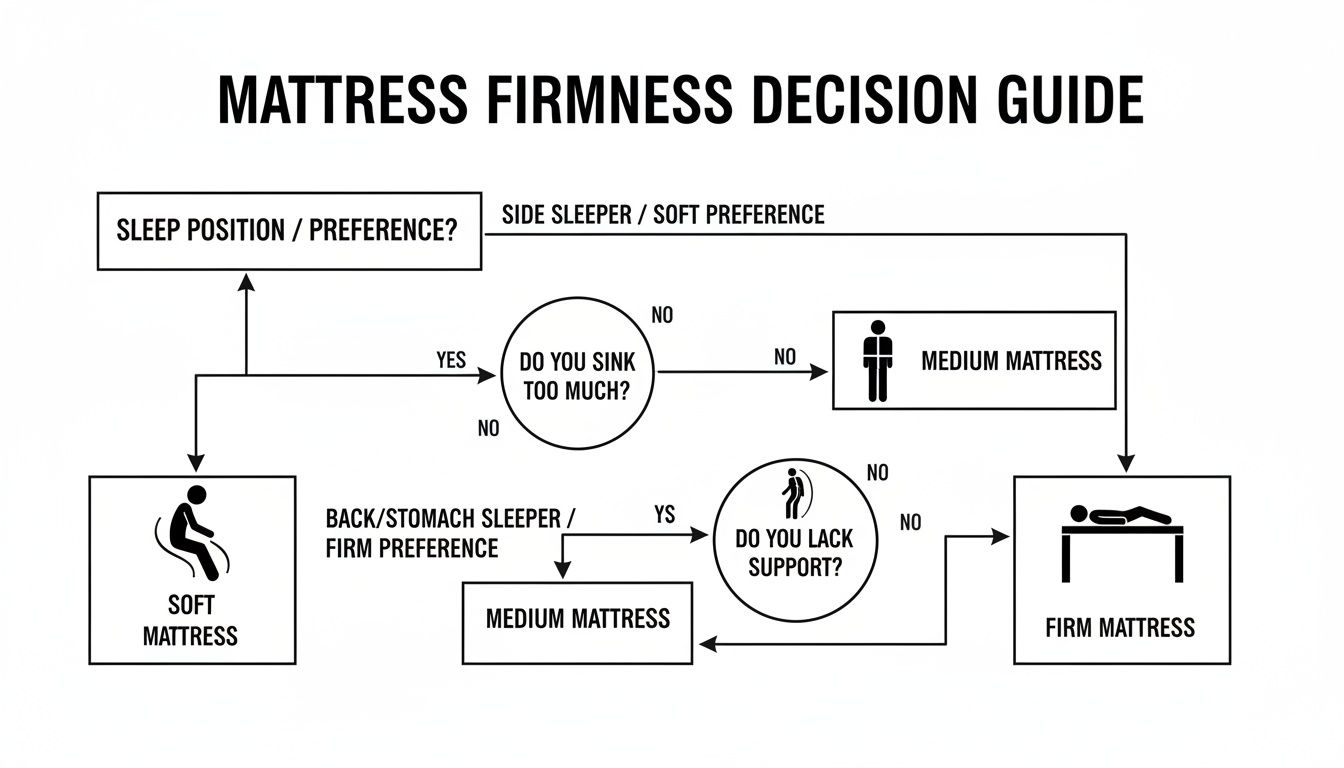
As you can see, the ideal outcome is a straight spine. That only happens when the right amount of sinkage and support are matched to your unique profile.
The Physics of Personalized Comfort
When you understand your body's specific needs, mattress shopping ceases to be frustrating guesswork and becomes a solvable puzzle. Industry data confirms that the vast majority of sleepers find their comfort zone within a relatively narrow window.
While personal preference certainly matters, the physics of support are non-negotiable. A mattress must be firm enough to hold you up and soft enough to contour to your curves. Finding that perfect equilibrium is the secret to truly restorative sleep.
Research confirms that about 80% of sleepers gravitate toward the 5-7 firmness range, with medium-firm (a 6/10) being the most popular choice. Lighter side sleepers under 130 pounds often prefer softer 3-5 profiles, while those over 230 pounds lean toward a firmer 7-8 for unyielding lumbar support. You can review the data on SleepFoundation.org to see how this breaks down.
This is exactly why a professional, data-driven fitting is so important—especially for couples with different needs where a one-size-fits-all approach is destined to fail. In our private Carlsbad showroom, we use pressure-mapping technology to literally show you how your body interacts with different surfaces, taking speculation out of the process. This allows us to scientifically recommend a firmness level that delivers optimal alignment and pressure relief, guaranteeing your new sleep system is a perfect match.
The Importance Of Materials And Craftsmanship
Securing the right firmness is a critical first step, but the materials that create that firmness are what separate a good mattress from a truly luxurious one. A number on a scale is meaningless if it is derived from cheap foams that sag or harsh chemical glues. Real, lasting comfort is born from superior components and time-tested construction methods that work with your body.
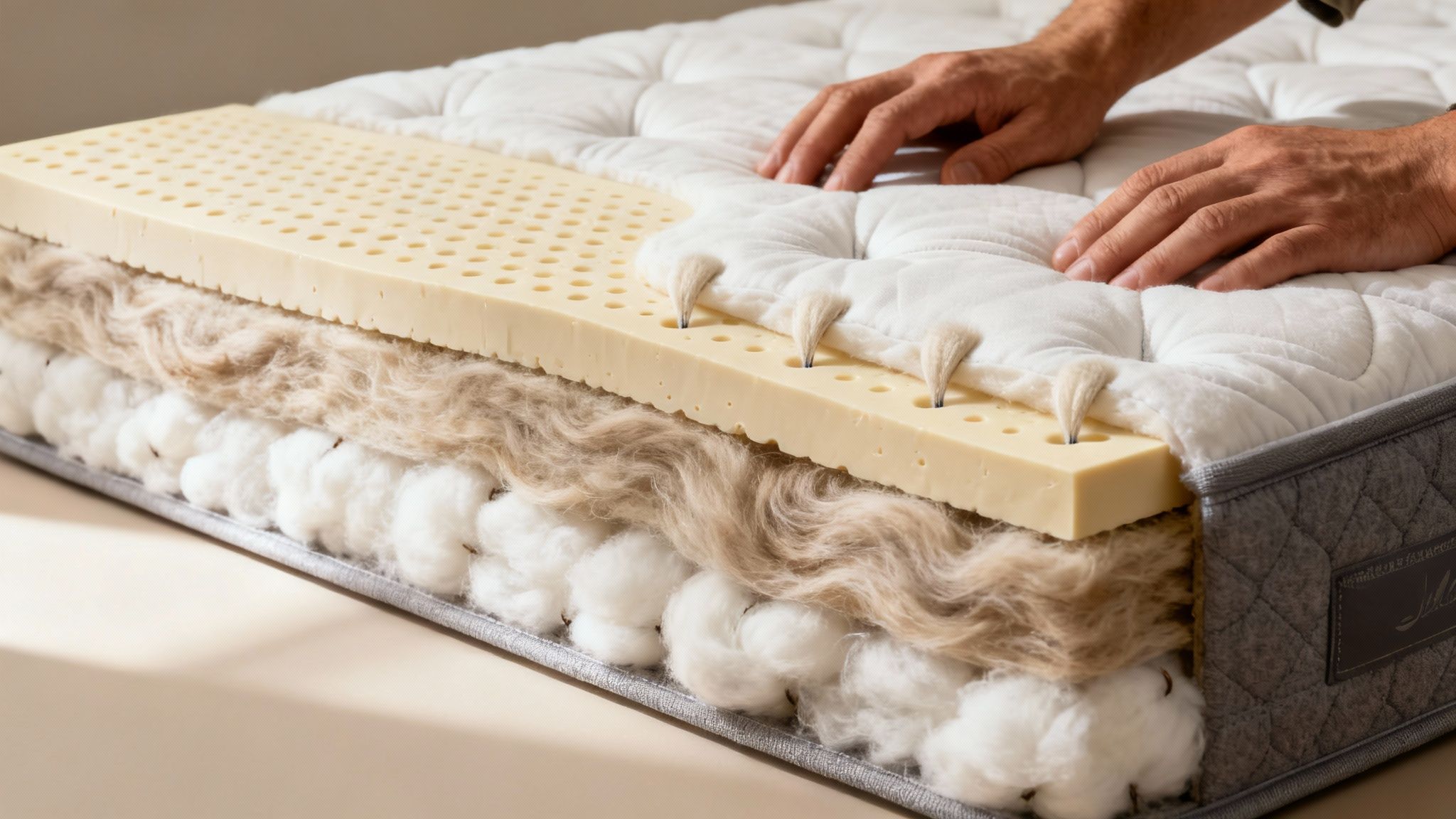
The typical mass-market approach involves gluing together layers of petrochemical foams. This is a fast and inexpensive way to build a bed, but these materials often trap heat and lose their ability to support you surprisingly quickly. A meticulously crafted mattress is built differently, with a focus on durability, breathability, and responsive support that lasts.
Why Natural Latex Is A Game-Changer For Side Sleepers
For side sleepers, natural latex is in a class by itself. While memory foam is known for its slow-sinking sensation, which can make you feel trapped, natural latex is the opposite—it provides a uniquely buoyant and responsive lift. It adapts to your curves instantly, cradling your hips and shoulders while gently supporting your waist to keep your spine perfectly aligned.
This dynamic response delivers incredible pressure relief without the "stuck" feeling, so you can shift and turn easily throughout the night. Furthermore, its natural open-cell structure allows air to flow freely, promoting a much cooler, more comfortable sleep. That’s a significant advantage for anyone living in sunny Carlsbad or Encinitas. We have a detailed guide that breaks down the differences between latex, memory foam, and hybrid mattresses and why the materials are so fundamental to your comfort.
A luxury mattress isn't just soft or firm; it's resilient. Its materials are chosen for their ability to provide consistent, breathable support night after night, for years to come—transforming it from a disposable product into a long-term investment in your wellness.
Hand-Tufting: The Mark Of True Artistry
One of the clearest signs of a premium, handcrafted mattress is a technique called hand-tufting. In this time-honored method, a skilled artisan passes ribbons or straps completely through every layer of the mattress—from top to bottom—and secures them tightly. It is a labor-intensive process with immense benefits.
Compared to the glued layers in most beds, hand-tufting offers serious advantages:
Unmatched Durability: Tufting physically locks all comfort and support layers together, preventing them from shifting, bunching, or developing lumps over time.
Enhanced Comfort: By compressing the layers, tufting creates a more consistent and responsive sleep surface, pre-conditioning the materials for incredible comfort from the very first night.
A Healthier Build: This technique eliminates the need for harsh chemical glues, resulting in a cleaner, more natural sleep environment.
You can see and feel the results. The gentle dimples on the surface of a hand-tufted mattress are not a flaw—they are the signature of a bed built to last a decade or more.
Wool And Cotton: Your Personal Climate Control
Finally, the materials just beneath the surface play a crucial role in regulating your temperature and managing moisture, which is key to deep, uninterrupted sleep. That is why the best mattresses eschew synthetic covers for natural, breathable fibers like organic wool and cotton.
Wool is a powerhouse material. It acts as a natural insulator, creating a perfect microclimate that keeps you warm when it's cool and cool when it's hot. Even better, it is incredibly effective at wicking moisture away, drawing perspiration from your skin so you stay dry and comfortable all night.
This commitment to high-performance, natural materials elevates a mattress from a simple cushion to a sophisticated sleep system. It is a philosophy that believes your bed should not only feel amazing but also be fundamentally healthier for you. During a private fitting, we can walk you through these details, helping you see firsthand how true craftsmanship translates directly into better sleep.
Building Your Complete Sleep System
Finding the right mattress firmness is a monumental first step, but it is not the complete picture. Truly restorative sleep comes from what we call a complete ‘sleep system’—a setup where your mattress, pillow, and foundation work together in perfect harmony. Think of it as a three-legged stool; if one leg is off, the entire structure is compromised.
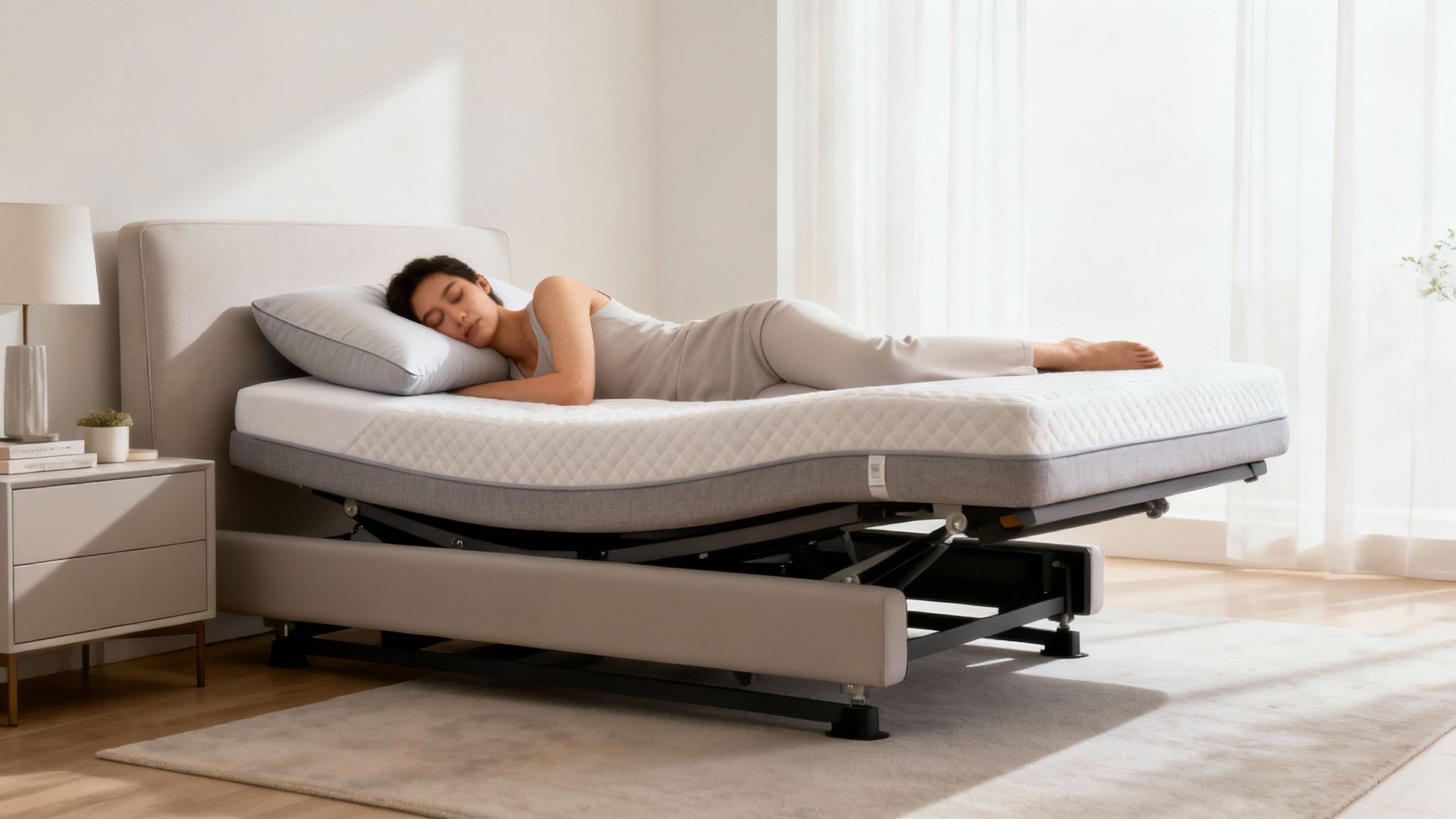
This holistic view is especially critical for side sleepers. You could invest in a world-class mattress, but pairing it with the wrong pillow negates much of the benefit. The goal is to create an ecosystem where every component is dialed in for your body’s unique needs.
The Non-Negotiable Role of Your Pillow
For a side sleeper, a pillow is not just an accessory—it is a critical piece of structural support. When you lie on your side, a significant gap exists between your head and the mattress. Your pillow’s sole job is to fill that space perfectly, keeping your head and neck in a straight, neutral line with the rest of your spine.
If a pillow is too thin, your head droops, placing strain on your neck and shoulder. If it is too thick, it props your head up at an awkward, painful angle. A professional pillow fitting in our Carlsbad studio solves this problem by matching the pillow's height and firmness to your shoulder width and your mattress's specific feel.
The right pillow acts as the final bridge in your support system. It completes the path of neutral spinal alignment that begins at your hips and ends at the top of your head, ensuring every vertebra is perfectly supported.
Elevating Comfort with an Adjustable Base
While a solid foundation is essential, an adjustable base can elevate your comfort to an entirely new level. For side sleepers—especially those dealing with hip or lower back pain—this technology can be a true game-changer.
By slightly elevating your head and feet, you can dramatically reduce the pull of gravity on your lumbar spine and pelvis.
Raising the upper body can ease pressure on the shoulders. Simultaneously, lifting your legs improves circulation and takes the load off your lower back and hips. It transforms your bed from a static surface into a dynamic environment that responds to your body's needs. If pressure points are a particular concern, you can also explore how to find the best mattress topper for pressure point relief in our dedicated guide.
Curating Your Personalized Sleep Environment
Ultimately, building your perfect sleep system is an intensely personal process. It takes an expert eye to understand how the individual components—mattress, pillow, base—will interact with your body. To truly optimize your rest, you might also look at ways to improve sleep quality naturally alongside your new setup.
During a private fitting, a Certified Sleep Coach acts as your guide. We analyze how each piece contributes to your overall alignment and comfort, ensuring your final system is a seamlessly integrated solution built for one purpose: to give you the deepest, most restorative sleep of your life.
Discovering Your Perfect Match In Carlsbad
Online reviews and generic mattress quizzes can only take you so far. Real, lasting comfort is not something you can find in an algorithm. It is deeply personal, and discovering it requires a more thoughtful, scientific approach. A private fitting with a Certified Sleep Coach at our Carlsbad studio is designed to remove the guesswork, ensuring your investment in your well-being is a sound one.
This experience is less like shopping and more like a wellness consultation. We begin with a conversation about your sleep habits, your challenges, and your long-term health goals. From there, we move beyond subjective feelings and introduce objective, data-driven insights.
The Power of Pressure Mapping
We utilize advanced pressure-mapping technology to create a visual "fingerprint" of your body's interaction with a mattress. This tool generates a detailed, color-coded map that shows us exactly where your body exerts the most force. It highlights your unique pressure points and allows us to see your spinal alignment in real-time.
For side sleepers, this is transformative. The map instantly reveals if a mattress is creating stress on your shoulder or allowing your hips to sink too far—issues that are nearly impossible to diagnose on your own. This objective data provides a clear path forward.
Luxury isn’t about a brand name; it’s about a bespoke process. It means using precise data to craft a sleep solution that is perfectly calibrated to your individual physiology for enhanced long-term health.
This data-driven process is the ultimate expression of modern luxury. It shifts the focus from simply selecting a product to building a personalized wellness solution—a core philosophy for our clients in Rancho Santa Fe and La Costa.
A Concierge Approach to Sleep Wellness
Armed with this information, your Sleep Coach can guide you toward the materials and constructions that directly address your specific needs. This level of detail is critical, especially for professionals whose daily performance hinges on getting restorative rest.
Whether we recommend a split-firmness system for a couple or a specific pillow profile to complete your alignment, every recommendation is backed by science. You can learn more about how we apply these principles in our guide to finding the best mattress for side sleepers in Carlsbad, CA. It is a dedicated service focused on one thing: enhancing your well-being.
At Golden Dreams Mattress, every guest enjoys a private concierge fitting with a Certified Sleep Coach. Book your complimentary 20-minute virtual consultation today and discover what true luxury sleep really feels like.
Still Have Questions? Let's Talk Specifics.
Finding the right mattress often brings up a few final questions, especially when dealing with pain or sharing a bed. Here are some of the most common scenarios we address with clients in our Carlsbad showroom—and the straightforward advice we provide.
What’s the Best Firmness for a Side Sleeper with Hip Pain?
If you are a side sleeper struggling with hip or shoulder pain, your ideal firmness is usually a medium-soft to medium mattress. This corresponds to a 4 to 6 on the 10-point scale. This range is specifically designed to provide pressure relief right where you need it, cradling your joints without allowing your spine to sag.
We often find that natural latex works wonders here. It contours to your body's curves instantly but has a responsive, buoyant feel. You get the cushioning without the slow-sinking feeling of memory foam, which can sometimes compromise alignment. The only way to know for sure is to see what your body tells us during a pressure-mapping session.
My Partner and I Are Completely Different Sizes. What Do We Do?
This is perhaps the most common challenge couples bring to us, and the solution is more elegant than you might think. The days of one person compromising their sleep are over. Instead of searching for a one-size-fits-all mattress that fits no one well, the answer is a split-firmness or dual-sided mattress.
It is exactly as it sounds: a single mattress handcrafted with a different firmness level on each side. This allows both you and your partner to receive the exact support and pressure relief your individual body types require. It is not a compromise; it is personalized comfort for two.
Is a Firm Mattress Ever a Good Idea for a Side Sleeper?
Generally, no. A truly firm mattress—an 8 to 10 on the scale—is almost always a poor match for a side sleeper. It simply lacks the necessary give to cushion the shoulders and hips, which forces the spine into an unnatural curve and creates painful pressure points.
The key exception is for heavier side sleepers, typically those over 230 lbs. For them, a medium-firm to firm surface (around a 7) can be the perfect fit. It provides the robust support needed to prevent their hips from sinking too deeply into the mattress, a primary cause of back pain for this group. The goal remains the same: find a mattress that feels supportive yet still contours enough to keep your spine perfectly straight.
At Golden Dreams Mattress, every guest enjoys a private concierge fitting with a Certified Sleep Coach. Book your complimentary 20-minute virtual consultation today and discover what luxury sleep really feels like.

Comments