How to Align Your Spine While Sleeping: A Guide to Restorative Sleep
- zach4549
- Nov 8, 2025
- 11 min read
Waking up refreshed isn’t just about feeling comfortable—it's about anatomy. The cornerstone of restorative sleep is maintaining a neutral spine, which is the natural, gentle curve your body holds when standing tall. If you can preserve that alignment overnight, you can prevent the neck pain, back stiffness, and nagging issues that disrupt deep sleep.
Why Spinal Alignment Is the Secret to Restorative Sleep
When we meet with clients in our Carlsbad showroom, most believe a mattress just needs to be "comfy." But true comfort is a byproduct of proper support. Think of your spine as a delicate instrument. During the day, gravity and posture place constant stress on it. Sleep is your body's only opportunity to decompress, repair muscle tissue, and fully recover.
If your spine is twisted or unsupported for eight hours, your muscles never rest. They stay tense, working overtime to hold your body in a strained position. This tension prevents you from reaching the deeper, more restorative stages of sleep. The result? You wake up feeling stiff, sore, and sometimes more tired than when you went to bed.
The Problem with Poor Alignment
Misalignment doesn't just cause morning stiffness; it can contribute to long-term wellness issues. By maintaining proper spinal alignment, you can explore ways for how to relieve lower back pain at home and stop minor aches from becoming chronic problems.
A misaligned spine can trigger a cascade of issues, including nerve compression, reduced circulation, and persistent inflammation. It turns your nightly rest into a period of prolonged physical stress instead of recovery.
This is a significant health matter. In 2022, the World Health Organization reported that roughly 222 million people worldwide were suffering from neck pain alone. This underscores the importance of simple preventive measures like correct sleep posture. You can explore the data and its connection to proper sleep support by reading reports on cervical health.
Introducing the Complete Sleep System
Achieving a neutral spine isn't solely the job of your mattress. It requires a harmonized approach we call a complete sleep system. Three essential components must work together in perfect concert:
Your Mattress: The foundation. It must support the weight and unique curves of your entire body.
Your Pillow: The precision tool. Its job is to align your neck and head with the rest of your spine.
Your Base: The underlying support. It enhances mattress performance and can offer customized positioning to relieve pressure.
When these elements are expertly matched to your anatomy and sleep style—something we specialize in during our private fittings—they create an environment where your spine can finally rest in its natural position. This is what unlocks truly restorative sleep.
Achieving a Neutral Spine in Any Position
Sleeping Position | Key Alignment Goal | Pillow Recommendation |
|---|---|---|
Back Sleeper | Maintain the natural S-curve of the spine, ensuring the lower back is gently supported. | A medium-loft pillow that cradles the neck without pushing the head too far forward. |
Side Sleeper | Keep the spine in a straight, horizontal line from the neck to the hips. | A higher-loft, firmer pillow to fill the gap between the ear and the shoulder. |
Stomach Sleeper | Prevent the lower back from arching and the neck from twisting excessively. | The thinnest pillow possible (or no pillow at all) under the head; a flat pillow under the hips. |
Getting this right is the first step toward waking up without pain. Each position has its challenges, but with the right system, a neutral spine is achievable.
Mastering Your Sleep Position for Optimal Alignment
Your preferred sleep position has the greatest impact on whether you wake up feeling refreshed or rickety. Whether you favor your side, back, or stomach, each posture comes with its own alignment challenges.
The goal isn't to force yourself into a position that feels unnatural. It's about making small, strategic adjustments that allow your muscles to finally release.
Side Sleepers: A Straight Line to Comfort
Most people are side sleepers. This position can be excellent for your spine, but only if the setup is correct. Your objective is to create a perfectly straight, horizontal line from your head down to your pelvis, mimicking your best standing posture while lying down.
Two things often go wrong. First, a gap between your head and the mattress lets your neck droop. Second, your top leg tends to slide forward, twisting your pelvis and straining your lower back. We often see this with clients from Encinitas and Rancho Santa Fe who are seeking solutions for hip pain.
Fortunately, the fix is straightforward and involves two key supports:
A Pillow for Your Head: You need a pillow with enough loft and firmness to completely fill the space between your ear and the outside of your shoulder. This is essential for keeping your neck in line with your spine.
A Pillow Between Your Knees: Tucking a slim but supportive pillow between your knees is a game-changer. It stops your hips from rotating and keeps your pelvis neutral, which removes pressure from your lumbar spine.
Back Sleepers: Supporting the Natural Curve
If you're a back sleeper, the challenge is maintaining the gentle "S" curve of your spine, especially in the lower back (the lumbar region).
A mattress that’s too firm is a common culprit; it leaves a gap under your lower back, forcing those muscles to stay tense. Conversely, a mattress that's too soft lets your hips sink too low, flattening that crucial curve and causing other issues.
The solution is proper support distribution. You need a mattress firm enough to hold up your torso but with enough give to contour to the arch of your lower back. For your pillow, a lower-profile model is usually best. It should support your neck without pushing your chin toward your chest.
Stomach Sleepers: A Strategy for Mitigation
Sleeping on your stomach is the most challenging position for your spine. It flattens your natural lumbar curve and forces you to twist your neck to one side for hours. If you can train yourself to sleep on your side or back, your body will thank you.
But for some, it's the only way to fall asleep. If that's you, the goal becomes harm reduction.
Use the thinnest pillow you can find under your head—or no pillow at all—to minimize neck strain. Then, slide a thin pillow under your pelvis and lower abdomen. This small tweak helps prevent your lower back from arching into a painful U-shape.
It's not about achieving textbook-perfect posture overnight. Making minor, consistent adjustments to how you sleep can lead to major relief. You're simply giving your body the support it needs to do its repair work.
This infographic shows how all the pieces—your mattress, pillow, and base—should work in concert to build your ideal sleep system.
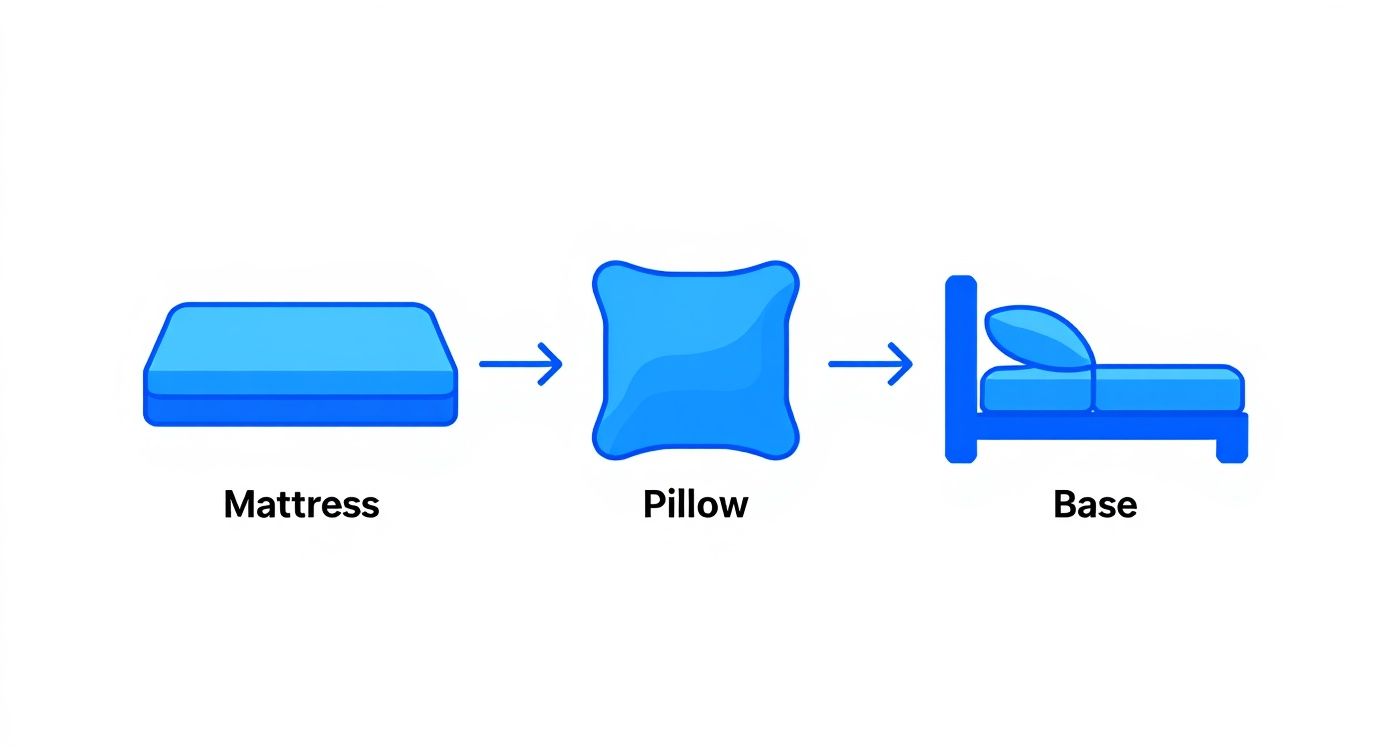
This process demonstrates that true spinal alignment isn't about finding one magic product. It’s about creating a cohesive system where every element works in harmony.
Choosing The Right Pillow For Cervical Support
Your pillow isn’t just an accessory; it's a precision tool for your neck health. Its purpose is to bridge the gap between your head and the mattress, holding your neck in a perfectly neutral position. Get this wrong, and you’re inviting morning stiffness and headaches.
Getting this right is non-negotiable if you want to align your spine while you sleep.
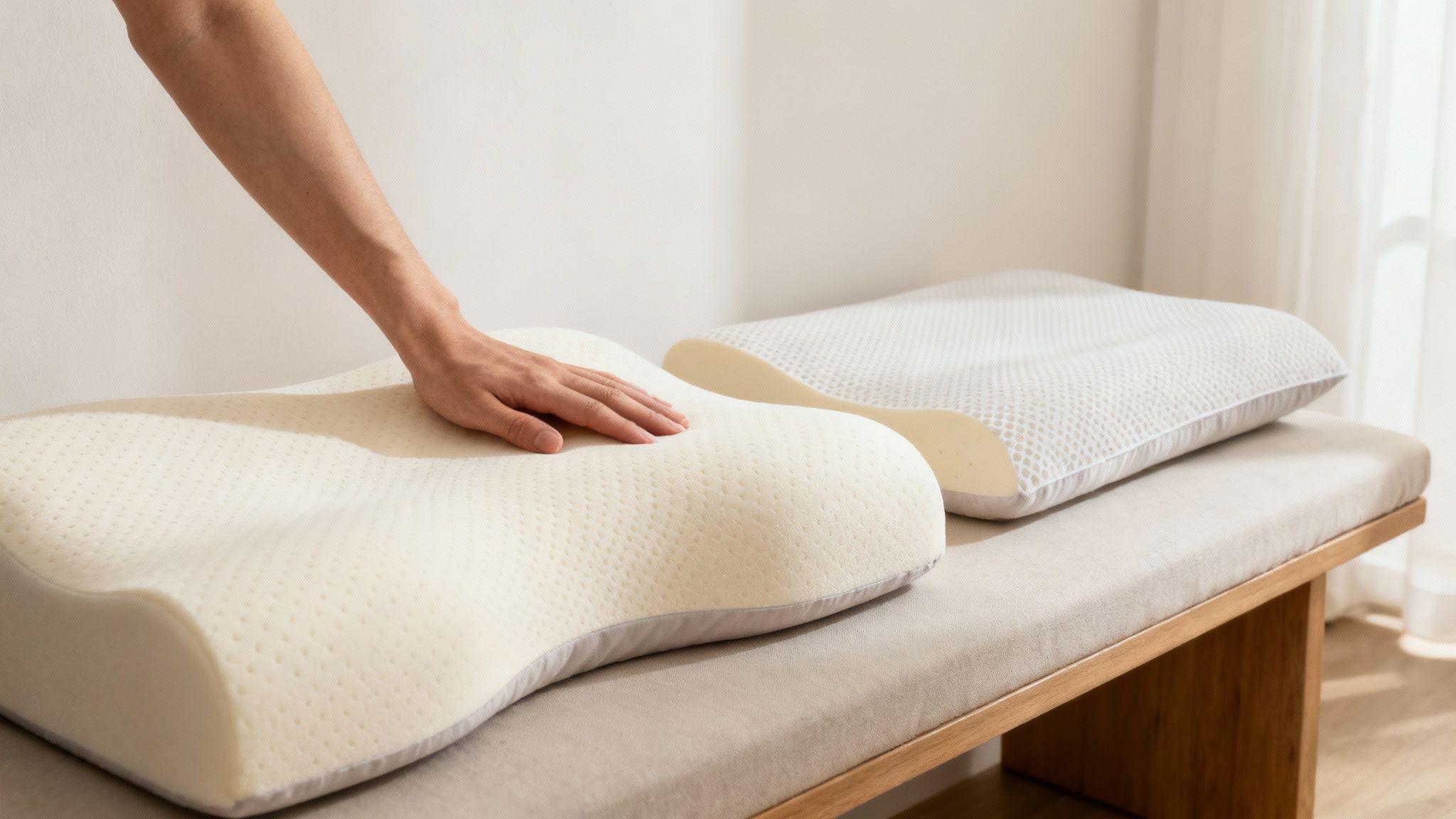
It all comes down to two factors: pillow loft (its height) and firmness. These must be matched perfectly to your sleep position and body frame.
For example, a side sleeper with broad shoulders needs a much higher and firmer pillow than a petite back sleeper. That high loft fills the space between their ear and the mattress, keeping their spine straight. A mismatch here is a direct cause of misalignment.
Matching Pillow Materials To Your Needs
The material inside your pillow dictates its supportive qualities, breathability, and durability. Mass-market polyester pillows flatten quickly, losing their structure and leaving your neck unsupported.
Premium materials, on the other hand, offer specific, lasting benefits:
Natural Latex: Incredibly responsive and resilient, latex gently contours to your head and neck without collapsing. It's also naturally hypoallergenic and sleeps cool.
Wool: A fantastic natural temperature regulator, wool wicks moisture away to create a dry, comfortable sleep environment. It provides a unique, springy support that’s both soft and substantial.
High-Density Memory Foam: Quality memory foam offers excellent pressure relief by molding precisely to your shape, ideal for anyone who needs consistent, cradling support.
Research supports this. Studies show that both pillow height and material can dramatically alter the curve of your cervical spine during sleep. An improper pillow is a leading cause of neck pain because it either pushes your head too high or lets it drop too low.
The Case For A Professional Pillow Fitting
Guesswork is the enemy of spinal alignment. Choosing a pillow in a store by giving it a quick squeeze is an unreliable way to find the right support for your anatomy. This is why a professional pillow fitting is so important.
A pillow fitting eliminates trial and error. By analyzing your sleep position, shoulder width, and mattress firmness, a sleep coach can identify the exact loft and material needed to hold your cervical spine in perfect alignment.
This personalized approach ensures your pillow and mattress work together as a cohesive system. To get the best results, it’s also smart to explore resources on finding the best pillow for neck support that speak to your specific needs.
We see it every day—a properly fitted pillow can immediately relieve neck tension for clients from La Costa to Encinitas. It’s a small change that delivers profound results.
To learn more, read our guide on how your pillow is as important as your mattress.
Your Mattress: The Foundation for Full-Body Alignment
A great pillow is essential for your neck, but your mattress is the foundation for your entire body. A truly supportive mattress does more than feel comfortable—it intelligently conforms to your curves while holding your spine in a neutral line.
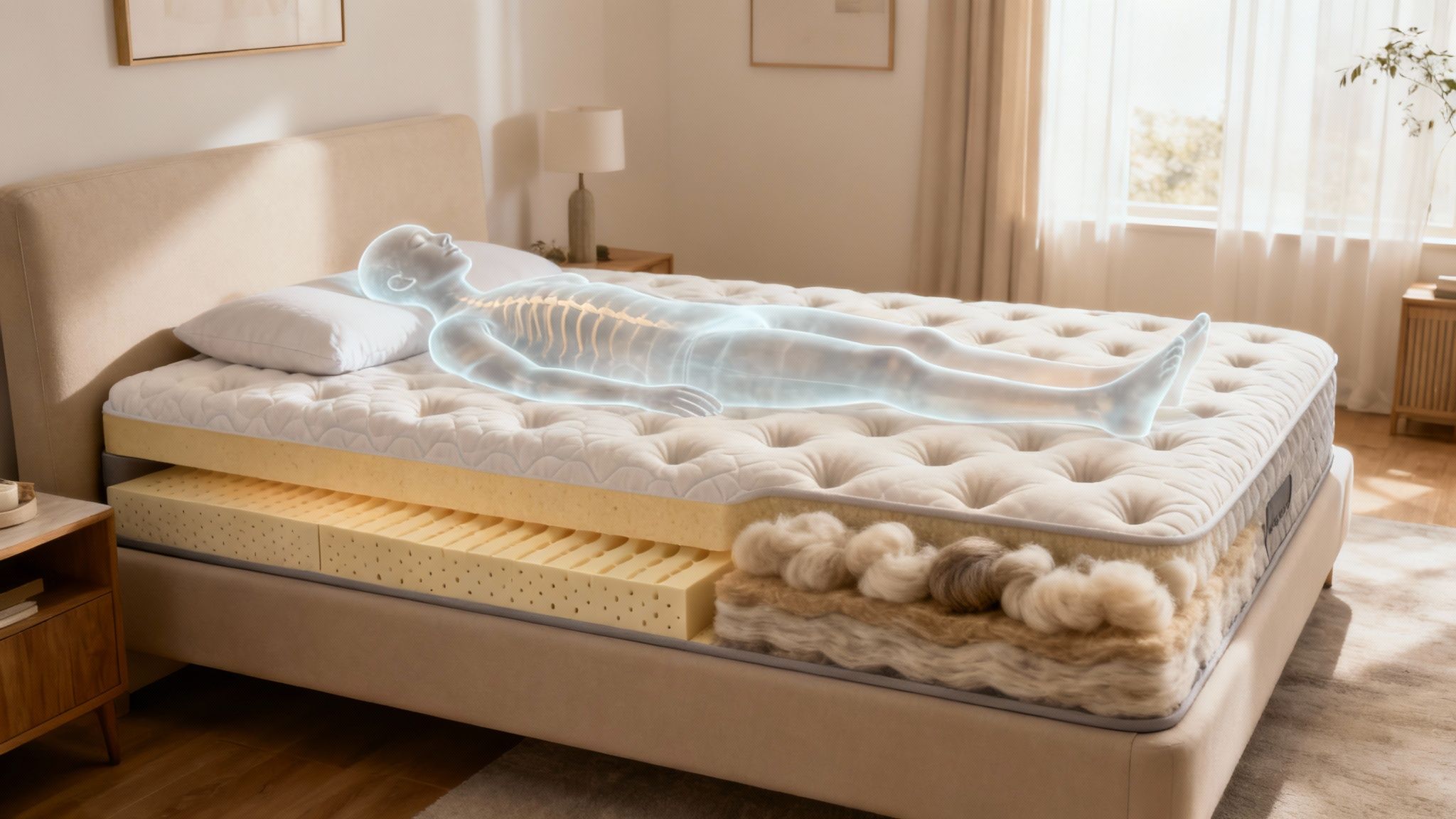
This balance is where most mass-produced, one-sided foam beds fall short. They may offer initial softness, but they often lack the sophisticated support core needed to prevent your hips—the heaviest part of your body—from sinking too far.
When that happens, your lumbar spine is pulled out of its natural curve, forcing your back muscles to work all night to keep you stable.
The Craftsmanship of True Support
What sets a premium mattress apart is the craftsmanship you can't see from the outside. These are features designed for longevity and consistent, therapeutic support.
Hand-Tufting: In this artisan technique, a craftsman passes ribbons through the entire mattress, securing them from top to bottom. This locks all internal layers of natural latex, wool, and cotton firmly in place, preventing them from shifting or creating lumps over time. The result is edge-to-edge support that feels the same in year ten as it does on day one.
Two-Sided, Flippable Design: Most modern mattresses are one-sided. A meticulously crafted two-sided mattress, however, is designed to be flipped and rotated. This simple act allows the comfort materials to recover and wear evenly, effectively doubling the mattress's lifespan and ensuring consistent spinal alignment for years.
Zoned Support Coils: Advanced innerspring systems feature strategic zones with firmer coils directly under your lumbar region and more forgiving coils at the shoulders and hips. This design provides robust support where you need it most while cradling your pressure points.
Materials That Breathe and Respond
Beyond construction, the materials themselves play a massive role. Natural fibers are chosen for superior performance, not just their eco-friendly appeal.
Natural latex offers a buoyant, responsive feel that gently lifts your body instead of just absorbing its weight like memory foam. When paired with breathable wool, which wicks away moisture and regulates temperature, you get a sleep environment that is both deeply supportive and restorative.
The right mattress cradles your hips and shoulders while firmly upholding your torso. It’s a delicate balance that demands precision and quality materials. Understanding what makes a mattress truly premium helps you see past marketing buzz and learn about the best mattress for back pain based on facts, not myths.
Ultimately, a mattress isn’t just another purchase; it's an investment in your daily wellness. The right one provides the foundational support that allows your entire sleep system—and your body—to function as it should.
Fine-Tuning Your Sleep with Bases and Pre-Sleep Habits
Your mattress and pillow do most of the heavy lifting, but the final adjustments often come from what’s underneath your mattress and what you do before you lie down. These two elements can turn a good sleep setup into a truly therapeutic one.
An adjustable base is more than a luxury item—it's a precision tool for spinal alignment. It gives you the power to make micro-adjustments that a flat foundation cannot, targeting specific pressure points with the push of a button.
The Power of an Adjustable Base
We often see clients in Carlsbad who struggle with lower back tension find relief with an adjustable base. A slight elevation of the feet can make an incredible difference. This tweak gently tilts the pelvis, easing strain on the lumbar spine and allowing those overworked muscles to relax.
The same goes for a minor head elevation, which can open airways. But the most popular setting is the "zero-gravity" preset. This position raises both the head and feet to create a feeling of weightlessness, designed to decompress the spine and improve circulation.
Zero-gravity isn't a marketing gimmick; it's a biomechanical posture designed to neutralize the forces on your spine, allowing for maximum decompression and muscle relaxation.
This level of customization is invaluable when you're pursuing perfect alignment. If you want to dive deeper, our guide on adjustable bases and how to pair them with your mattress has all the details.
Pre-Sleep Rituals for a Supple Spine
Your sleep system works best when your body is ready for rest. A short pre-sleep ritual helps release the tension you’ve built up all day, preparing your muscles and spine for a night of passive recovery.
These are gentle, calming movements designed to lengthen tight muscles and quiet your nervous system.
Gentle Cat-Cow: On your hands and knees, slowly move between arching your back and dropping your belly. This simple flow mobilizes your vertebrae and eases stiffness.
Child's Pose: From a kneeling position, fold your torso over your thighs and reach your arms forward. This pose is a fantastic stretch for the lower back and hips.
Supine Spinal Twist: Lie on your back, pull one knee to your chest, and gently guide it across your body. Keep your shoulders flat on the bed to feel a releasing stretch in your lower back.
Spending just a few minutes on these stretches signals to your body that it's time to let go. When you combine this mindful transition with a supportive sleep system, you create the perfect conditions for your spine to rest, recover, and realign.
Your Top Questions About Spinal Alignment, Answered
As Certified Sleep Coaches, we've heard nearly every question. Here are some of the most common things we discuss with guests in our Carlsbad showroom.
How Can I Tell if My Spine Is Misaligned at Night?
Your body will tell you, usually the moment you wake up. Morning stiffness, a dull ache in your low back, or a pins-and-needles sensation in your arms are classic signs. When your spine is aligned, your muscles fully relax and repair. If you’re waking up tense, something is off.
Another tell? Constant tossing and turning. While some movement is normal, if you feel like you're fighting your mattress all night, your body is likely struggling to find a position that relieves pressure.
Will a Mattress Topper Fix My Alignment?
A topper is a temporary fix, not a solution. It can soften a mattress that feels too hard, but it cannot restore support to a sagging mattress.
A topper will simply follow the dips of the mattress underneath, meaning your spine will, too. It doesn't solve the underlying problem of inadequate foundational support.
Is Firm or Soft Better for My Back?
This is the most frequent question we receive, and the answer is neither. The goal isn’t “firm” or “soft”—it’s supportive. A truly supportive mattress has a strong core to keep your spine level, combined with comfort layers that yield just enough for your shoulders and hips.
If it’s too firm, it creates pressure points. Too soft, and you get that dreaded hammock effect where your hips sink too low. The right feel is entirely unique to your body shape, weight, and sleep position.
How Long Until My Body Adjusts to a New Supportive Mattress?
If your muscles have been fighting a poor mattress for years, they need time to learn how to relax again. Allow for an adjustment period of about two to four weeks.
During this time, you might feel new sensations as your body recalibrates. This isn’t a bad sign—it’s your muscles releasing old tension and settling into a healthier, more neutral posture. You are essentially retraining your body to accept the support it has been missing.
At Golden Dreams Mattress in Carlsbad, every guest enjoys a private concierge fitting with a Certified Sleep Coach. Book a free 20-minute virtual sleep consultation today and discover what luxury sleep really feels like.