Shoulder Pain Relief While Sleeping: A Guide to Restorative Nights

If you have ever felt that deep, nagging shoulder ache flare up the moment you lie down, you understand the frustration. Your bed should be a sanctuary of rest and recovery, but instead, it feels as though it’s working against you. This is more than a simple annoyance; it is your body sending a clear signal that something is fundamentally wrong with your sleep environment.
To achieve true relief, you must stop thinking of your bed as just a mattress. It is a complete sleep system. The mattress, pillow, and foundation must work in concert to eliminate the direct pressure and misalignment that cause pain to spike during the night.
Understanding Why Your Shoulder Aches at Night

During the day, your muscles are actively engaged, providing support to your joints. When you fall asleep, that critical role is transferred entirely to your mattress and pillow. If they fail to provide adequate support, your shoulder bears the consequences.
This is a familiar story we hear in our Carlsbad showroom, particularly from clients in active communities like Encinitas and Rancho Santa Fe. Minor inflammation from a day of golf, tennis, or surfing may feel insignificant while you are moving, but it can become intensely painful when you are lying still on an unsupportive surface.
The Role of Pressure and Alignment
The shoulder is the most mobile joint in your body—a marvel of engineering that also makes it incredibly vulnerable. When you get into bed, two primary factors put it at risk: direct pressure and poor spinal alignment.
Direct Pressure: For a side sleeper on a mattress that is too firm, the shoulder is forced to bear a disproportionate amount of body weight. This compresses the delicate rotator cuff tendons and the bursa (the small, fluid-filled sacs that cushion the joint), leading to inflammation and a sharp, persistent ache.
Poor Alignment: Conversely, a mattress that is too soft creates a "hammock effect." Your hips and torso sink too deeply, causing your spine to curve downward. This unnatural posture pulls the shoulder joint out of alignment, straining the surrounding muscles throughout the night.
Your Sleep System: The Foundation of Comfort
One of the most significant misunderstandings in sleep wellness is treating the bed as a single object. True comfort and support originate from a cohesive sleep system, where each component performs a critical function.
Your mattress provides foundational support, your pillow manages neck and shoulder alignment, and an adjustable base can offer customized pressure relief. When these elements do not work in harmony, the system fails—and your sleep becomes the primary casualty.
A mass-produced, one-size-fits-all mattress is designed for a generic "average" person, not for your body. It lacks the sophisticated, zoned support required to properly cradle the shoulder. A thoughtfully designed sleep system, however, is tailored to your sleep habits, physique, and specific points of pain.
For instance, a side sleeper with shoulder pain requires a surface with zoned support—softer where the shoulder makes contact but firmer under the hips to maintain a perfectly straight spine. Understanding this dynamic is the key to resolving nighttime shoulder pain. It is not an unavoidable problem but an ergonomic puzzle that, when solved, allows your body to heal and achieve truly restorative rest.
Finding Your Best Pain-Free Sleep Position
Your sleeping position can either exacerbate your shoulder pain nightly or become a powerful tool for relief. The goal is not to force yourself into a single "perfect" position, but to find a posture that maintains a neutral spine and removes stress from the aching joint.
These are not generic tips; they are the same foundational adjustments a Certified Sleep Coach in our Carlsbad showroom would guide you through. They are designed to empower you to reclaim control over your comfort, starting tonight.
For Those Who Sleep on Their Back
Sleeping on your back is often the ideal starting point for shoulder health. It is the most neutral position, distributing your body weight evenly and preventing the direct compression that occurs when sleeping on your side.
Even back sleepers can inadvertently strain the joint if the arm on the painful side falls into an awkward position during the night. Fortunately, a simple, elegant solution can correct this immediately.
Actionable Tip: Take a small, supportive pillow—a travel pillow often works well—and tuck it under the forearm of your sore shoulder. This subtle elevation cradles your arm, keeping the shoulder joint in a relaxed, open position and preventing it from rotating inward or falling back into a stressful angle.
This is a minor adjustment, but the relief can be profound. You are effectively offloading the joint for the entire night.
For Committed Side Sleepers
We understand. If you have been a side sleeper your entire life, the advice to "just sleep on your back" is both frustrating and unrealistic. The good news is that you do not have to switch. With a few intelligent modifications, you can continue sleeping on your side without waking in agony.
The primary issue for side sleepers is the tendency to roll forward. This collapses the chest and places immense direct pressure on the front of the shoulder capsule and rotator cuff tendons. The key is to prevent this forward rotation.
Place a firm, full-sized pillow in front of your chest and simply embrace it. This technique acts as a supportive brace for your top arm and torso. It physically prevents your body from curling forward, keeping your shoulder joint perfectly stacked and stable.
By propping up the weight of your top arm, you eliminate the downward drag on your painful shoulder, allowing tense muscles to finally relax. Of course, ensure you are sleeping on your non-painful side. If both shoulders are problematic, it may be time to seriously experiment with the supported back-sleeping position. For many of our clients from La Costa and Encinitas, the final piece of the puzzle is a professional pillow fitting, which ensures the space between their neck and the mattress is filled perfectly to maintain that crucial alignment.
These postural tweaks deliver optimal results when your mattress is performing its job correctly. A sleep system that conforms to your body’s curves without sagging is essential to making these positions effective. The goal is to create a healing environment where your body can truly rest and repair.
How Your Mattress Can Make or Break Shoulder Pain
While adjusting your sleep position can offer immediate relief, your mattress is the foundation of long-term comfort. More often than not, it is the true culprit behind chronic shoulder ache. The right mattress works with your body, cradling its natural curves. The wrong one fights against it, creating painful pressure points night after night.
A mattress that is too firm offers no give. When you lie on your side, it shoves back against your shoulder, compressing the joint. Conversely, a mattress that is too soft allows your hips to sink too low, creating a hammock effect that misaligns your spine and strains your shoulder.
Better Materials Mean Better Mornings
This is where the distinction between a mass-produced bed-in-a-box and a true handcrafted mattress becomes clear. Most conventional mattresses rely on simple foams that either collapse under your weight or remain stubbornly rigid. A premium sleep system, however, utilizes sophisticated, natural materials designed for both buoyant support and adaptive contouring.
Natural Latex: Unlike memory foam, which can trap heat and create a "stuck" feeling, GOLS-certified organic latex offers instant responsiveness and breathability. It gently contours to your shoulder while supporting your torso, keeping your spine perfectly level.
Hand-Tufted Wool: The art of hand-tufting is not merely aesthetic. It compresses layers of natural wool, binding them together without toxic glues. The result is a more responsive, durable surface that resists sagging and provides consistent support for years.
To truly understand this, it’s worth reviewing how to choose the best pressure relief mattress for your specific needs.
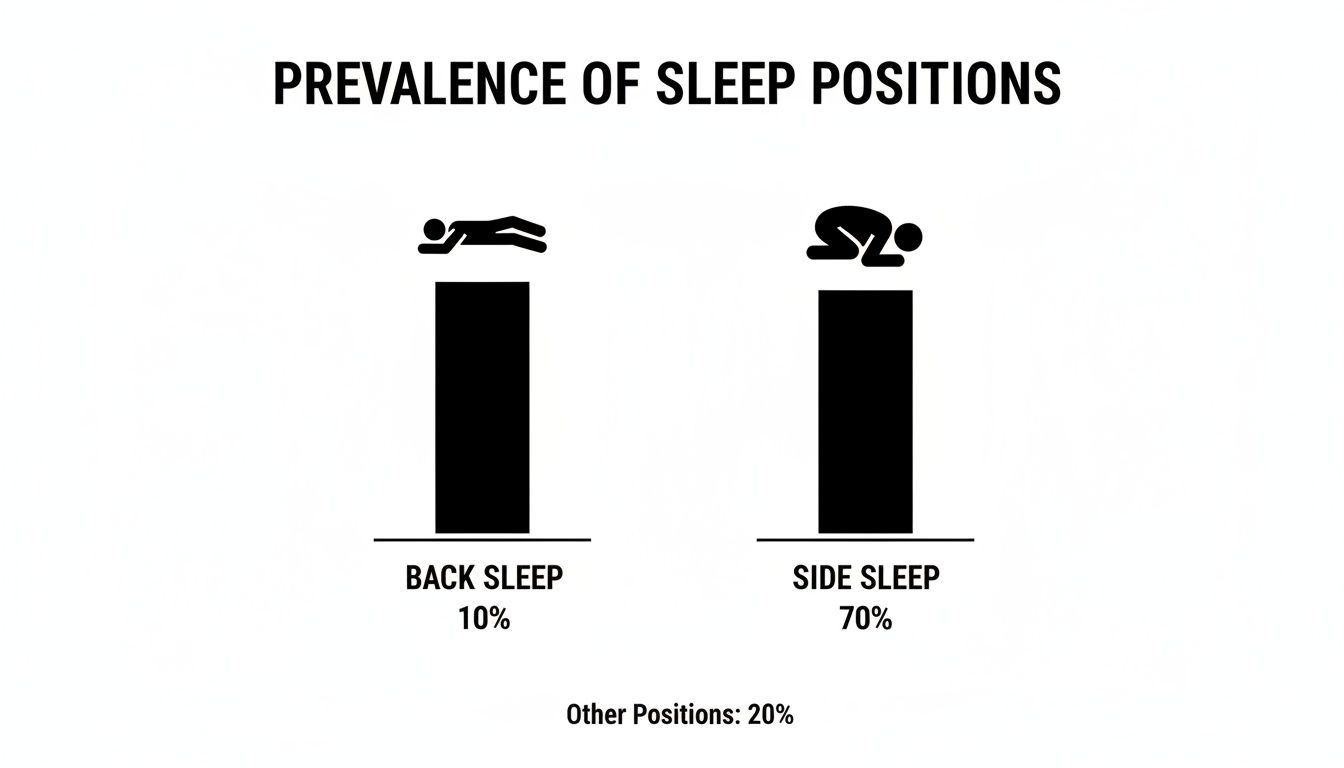
As the infographic illustrates, side sleeping concentrates a tremendous amount of force on the shoulder joint. A pressure-relieving mattress is not a luxury; it is a necessity for restorative sleep.
Why Zoned Support Is a Game-Changer for Side Sleepers
For those who spend most of the night on their side, a mattress with zoned support is the key to waking up pain-free. This intelligent design provides softer, more forgiving layers specifically in the shoulder and hip areas, allowing them to sink in just enough to relieve pressure. Meanwhile, firmer support under the torso and lower back maintains perfect spinal alignment.
An incredible 28% of the global workforce contends with shoulder pain that worsens at night. In our Carlsbad mattress studio, our pressure mapping data consistently shows that side sleepers often require two to three inches of zoned, responsive material to offload the shoulder joint by as much as 65%. These findings align with broader research indicating that such systems can improve overall sleep quality scores by 40%.
We explore this topic further in our guide to the best mattress for side sleepers with shoulder pain.
A mattress is not just a cushion; it is a high-performance tool for nightly recovery. Its ability to manage pressure and maintain spinal alignment is the single most important factor in preventing sleep-related shoulder pain.
Ultimately, the ideal mattress is one that disappears beneath you, managing your weight so perfectly that your muscles can finally relax and your joints can decompress and heal. That level of personalized support is the hallmark of a truly exceptional sleep system.
Choosing the Right Pillow for Shoulder Alignment
You can invest in the world's finest mattress, but if you pair it with the wrong pillow, you have undermined your entire effort. A pillow is not a mere accessory; it is the second half of your sleep system, solely responsible for keeping your head, neck, and shoulders in proper alignment.
When a pillow’s height, or loft, is incorrect, it forces your neck into an unnatural angle. This creates a chain reaction of strain that travels directly down into your shoulder joint, tensing the very muscles that need to relax and heal overnight. The goal is to achieve a neutral spine, where your head aligns perfectly with your backbone as if you were standing with perfect posture.
Matching Pillow Loft to Your Sleep Position
Finding the correct pillow loft is determined almost entirely by your primary sleep position and mattress firmness.
To check your alignment, have someone take a photo of you from behind while you are lying in your normal side-sleeping position. Is your head tilting up or down? If it is not perfectly straight, your pillow is the wrong height.
Side Sleepers: You require a firmer, higher-loft pillow to perfectly fill the gap between your ear and the mattress, keeping your neck straight.
Back Sleepers: A medium-loft pillow is typically the ideal choice, supporting the natural curve of your neck without pushing your head too far forward.
Stomach Sleepers: This position is notoriously hard on the neck and shoulders. If you cannot change, use the thinnest, softest pillow available—or no pillow at all.
This quick reference table can help you visualize your goal.
Pillow Loft Guide for Shoulder Alignment
Sleep Position | Ideal Pillow Loft | How It Helps Your Shoulder |
|---|---|---|
Side Sleeper | High Loft (Firm) | Fills the space between the ear and mattress, preventing the head from dropping and straining the shoulder underneath. |
Back Sleeper | Medium Loft (Medium) | Supports the natural curve of the neck, keeping the head aligned with the spine and preventing forward head posture. |
Stomach Sleeper | Low Loft (Soft/Thin) | Minimizes the upward angle of the head and neck, reducing the twist and strain that can radiate to the shoulders. |
Combination Sleeper | Medium Loft (Adaptable) | Offers a versatile height that works for both back and side positions, often with zoned support or scrunchable fill. |
Matching your pillow to your sleep style is the fastest way to take direct pressure off the shoulder joint. For a more detailed breakdown, explore our guide on finding the best pillow for shoulder pain, a Carlsbad guide to restorative sleep. You may also find this external guide on how to choose the perfect pillow useful.
Beyond the Pillow: The Role of an Adjustable Base
For the ultimate in pressure relief, an adjustable base elevates your entire sleep system. By slightly raising your upper body, you can shift your body weight completely off the shoulder joint, providing a level of customized comfort a flat foundation cannot match.
Research shows 67 million Americans have their sleep disrupted by nightly shoulder pain. For the 55% of adults who are side sleepers, the pressure on their shoulder can increase by 70% on an unsupportive bed. An NIH-funded trial confirmed that adjustable bases can relieve this specific pressure by 62% with just a gentle elevation.
A professional pillow fitting, like those offered in our Carlsbad showroom, removes the guesswork. We ensure your pillow and mattress work in perfect harmony to cradle your body and provide genuine relief.
Simple Pre-Bed Stretches for Shoulder Relief
A truly restorative night's sleep does not begin when you turn off the lights; it starts with how you wind down. Just as reading a book can calm the mind, a few gentle movements can prepare your body for rest, making a significant difference in overnight shoulder pain.
These are not intense exercises. This is about quietly releasing the tension that has accumulated throughout the day—especially for our active clients in Carlsbad and Rancho Santa Fe.
Gentle Movements to Release Tension
Before getting under the covers, set aside five minutes for a couple of simple, targeted stretches designed to boost blood flow and gently loosen the tight muscles around the shoulder joint.
Here are two highly effective recommendations:
Pendulum Swings: Stand, lean forward slightly, and let your affected arm hang straight down. Gently swing the arm in small circles, first clockwise, then counter-clockwise. You are using gravity to create space within the joint without actively engaging your muscles.
Cross-Body Stretch: Bring your affected arm across your chest. Use your other arm to gently pull it closer to your body until you feel a light stretch across the back of the shoulder. Hold for 15-20 seconds while breathing deeply. If you feel any sharp pain, ease off immediately.
These simple movements signal to your body that the day's stress is over and it is time for rest and recovery.
Pre-Sleep Habits for Added Comfort
Beyond stretching, a few small adjustments to your evening routine can have a profound impact.
First, consider applying a warm compress or taking a warm shower before bed. The warmth helps relax tight shoulder muscles, making it easier to find a pain-free position. It is a simple act of self-care that soothes soreness and calms the nervous system.
It is also critical to be mindful of your posture just before you try to sleep. Many of us scroll through our phones in bed, propped up on an elbow or with a shoulder in an awkward, twisted position. This can create fresh tension just as you are trying to rest.
Instead, cultivate a sleep sanctuary. Make your bed a place for sleep, and only sleep. This discipline helps prevent the unconscious strain that leads to nighttime pain, ensuring your shoulder is in a neutral, relaxed state when it is finally time to close your eyes.
Personalized Solutions for Lasting Shoulder Pain Relief
You have adjusted your sleep position, tried different pillows, and incorporated nightly stretches, but the nagging shoulder pain persists.
If this describes your experience, your body is sending a clear message: a generic approach is insufficient. When foundational steps do not bring relief, it is time to consider a more precise, data-driven solution. Lasting comfort is not found in a one-size-fits-all box; it is discovered through a personalized fitting that understands your unique body.
When to Seek Expert Guidance
Knowing when to seek professional help is essential. Consider a professional sleep consultation if you are experiencing any of the following:
The pain persists despite several weeks of adjustments.
You are waking up with numbness or a "pins-and-needles" sensation in your arm or hand.
Discomfort causes you to toss and turn all night.
You rely on pain medication to get through the night.
These symptoms indicate a fundamental mismatch between your body and your sleep system—a problem that guesswork and online reviews cannot solve.
The Power of a Professional Fitting
Attempting to fix shoulder pain without understanding your body's specific pressure points is like solving a puzzle with missing pieces. A professional fitting changes the dynamic entirely, moving from hope to certainty.
Tossing and turning from shoulder pain is a reality for about 20% of adults worldwide who report chronic shoulder discomfort. In our Carlsbad studio, we use advanced pressure mapping to pinpoint these exact pressure zones, allowing us to design systems with organic latex and wool that cradle the shoulders and align the spine. Find more insights on the global mattress market.
A Certified Sleep Coach uses this data to assemble a complete sleep system. This includes selecting a mattress with the right zoned support, finding the perfect pillow to keep your neck neutral, and sometimes integrating an adjustable base to eliminate pressure entirely. For those serious about ending their shoulder pain, understanding how the best adjustable bed base can be a vital component of a personalized sleep system can be a turning point.
This concierge approach removes all uncertainty from the process. Instead of hoping a new mattress will work, you are guided to a solution scientifically proven to fit your body. It is the definitive next step for anyone in North County San Diego who is ready to invest in truly restorative, pain-free sleep.
At Golden Dreams Mattress in Carlsbad, every guest enjoys a private concierge fitting with a Certified Sleep Coach. Book a free 20-minute virtual sleep consultation with a Certified Sleep Coach.

Comments