How to Stop Tossing and Turning at Night for Deeper Sleep
If you find yourself constantly shifting positions throughout the night, your body is sending a clear signal: something is preventing the deep, restorative sleep you need. The cause is almost always rooted in an unsupportive sleep system creating pressure points, a bedroom that’s too warm, or daily habits that disrupt your natural sleep cycle.
Addressing these core issues—beginning with your mattress, pillow, and sleep environment—is the most direct path to achieving the still, peaceful rest your body craves.
Why You Keep Tossing and Turning at Night

Constant repositioning is more than a minor annoyance; it’s a protective mechanism. Your body is instinctively trying to relieve discomfort, regulate its temperature, or quiet an active mind. Each turn is a small interruption, pulling you away from the deeper, more restorative stages of sleep.
In our private mattress showroom in Carlsbad, we have assisted countless clients from across North County San Diego—from Encinitas to Rancho Santa Fe—who share this same frustration. They feel the exhausting effects of restless nights and understand that a change is necessary.
The Core Causes of Restlessness
Understanding the "why" is the first step toward finding an effective solution. While many factors can contribute to a restless night, the issue almost always stems from one of these three areas:
Physical Discomfort: This is the most common culprit. A mattress ill-suited to your body creates pressure on your hips and shoulders, forcing you to move to find relief. The same holds true for a pillow that fails to properly support the delicate curvature of your neck.
Environmental Disruptions: Your bedroom plays a significant role. A room that is too hot, too bright, or too noisy can easily fragment your sleep and trigger movement. Overheating, in particular, is a major driver of tossing and turning.
Lifestyle and Mental Factors: Your daily activities directly impact your nightly rest. Late-afternoon caffeine, stress from a demanding career, or screen time before bed can leave your nervous system overstimulated, making it nearly impossible to settle into stillness.
A Widespread Challenge
If this experience sounds familiar, you are certainly not alone. A recent report from the National Sleep Foundation highlights a significant trend. The 2025 Sleep in America® Poll found that nearly 70% of adults struggle to stay asleep at least three nights a week, leading to frequent awakenings.
Half of all adults surveyed received a failing grade for their overall sleep satisfaction, which underscores how profoundly disrupted sleep can impact daily life.
At its core, tossing and turning is your body's unconscious search for comfort, alignment, and tranquility—three qualities your sleep system should provide effortlessly.
This guide will move beyond generic advice to help you pinpoint the specific causes of your restless nights. We'll explore how your mattress, environment, and daily routines work in concert. For a deeper dive into foundational habits, you might also find our guide on how to improve sleep quality naturally beneficial.
By understanding these connections, you can begin making targeted changes that lead to the still, peaceful sleep you deserve.
Curating Your Bedroom for Uninterrupted Rest
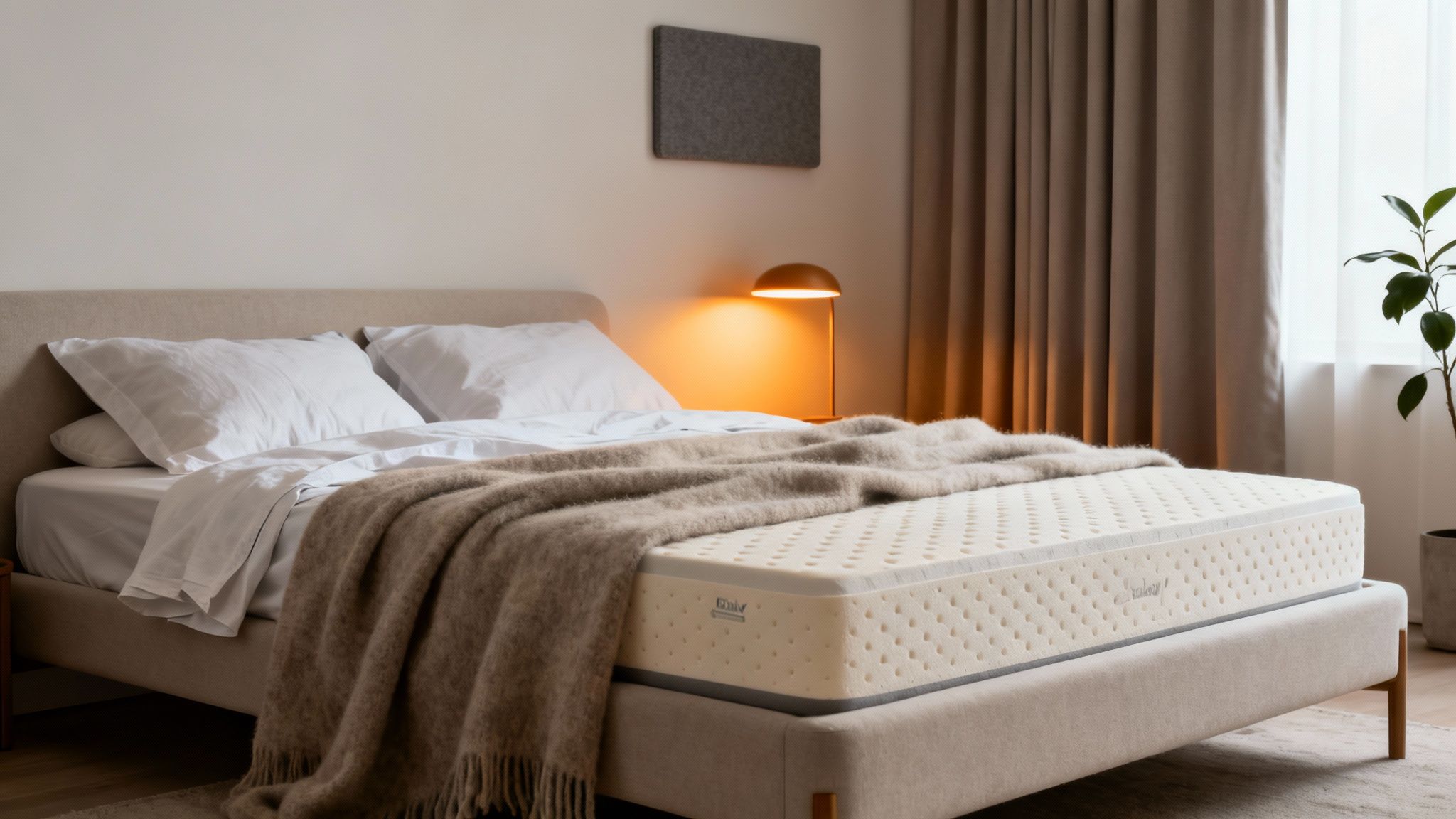
Your bedroom should be a sanctuary—a space intentionally designed for deep rest, not one that subtly works against you. To stop tossing and turning, we must look beyond the mattress and address the entire environment. A truly restorative space calms the nervous system and signals to your body that it is time to be still.
This involves attending to details that often go overlooked, from the color temperature of your lighting to the ambient sounds of your room. Every element either contributes to or detracts from your ability to rest.
Mastering Light for Deeper Sleep
Your brain's internal clock is incredibly sensitive to light. The wrong type of light in the evening can suppress your production of melatonin—the essential sleep hormone—and keep your mind active long after you’ve turned in.
Creating absolute darkness is non-negotiable. Even small amounts of light from a streetlamp, a clock radio, or an adjacent hallway can fragment your sleep, causing you to shift positions without full awareness.
Warm Your Lighting: In the hour before bed, avoid bright, blue-toned overhead lights. Switch to softer, warmer lamps with a light temperature around 2700K, which mimics a sunset and signals to your brain that it's time to wind down.
Eliminate Ambient Light: Cover or unplug electronics with standby lights. A tiny blinking LED is surprisingly disruptive.
Invest in Darkness: A pitch-black room is essential for deep sleep. For residents of Carlsbad and other coastal communities where ambient light is common, quality window treatments are key. Explore this ultimate guide to finding the best blackout curtains to ensure your sanctuary remains completely dark.
Achieving Thermal Neutrality
One of the most frequent reasons people toss and turn is straightforward: they are too hot. As you fall asleep, your body's core temperature naturally drops. If your mattress or bedding traps heat, your body must work—and move—to cool itself.
The objective is thermal neutrality, a state where your environment allows your body to maintain its ideal sleep temperature without effort.
This is about more than setting the thermostat. It involves creating a microclimate around your body that breathes, wicks away moisture, and prevents the temperature spikes that cause you to kick off the covers.
Here, the materials in your sleep system demonstrate their value. Mass-market memory foams are notorious for trapping heat. Natural materials, by contrast, excel at temperature regulation. A mattress constructed with breathable Talalay latex, wool, and organic cotton creates a sleep surface that remains cool and dry all night, significantly reducing restlessness. We explore this further in our guide to the best temperature for sleeping at night.
Cultivating a Quiet Space
Noise is another major trigger for unconscious movement. The low hum of an appliance, distant traffic, or an air conditioner cycling on can be just enough to pull you into a lighter stage of sleep.
The impact of these disruptions is well-documented. A recent study reveals our sensitivity to our surroundings. Travelers, for instance, report 63% worse sleep quality when away from home, with 75% blaming noise and 72% blaming lighting for their restlessness. This serves as a powerful reminder of how critical a controlled, quiet sleep environment is.
To combat this, consider introducing a consistent, gentle sound to mask abrupt noises. A white noise machine or a quiet fan can create a stable auditory backdrop, helping your brain ignore minor disturbances that would otherwise cause you to toss and turn.
Building Your Foundation for Stillness
When clients visit our Carlsbad showroom to solve their restlessness, they often believe they need a new mattress. In truth, they need a complete “sleep system.”
This distinction is crucial. A sleep system is a thoughtfully matched set of components—the mattress, pillow, and base—all working in harmony to deliver the precise support and comfort your body requires for truly still, motionless sleep.
This is where exceptional craftsmanship and superior materials stop tossing and turning at the source. A well-designed system provides consistent, pressure-free support all night long, so your body never has to shift in search of a more comfortable position.
The Two-Sided Mattress: A Commitment to Durability
In the pursuit of cost reduction, the modern mattress industry has largely abandoned one of the most vital features for longevity: the two-sided, flippable design. This shift represents a significant compromise in quality.
A one-sided mattress experiences wear in the same areas night after night, leading to premature sagging and permanent body impressions that disrupt spinal alignment and create painful pressure points.
A two-sided mattress, however, is an investment in consistent performance.
Even Wear: Flipping and rotating your mattress every few months allows the materials to recover and wear evenly, dramatically extending its comfort life.
Consistent Support: It prevents the permanent dips that cause you to roll toward the middle or feel pressure on your hips and shoulders.
Artisanal Craftsmanship: Two-sided construction is a hallmark of a high-quality, handcrafted bed. It signifies a commitment to durability over disposability.
This enduring support is the foundation for ending your nightly struggle, ensuring the surface you sleep on years from now feels just as supportive as it does today.
Hand-Tufting: The Secret to Unwavering Support
Another detail that distinguishes true luxury from mass-market products is hand-tufting. This time-honored technique involves an artisan passing thick ribbons through the entire mattress—from top to bottom—and securing them tightly. It is far more than a decorative touch.
Hand-tufting locks all internal layers of natural latex, wool, and cotton together, preventing them from shifting or bunching over time. It also pre-compresses the materials, ensuring the mattress maintains its intended feel and support for years.
This process eliminates the weak points created by glues used in most conventional mattresses, which can break down and create an uneven, unsupportive surface.
A hand-tufted mattress provides true edge-to-edge consistency. Every square inch of the surface delivers the support your body needs, eliminating the weak spots that trigger restless repositioning.
The Critical Role of Your Pillow and Base
Your mattress cannot perform its job in isolation. A complete sleep system recognizes that your head, neck, and overall posture are equally important for achieving stillness.
A Personalized Pillow FittingThe pillow is arguably the most overlooked component of proper sleep. If your pillow has the wrong height or firmness for your sleep style, the muscles in your neck and shoulders are forced to work all night, leading to constant micro-adjustments.
For side sleepers, an improper pillow can throw the entire spine out of alignment, exacerbating hip and shoulder pain. A professional pillow fitting in Carlsbad at our showroom ensures your head rests in a perfectly neutral position, which instantly relieves strain.
The Non-Negotiable BaseThe base is the literal foundation of your sleep. Placing a premium mattress on a weak or sagging box spring completely undermines its ability to support you.
A high-quality foundation provides a solid, flat surface that allows the mattress to perform as designed. For an even greater impact, an adjustable base allows you to find positions of near-weightless comfort—such as elevating your legs to relieve lower back pressure or slightly raising your head to open airways. Proper support from the base is essential, and our guide on finding the best mattress for spinal alignment explores this relationship in detail.
Your mattress is the core of your sleep, and this helpful guide on choosing a new mattress for better sleep offers a great overview of what to look for. But the materials inside that mattress are what truly make the difference.
Luxury Materials vs. Mass-Market Components
The table below illustrates why the materials in your sleep system have such a profound impact on restlessness.
Feature | Artisanal Sleep System (e.g., Natural Latex & Wool) | Mass-Market Mattress (e.g., Memory Foam & Synthetics) |
|---|---|---|
Pressure Relief | Responds instantly, offering buoyant support without a "sinking" sensation. | Slow response time can create a feeling of being "stuck" and traps body heat. |
Breathability | Excellent. Natural fibers actively wick away moisture and allow air to circulate freely. | Poor. Synthetic foams often trap heat, causing overheating and discomfort. |
Durability | High resilience. Naturally resists body impressions and sagging for many years. | Prone to developing permanent body impressions and losing support quickly. |
Motion Isolation | Superior, especially with pocketed coils and dense natural latex. | Generally good initially, but degrades significantly as the foam breaks down. |
Ultimately, choosing artisanal materials like natural latex and wool is not merely about luxury—it's about creating a sleep environment that is breathable, responsive, and durable enough to keep you comfortable and still all night.
Your Daily Habits Are Your Best Sleep Aid
A peaceful night's sleep is not something that simply happens; it is cultivated during the day. As sleep coaches, we observe a consistent pattern: even the finest mattress cannot calm a body that is not prepared for rest. Your daily routines are powerful tools that signal to your body when it is time to power down.
This is not about a radical lifestyle overhaul. It is about making small, intelligent adjustments to how you manage light, what you consume, and how you wind down. These simple shifts prepare your body for a night of deep, motionless sleep.
Get in Sync with Your Body Clock
Your body operates on an internal 24-hour clock known as the circadian rhythm. This rhythm governs your sleep-wake cycle and is highly sensitive to environmental cues—especially light. Working with this natural cycle, not against it, is one of the most effective ways to stop tossing and turning.
Consistency is paramount. Going to bed and waking up around the same time every day, including weekends, is the bedrock of a stable rhythm. When your body knows what to expect, it anticipates sleep, helping you drift off faster and stay asleep longer.
Morning sunlight is a powerful ally. A short walk in Carlsbad or enjoying your coffee on the patio sends a strong "wake up" signal to your brain. This simple act helps lock in your cycle, making your body far more receptive to sleep cues that evening.
The Truth About Caffeine and Alcohol
We understand. A morning coffee is a ritual for many, and a glass of wine can feel like the perfect way to unwind. While both have their place, their timing and quantity can disrupt your sleep architecture, leaving you wrestling with your bedding all night.
Caffeine has a surprisingly long half-life. A 3 p.m. espresso can easily remain in your system at 10 p.m. We advise our clients to set a firm cutoff at 2 p.m. for any caffeinated beverages. This allows your body ample time to fully metabolize it before bed.
Alcohol is more deceptive. It may induce drowsiness and help you fall asleep quickly, but it fragments the quality of your sleep later on. As your body processes the alcohol, it triggers a rebound effect, often causing you to wake up or shift restlessly in the second half of the night.
Create an Evening "Buffer Zone"
In our demanding world, we often attempt to transition abruptly from a stressful day to sleep. This approach rarely works. Your brain and body require a gentle off-ramp to decompress—what we call an evening "buffer zone."
This is a dedicated hour or so before bed where you intentionally switch to calming, low-stimulus activities. It is a personal ritual that signals the day is officially over.
Go dim. Lower the lights in your home to a soft, warm glow.
Log off. Set aside the work laptop and stop checking emails.
Get quiet. Read a physical book, listen to calming music, or perform a few gentle stretches.
This buffer zone helps lower cortisol (the stress hormone) and allows your brain to shift from high alert to a state of calm.
The goal isn't just to be tired; it's to be calm. A brain that is tired but wired is a perfect recipe for a night spent tossing and turning.
Stop the Blue Light Sabotage
One of the greatest modern sleep disruptors is the device in your hand. The blue light emitted from phones, tablets, and TVs directly suppresses the production of melatonin, the hormone that signals sleep.
Scrolling before bed keeps your mind engaged when it should be winding down. A global study found people are spending an extra 40 minutes on their phones before bed, directly displacing restorative sleep and increasing restless movements. You can explore the data in the 2025 IKEA Sleep Report.
The solution is simple but powerful: put all screens away at least 60-90 minutes before you intend to be asleep. If you must use a device, activate its "night mode" or wear blue-light-blocking glasses. This one change can make a profound difference in how quickly you fall asleep and how still you remain throughout the night.
The Concierge Approach to Finding Perfect Sleep
Investing in your sleep is one of the most important health decisions you will ever make. It is a direct investment in your energy, mental clarity, and overall well-being.
However, the conventional mattress buying process—wandering through a brightly lit, overwhelming showroom—is based on guesswork and sales pressure. That approach is simply not sufficient.
To stop tossing and turning for good, you need a solution built around your unique physiology and sleep challenges, not a one-size-fits-all product. This is precisely why a personalized, expert-guided fitting is so crucial. It is an educational, collaborative process designed to find a lasting solution.
Beyond the Showroom: A Private Consultation
Imagine an experience where the goal is not merely to sell you a mattress, but to genuinely solve your sleep problem. That is the essence of a private fitting with a Certified Sleep Coach. We work by appointment only, which guarantees the time and space are dedicated entirely to you, without distraction.
The process begins with a conversation, not a sales pitch. We start with a detailed health and lifestyle intake to understand your specific challenges.
Are you a side sleeper struggling with persistent hip pain?
Does your partner's every movement disturb your sleep?
Do you wake up feeling stiff and sore despite a full night's rest?
Clarifying these details provides the blueprint for your ideal sleep system. It allows us to move beyond generic advice and focus on the precise support and comfort your body requires.
Using Data to Pinpoint Discomfort
Words can only convey part of the story. To truly understand why you are shifting all night, we need to see what is happening when you lie down. This is where a diagnostic tool like pressure mapping becomes transformative.
Pressure mapping technology uses a sensor-filled mat to create a live, color-coded image of how your body interacts with a mattress. This map instantly reveals "hotspots"—areas of high pressure, typically at the shoulders and hips, that can restrict circulation and trigger your body’s instinct to move.
Viewing a visual of your own pressure points is often an enlightening moment for our clients. It shows exactly where a mattress is failing you and, more importantly, allows us to demonstrate in real-time how the right surface makes those hotspots disappear. It is a data-driven process that removes the guesswork from finding comfort.
The Art of the Perfect Pillow Fitting
A mattress is only half the solution. If your head and neck are out of alignment, your body will never fully relax. A professional pillow fitting is a critical, and often overlooked, step toward ending restless nights.
The goal is simple: find a pillow with the perfect loft (height) and material to keep your spine in a neutral, straight line.
For a side sleeper, the pillow must fill the space between your ear and the edge of your shoulder. For a back sleeper, it should support your neck's natural curve without pushing your chin to your chest. The difference is immediate.
During a fitting, we will have you test various pillow options—from natural latex to wool—to pair perfectly with your sleep position and chosen mattress. Getting this right can instantly relieve the neck strain that affects so many professionals in Encinitas and Rancho Santa Fe who spend hours at a desk.
This infographic breaks down a simple daily routine to prepare your body for this kind of deep, restorative rest.
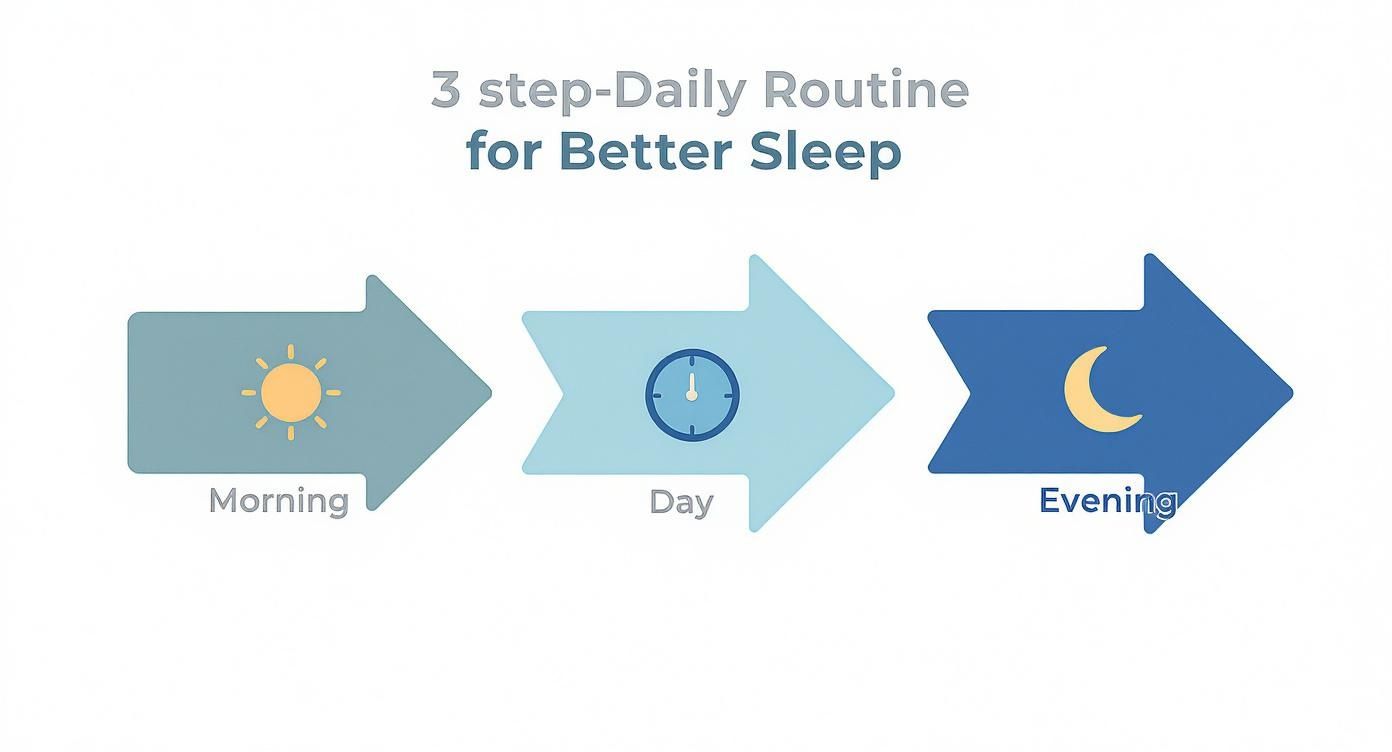
As you can see, quiet nights are often the result of intelligent habits during the day, from getting morning light to establishing a calming wind-down routine. When you combine a truly supportive sleep system with these daily practices, you create the ideal conditions for motionless, restorative sleep.
Common Questions We Hear in the Showroom
From our private showroom in Carlsbad, we have the privilege of speaking with people from all over North County San Diego about what is genuinely keeping them up at night. After hundreds of these conversations, certain questions about restless sleep arise repeatedly. Here are the direct answers from our Certified Sleep Coaches.
How Long Does It Actually Take to Get Used to a New Luxury Mattress?
The adjustment is not always instantaneous, and that is a positive sign. Acclimating to a new, properly supportive mattress can take anywhere from a few nights to a few weeks. A high-quality bed made with natural materials like latex or wool feels entirely different from a mass-produced memory foam mattress.
Your body may have been compensating for poor alignment for years. It needs time to unlearn those habits and relax into a new, healthier posture. We encourage our clients to allow at least 30 nights to fully acclimate. During that time, your muscles and spine are recalibrating—a sign the mattress is finally doing its job correctly.
Can an Adjustable Base Really Stop Tossing and Turning?
Absolutely. An adjustable base is not a novelty; it is a transformative tool for restless sleepers. A flat foundation simply cannot offer the same customized comfort.
By elevating your head a few degrees, you can open airways to reduce snoring or ease symptoms of acid reflux—two common causes of unconscious movement. Elevating the legs improves circulation and relieves significant pressure from the lower back, a major source of discomfort for many of our clients in La Costa. Finding that "zero gravity" position distributes your weight so evenly that the urge to move often dissipates entirely.
My Partner’s Movement Is the Real Problem. What Can I Do?
This is perhaps the number one concern we hear from couples. When one person is a light sleeper, every small movement from the other side can feel disruptive. The solution is a mattress with exceptional motion isolation.
Hand-crafted mattresses with pocketed coil systems excel at this because each spring is individually wrapped and moves independently. As a result, movement on one side of the bed does not transfer. Natural latex is another excellent choice, as it absorbs energy at the point of impact. During a private fitting, we can demonstrate how different materials absorb motion, giving you confidence in your selection.
Is a Firm Mattress the Best Way to Stop Restlessness?
This is a pervasive myth we are always happy to clarify. The ideal firmness is entirely unique to your body type, weight, and sleep position. A mattress that is too firm for a side sleeper will create painful pressure points on their shoulders and hips, forcing them to shift all night seeking comfort.
The goal isn’t “firmness.” It’s “supportive alignment.” A truly great mattress contours to your body’s natural curves while keeping your spine perfectly straight.
Conversely, a mattress that is too soft for a back or stomach sleeper allows their hips to sink, misaligning the spine and causing them to constantly reposition to relieve strain. The only way to find the right balance is with a hands-on fitting. A personalized pillow fitting in Carlsbad combined with a mattress assessment is the key to discovering the perfect level of support your body needs to finally sleep still.
At Golden Dreams Mattress in Carlsbad, every guest enjoys a private concierge fitting with a Certified Sleep Coach. Book a free 20-minute virtual sleep consultation with a Certified Sleep Coach.

I can really relate to the part about using gadgets before bed. It’s true that we often don’t realize how much it can affect the quality of our sleep. This article serves as a reminder to start making small changes to my habits. Read more https://unair.ac.id/terapkan-perilaku-sleep-hygine/