How to Reduce Back Pain While Sleeping for a Better Morning

Waking up with a sore back isn’t just a part of getting older—it’s a clear sign your sleep environment is working against you, not for you. The solution is often less complicated than you might imagine. It comes down to optimizing your sleep posture and investing in a supportive sleep system that keeps your spine properly aligned all night long.
Why Your Sleep Quality and Back Pain Are Inseparable
For high-achievers here in Carlsbad and across North County San Diego, a demanding lifestyle leaves zero room for unproductive days slowed by preventable pain. Waking with an aching back does more than disrupt your morning; it drains your focus, energy, and sense of well-being. And you are not alone.
Low back pain is a significant global issue. It affected a staggering 619 million people in 2020, with projections showing that number could climb to 843 million by 2050. There is also a direct link between how much you sleep and how much you hurt. One large-scale study found that getting less than 6.55 hours of sleep per night significantly increases the risk of low back pain. In fact, every extra hour of quality rest can slash that risk by over 13%. You can dig into the full study on sleep and pain connections here.
It’s Not Just a Mattress, It’s a Complete Sleep System
Many people believe a new mattress is the magic bullet for back pain. While the mattress is certainly the centerpiece, a truly restorative night's sleep comes from a complete sleep system—a carefully matched combination of components working in harmony to support your unique body.
Think of it like a high-performance automobile. The engine is critical, but it needs the right transmission, suspension, and tires to deliver a smooth, powerful ride. Your sleep system functions in precisely the same way.
The Mattress: This is your foundation for support and pressure relief. It must contour to your body's natural curves without letting your hips sag—a classic cause of spinal misalignment.
The Pillow: This is dedicated to aligning your head and neck with the rest of your spine. A pillow that’s too high, too low, or too flimsy can create tension that radiates directly down your back. A proper pillow fitting in our Carlsbad studio is non-negotiable for achieving this balance.
The Base: A quality foundation, especially an adjustable one, transforms your bed from a flat surface into a dynamic wellness tool. It allows you to find positions that decompress the spine and relieve pressure.
When these three pieces are correctly matched to your body and sleep style, they create an environment where your muscles can finally relax and your spine can rest in a neutral, unstrained position. That is the true goal.
Moving from Discomfort to True Recovery
If you’re waking up sore, it’s a clear signal of a mismatch between your body and your bed. Perhaps your mattress is too old, too soft, or simply the wrong design for you. The eight hours you spend in bed should be for healing and repair, not a nightly battle against an unsupportive surface.
To help you get started right away, here is a quick guide to some of the most effective strategies we recommend to our clients.
Quick Guide to Reducing Morning Back Pain
Strategy | Why It Works | Pro Tip for North County Residents |
|---|---|---|
Test Your Mattress Firmness | Prevents hips from sinking, which keeps the lumbar spine from bowing unnaturally all night. | Lie on your back and slide a hand under your lower back. You want light contact, not a huge gap (too firm) or no space at all (too soft). |
Get a Custom Pillow Fitting | A pillow with the wrong height misaligns your neck and upper back, creating tension. | The perfect pillow depends on your mattress softness. We conduct this after you find the right mattress during a private fitting in Carlsbad. |
Try a Small Base Adjustment | Elevating your head and feet slightly (Zero-G position) takes the load off your lumbar spine instantly. | Even a 5-10 degree adjustment on an adjustable base can provide significant relief for chronic low-back tension. |
Pre-Sleep Stretching | Gentle stretches like Cat-Cow or a Supine Twist release muscle tension from the day. | Perform these for just 5 minutes on the floor before getting into bed to help your muscles relax into a neutral position. |
This table is just the starting point. By understanding how proper support leads to spinal alignment and pressure relief, you can turn your nights from a source of pain into a period of genuine recovery. The next sections will walk you through exactly how to achieve it.
Finding the Right Sleep Position for Spinal Health
Your sleeping position is the foundation of a pain-free morning, but the generic advice—"just sleep on your back"—doesn't tell the whole story. The goal isn't to force yourself into an unnatural posture. It’s about optimizing the position you already find comfortable for better spinal alignment.
It's a subtle but crucial distinction.
The connection between how you sleep and how you feel is profound. Low back pain is the leading cause of disability across the globe, and a poor night's sleep feeds the cycle. Poor sleep can actually predict the severity of your pain the following day. The good news? The solution often lies in simple, elegant adjustments to how you rest.
The Side Sleeper Solution
This is the most common sleep style, and for good reason. It can be fantastic for your spine, but only if you support it correctly. The biggest challenge for side sleepers is keeping the top leg from dropping forward, which twists the pelvis and pulls the lower back out of alignment.
The fix is surprisingly simple: place a supportive pillow between your knees. This keeps your hips, pelvis, and spine beautifully aligned. The key is finding a pillow that's firm enough to prevent your knees from touching. For many of our clients, using a specialized knee pillow provides the ideal density and ergonomic shape to hold that alignment all night long.
Optimizing for Back Sleepers
Sleeping on your back is excellent for distributing body weight evenly. Still, many people find it strains their lower back. This usually happens when a gap forms between the lumbar spine and the mattress, forcing those muscles to remain tense all night to support your natural curve.
To correct this, place a small, thin pillow or a rolled towel under your knees. That slight elevation softens the curve in your lower back, allowing it to relax fully into the mattress. It’s a tiny change that delivers a huge release of tension.
A Quick Note on Pillows: Your head pillow is just as critical here. If you're a back sleeper, it should support the natural curve of your neck without pushing your head too far forward. Your chin should be level, not tucked toward your chest.
This simple graphic illustrates how proper support leads directly to better alignment.
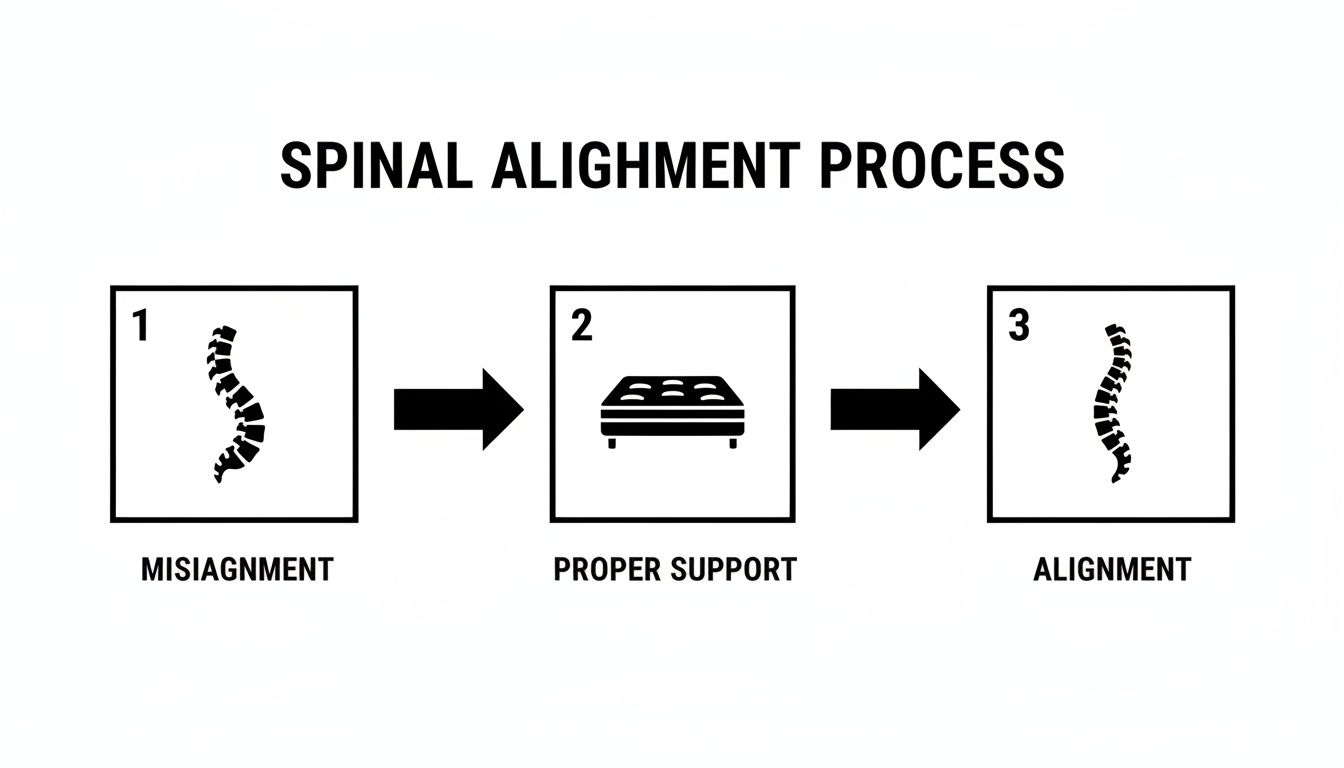
A neutral spine isn't an accident. It’s the direct result of a sleep system that correctly cradles your body's unique shape.
The Challenge of Stomach Sleeping
From a spinal health perspective, this is the most problematic position. Stomach sleeping flattens the natural curve of your lower back and forces you to turn your neck to one side for hours. This creates significant strain from your neck all the way down your spine.
We understand—changing a lifelong habit is difficult. If you are a dedicated stomach sleeper, a helpful first step is to place a thin pillow under your pelvis and lower abdomen. This can help relieve some of the pressure on your spine.
Ultimately, the goal should be to gradually transition to your side or back. Body pillows are an excellent tool for this. They give you something to lean against, mimicking the sensation of sleeping on your stomach while keeping you in a much healthier side position.
We have a whole guide with more tips on this, and you can learn more about how to align your spine while sleeping in our article. Finding what works for you is a personal journey, but these biomechanical principles provide a clear roadmap. Proper support transforms your sleep from a potential source of pain into a powerful period of recovery.
The Craftsmanship of a Supportive Luxury Mattress
True luxury in a mattress isn't about a high price tag or slick marketing. It's about the quality of the materials, the intelligence of the design, and the skill of the hands that built it. For our clients in Carlsbad and Rancho Santa Fe looking to finally alleviate back pain, understanding this craftsmanship is the first step toward lasting relief.
A well-made mattress is an investment in your well-being, designed to provide uncompromising support for years, not just a few months until the foam gives out.
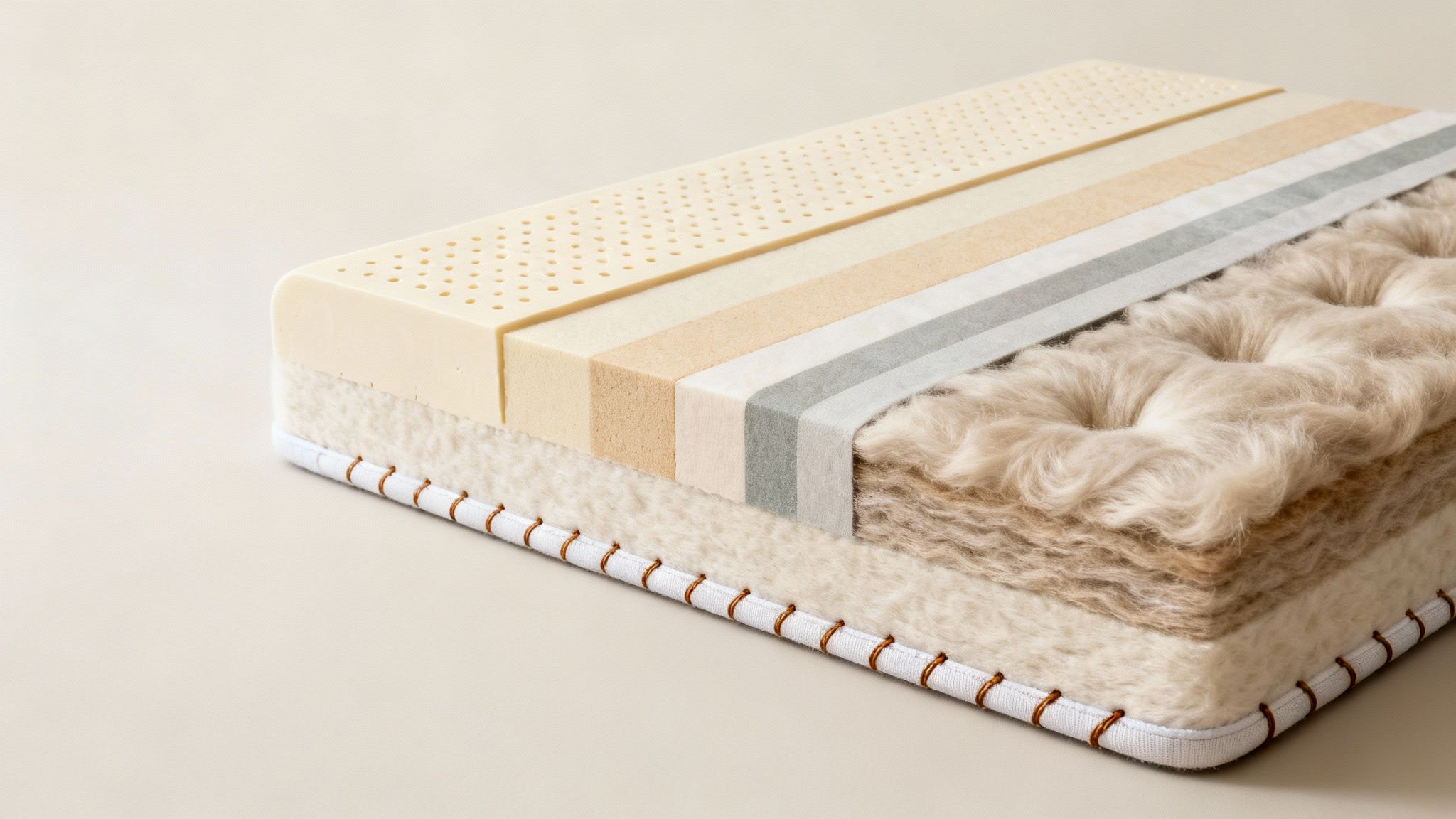
When we talk about support, we mean the mattress’s ability to hold your spine in a neutral, natural line, regardless of your sleep position. This is where the difference between a mass-produced bed-in-a-box and an artisan-built mattress becomes crystal clear.
Beyond the Foam Box: The Importance of Natural Materials
Many modern mattresses rely on petrochemical foams. These materials trap heat and, frankly, lose their supportive ability far too quickly. A genuinely premium mattress, by contrast, is built with superior, natural components chosen for their performance and durability.
Natural Latex: Sourced from the sap of rubber trees, natural latex offers a unique combination of gentle contouring and buoyant support. Unlike memory foam that can create a "stuck" feeling, latex responds instantly as you move, keeping your spine aligned. Its open-cell structure also allows air to flow freely, a crucial benefit for anyone who sleeps warm.
GOTS-Certified Wool: This is nature's performance fiber. It acts as a microclimate controller, wicking away moisture to keep you cool in the summer and warm in the winter. It’s also a natural fire barrier, eliminating the need for the chemical sprays found in most mainstream beds.
These materials aren’t just filler; they are the foundation of a sleep surface that actively contributes to your spinal health.
The Art of Hand-Tufting and Two-Sided Design
One of the easiest ways to identify a meticulously crafted mattress is hand-tufting. This is a time-honored technique where artisans pass thick ribbons completely through the mattress—from top to bottom—and secure them with ties.
This does more than create a classic look. It locks all the internal layers of wool, cotton, and latex in place, preventing them from shifting or bunching over time. The result is consistent support across the entire bed for its full lifespan. In contrast, most one-sided mattresses are merely glued together, a primary reason they begin sagging and developing body impressions so quickly.
Furthermore, a true luxury mattress is almost always two-sided and flippable. This was once the standard, but mass-market brands abandoned it to cut costs. Being able to regularly flip and rotate your mattress effectively doubles its lifespan, ensuring it wears evenly and continues to provide the support your back requires.
A two-sided, hand-tufted mattress isn't just a product; it's a piece of functional furniture designed for longevity. It represents a commitment to enduring quality over disposable convenience.
Intelligent Support Where You Need It Most
Even with the finest materials, a mattress must be engineered for the human body's shape. This is where a zoned support system becomes non-negotiable for anyone with back pain.
Our bodies are not weighted evenly—most of the load is in our hips and shoulders. A zoned coil system is designed with this in mind. It uses firmer coils in the center third of the mattress to support the heavier lumbar area and prevent your hips from sinking. Simultaneously, it offers more forgiving support at the shoulders, allowing side sleepers to sink in just enough to keep their spine perfectly straight. This targeted approach is fundamental for solving chronic back or hip pain.
While this gives you a good foundation, we've gone even deeper on this topic. You can learn more by reading our guide to the best mattress for back pain and the marketing myths to avoid.
Ultimately, the right mattress provides a foundation that allows your muscles to completely relax and recover overnight. It’s not about finding something "firm" or "soft," but finding something intelligently built to align you. This level of craftsmanship is what truly separates waking up sore from waking up restored.
Your Pillow and Base: The Two Most Overlooked Back Pain Fixes
A great mattress is the hero of your sleep story, but it cannot perform its job alone. If your neck is kinked or your lower back is strained, even the world's best mattress won't prevent morning aches. That’s where the supporting cast comes in: your pillow and your base.
Getting these two elements right is often the final piece of the puzzle for solving stubborn back pain.
Your Pillow Is a Precision Tool, Not an Afterthought
Consider this: your pillow is responsible for supporting your head and neck, which connects directly to the rest of your spine. If it’s the wrong height or firmness, it forces your neck into an unnatural angle all night, sending tension radiating down your back.
Many people in Encinitas and La Costa play a frustrating guessing game, cycling through pillows that feel good for five minutes but lead to a stiff neck by morning. The secret isn't finding a "good" pillow; it's finding the right pillow for you.
A professional pillow fitting in our Carlsbad studio is a game-changer. A Certified Sleep Coach doesn't guess—we measure. We analyze:
Your Go-To Sleep Position: Side sleepers need a thicker, firmer pillow to fill the gap between their ear and the mattress. Back sleepers need a lower-profile pillow that cradles the neck’s natural curve without pushing the chin forward.
Shoulder Width: This is critical for side sleepers. Broader shoulders require a higher loft to keep your head from drooping and twisting your spine.
Mattress Firmness: How much you sink into your mattress directly affects the pillow height you need. A plush mattress requires a thinner pillow than a firm one.
A quick pillow fitting can make a world of difference. For those who need extra support to keep their hips and spine aligned, it's also worth exploring the significant benefits of body pillows.
A proper pillow fitting isn’t a luxury; it’s a necessity. It ensures the top of your spine is as perfectly aligned as the bottom, creating a seamless line of support from head to toe.
Stop Thinking of an Adjustable Base as a Gadget—It's a Wellness Tool
Adjustable bases were once viewed as purely for medical needs. Not anymore. Today, they are one of the most powerful tools we have for actively managing back pain and improving sleep quality.
An adjustable base turns your flat, static bed into a dynamic sleep surface you can customize for instant relief. Just a few degrees of elevation can completely change how pressure is distributed across your body.
Find Your Angle: Zero-Gravity and Beyond
The most famous setting is the zero-gravity position, which elevates your head and legs slightly above your heart. The feeling is one of near-weightlessness, and for people with lower back pain, it’s a revelation. This gentle posture decompresses the lumbar spine, taking the load off tired, tense muscles.
You don’t have to go full zero-G to feel the benefits. Small, targeted adjustments can provide incredible relief:
Raise the head slightly to open airways, which can help with snoring and acid reflux.
Lift the legs just a few inches to ease pressure on the lower back and improve circulation.
For residents in Rancho Santa Fe dealing with specific conditions like spinal stenosis, the ability to dial in the perfect angle of comfort is something a flat foundation could never provide. If you want to dive deeper into how this works, our guide on finding the best adjustable base for back pain breaks it all down.
Ultimately, investing in a complete system—the right mattress, a professionally fitted pillow, and a versatile adjustable base—is the most direct path to breaking the cycle of back pain. It’s a holistic approach that guarantees every inch of your body is properly supported, so you can finally achieve the restorative sleep you deserve.
A Simple Pre-Sleep Routine to Ease Back Tension
A pain-free morning begins the night before. While the right mattress and pillow are your foundation, a few minutes of intentional self-care before bed can make a world of difference. Think of it as releasing the tension your body collected during the day, preparing your muscles for truly restorative rest.
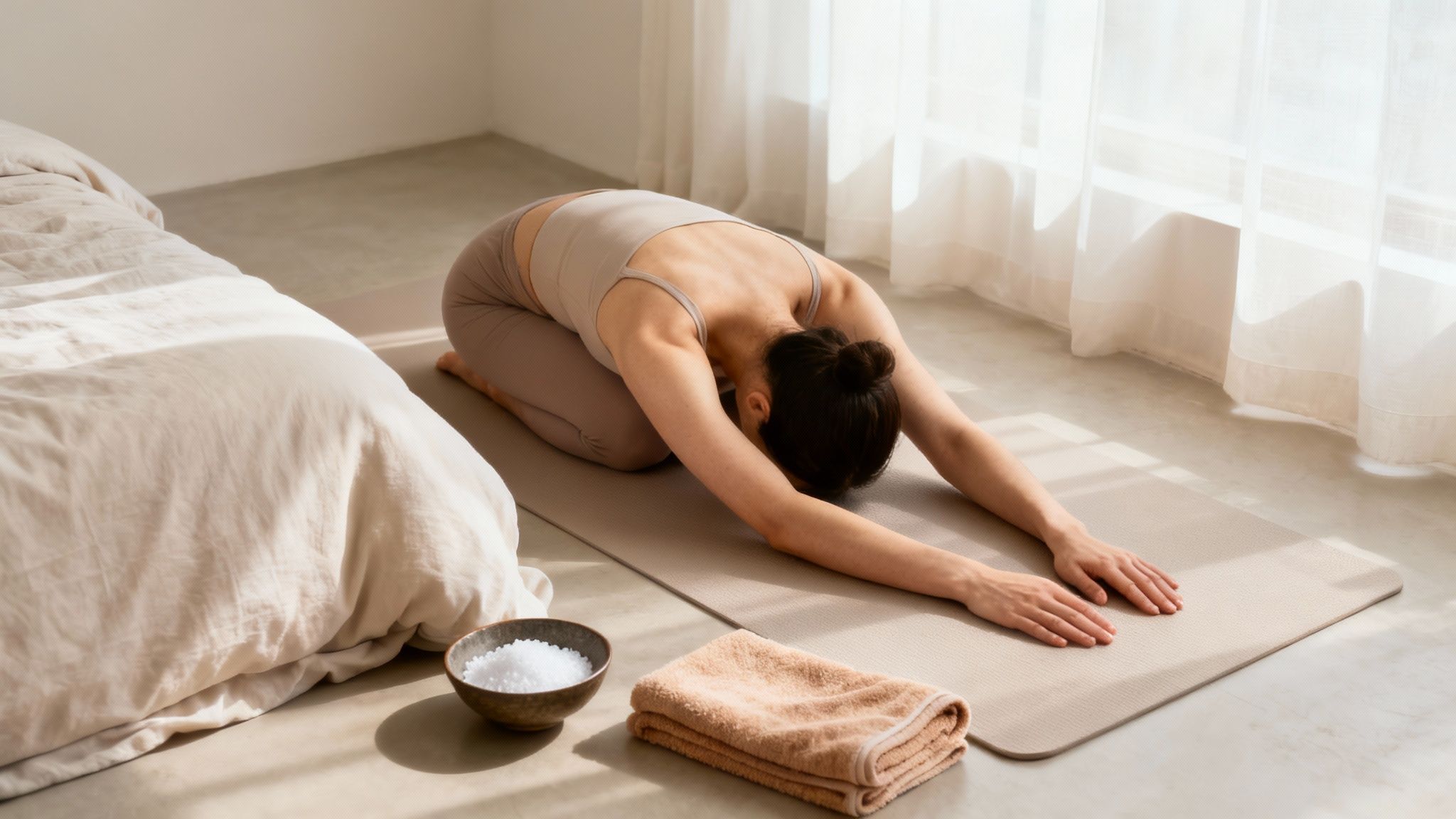
Taking this step is more important than ever. Low back pain has become a significant global issue, with an estimated 619 million cases worldwide in 2020, according to the Institute for Health Metrics and Evaluation. Here in North America, factors like long hours spent sitting and rising obesity rates only add to the strain.
The good news is that sleep itself is a powerful tool for healing. One study even found that every extra hour of sleep can slash the risk of lumbar strain by 13.6%.
Gentle Movements to Decompress Your Spine
You don't need a full yoga session. Just five minutes of gentle, focused movement can signal to your body that it’s time to let go of the day's stress. These stretches are handpicked to target the lower back, hips, and hamstrings—the primary areas for holding tension.
Cat-Cow Stretch: On your hands and knees, inhale as you drop your belly and look up (Cow pose). Exhale as you round your spine toward the ceiling and tuck your chin (Cat pose). Repeat this 5-10 times to gently mobilize your entire spine.
Child’s Pose: From your hands and knees, sit back on your heels and fold forward, resting your forehead on the floor. This is a fantastic passive stretch for the lower back that also helps calm the nervous system. Hold it for 30-60 seconds, taking deep breaths into your back.
Supine Twist: Lie on your back and pull your knees into your chest. Let your arms fall out to the sides in a 'T' shape. Gently drop both knees to one side, keeping your shoulders flat on the floor. Hold for 30 seconds before slowly switching to the other side. This is excellent for releasing tightness in the lumbar spine.
The goal here isn't about pushing for a deep, intense stretch. It's about a gentle release. You are simply untying the small knots of tension from your day before you lie down for eight hours.
Wellness Rituals for Deeper Muscle Relaxation
Beyond movement, a few simple habits can calm your muscles and improve sleep quality. These rituals help soothe soreness and can even reduce inflammation, creating a better internal environment for your body to heal overnight.
Try adding one of these to your nightly routine:
A Warm Epsom Salt Bath: Magnesium is nature's muscle relaxant. Soaking in a warm bath with Epsom salts for about 20 minutes can ease muscle soreness and stiffness, making it much easier to get comfortable in bed.
Targeted Heat Therapy: If a bath isn't your preference, a warm compress or heating pad on your lower back for 15-20 minutes works wonders. The warmth boosts blood flow, helping tight muscles relax and easing pain.
Anti-Inflammatory Eating: You are what you eat. Avoiding inflammatory foods like processed sugars, fried foods, and excessive red meat, especially close to bedtime, helps calm your body's overall inflammatory response, which can quiet chronic aches.
This simple routine is more than a checklist; it's a commitment to your well-being. By pairing these habits with a sleep system that provides correct spinal alignment, you create the perfect conditions for your body to fully repair and restore itself while you sleep.
Common Questions We Hear in Our Showroom
Navigating the world of high-end mattresses can bring up many questions. In our Carlsbad showroom, we spend our days providing clients with clear, science-backed answers so they can make a choice they feel confident about. Here are a few of the most common topics we discuss regarding sleep and back pain.
Is a Firm or Soft Mattress Better for Back Pain?
This is perhaps the greatest myth in the mattress industry. The objective isn't "firm" or "soft"—it's supportive. A truly supportive mattress achieves two things simultaneously: it cushions your hips and shoulders to relieve pressure while also holding up your lower back to keep your spine in a straight, neutral line.
For many people, that ideal point feels "medium-firm," but this is entirely subjective. The right feel for you depends on your body type, weight distribution, and sleep position. The only way to know for sure is with a private fitting using pressure-mapping technology. It removes the guesswork and provides you with data, not just a label on a mattress.
How Do I Know if My Pillow Is Causing My Back Pain?
Your pillow’s primary job is to keep your head and neck aligned with the rest of your spine. If it’s too high or too flat, it forces your neck into an awkward angle, and that strain can easily travel down your back.
The telltale signs of a poor pillow fit usually appear the moment you wake up:
A stiff, sore neck
Tension headaches that start at the base of your skull
Pain in your shoulders or upper back
As a general rule, side sleepers need a thicker, firmer pillow to fill the space between their ear and the mattress. Back sleepers need something thinner that cradles the natural curve of the neck. A professional pillow fitting in Carlsbad is the quickest way to get it right.
Can an Adjustable Base Really Help With Back Pain?
Absolutely. An adjustable base transforms a mattress from a static slab into a dynamic tool for your body. It allows you to fine-tune your sleeping posture to actively take pressure off your spine.
For instance, raising your legs just a few inches can take a massive load off your lower back. The "zero-gravity" position, which lifts both your head and feet slightly, creates a feeling of weightlessness that allows your lumbar spine to completely relax. For people with conditions like spinal stenosis, the ability to fine-tune that angle provides a type of relief a flat foundation simply cannot match.
The most important step is taking personalized action. Reading articles like this is a great start, but true, lasting relief comes from a sleep system built specifically for your body.
At Golden Dreams Mattress in Carlsbad, every guest enjoys a private concierge fitting with a Certified Sleep Coach. We use advanced pressure mapping and a deep understanding of sleep science to build your perfect system, ensuring every piece works in harmony to support your spine.
Exceptional sleep is the foundation of a life well-lived. Book a free 20-minute virtual sleep consultation with a Certified Sleep Coach and discover what luxury sleep really feels like.

Comments