8 Unmistakable Signs You Need a New Mattress for Restorative Sleep

A truly restorative night’s sleep is the cornerstone of wellness, influencing everything from daily energy and cognitive function to long-term health. Yet, the very foundation of your rest—your mattress—often degrades so gradually that you may not notice its subtle sabotage. You adapt to minor aches, accommodate a slight dip in the surface, or dismiss restless nights as a symptom of a busy life. Over time, these small compromises accumulate, chipping away at your sleep quality and overall well-being.
As sleep coaches serving discerning clients in Carlsbad, Encinitas, and Rancho Santa Fe, we believe a mattress is not merely furniture; it is a critical performance tool. It is an active investment in your health, meticulously engineered for nightly rejuvenation. This guide details the eight definitive signs that your current sleep system is failing you. Recognizing these specific indicators is the first step toward reclaiming the deep, uninterrupted sleep your body and mind require to perform at their best. We will explore everything from physical discomfort and visible wear to the less apparent indicators like poor temperature regulation and allergen buildup.
1. Persistent Morning Pain and Stiffness
If you consistently wake feeling achy, stiff, or more tired than when you went to bed, your mattress is the likely culprit. A mattress is not just a cushion; it is a foundational piece of health equipment designed to support your body's unique structure. When it fails, morning pain is one of the first and most telling signs you need a new mattress.

As materials like mass-produced foams and springs age, they lose their resilience and ability to provide even support. This degradation creates pressure points and allows your spine to fall out of its natural, neutral alignment, forcing your muscles to work overnight to compensate. Instead of recovering, your body spends hours in a state of subtle strain, leading directly to that familiar morning discomfort in the lower back, hips, neck, or shoulders.
Why This Sign Matters
Ignoring morning pain can contribute to chronic issues. A supportive mattress should alleviate pressure, not create it. For example, a side sleeper whose mattress has become too soft may experience intense hip and shoulder pain as those joints sink too deeply, misaligning the spine. Conversely, a back sleeper on a worn-out mattress may find their lumbar region unsupported, causing persistent lower backaches. The right sleep system promotes restorative, pain-free rest, essential for your daily energy and long-term wellness.
"Your mattress should be a place of recovery, not a source of discomfort. If the first hour of your day is spent stretching out aches that weren't there the night before, your sleep surface has failed its most important job."Nate Cangemi, Certified Sleep Coach
Actionable Steps to Address Morning Pain
Before investing in a new sleep system, a methodical approach can confirm the mattress is the issue.
Pain Journaling: For one week, document your pain upon waking. Note the location (e.g., right hip, lower back) and intensity on a scale of 1 to 10. This data provides a clear baseline.
Identify Your Support Gaps: Use your pain journal to pinpoint where your mattress is failing. Pain in the lumbar region often signals a lack of core support, while shoulder pain can indicate a surface that is too firm for a side sleeper.
Consider Your Entire Sleep System: Your pillow and base are critical components. A pillow that is too high or low can cause neck and shoulder stiffness, regardless of your mattress quality. An expert pillow fitting in our Carlsbad showroom can often resolve this.
If your tracking confirms a pattern of morning pain, it is a definitive sign that your mattress no longer meets your body's needs. To find a solution tailored to your specific pressure points and sleep style, learn more about how to find the best mattress for back pain in Carlsbad and how professional guidance makes a significant difference.
2. Visible Sagging, Indentations, or Loss of Shape
Among all the signs you need a new mattress, visible structural failure is the most definitive. When your mattress develops a permanent sag, dip, or body-shaped indentation, its core support system has broken down. These depressions, often most noticeable where you sleep, signal that the foam, coils, or latex can no longer rebound to their original shape.
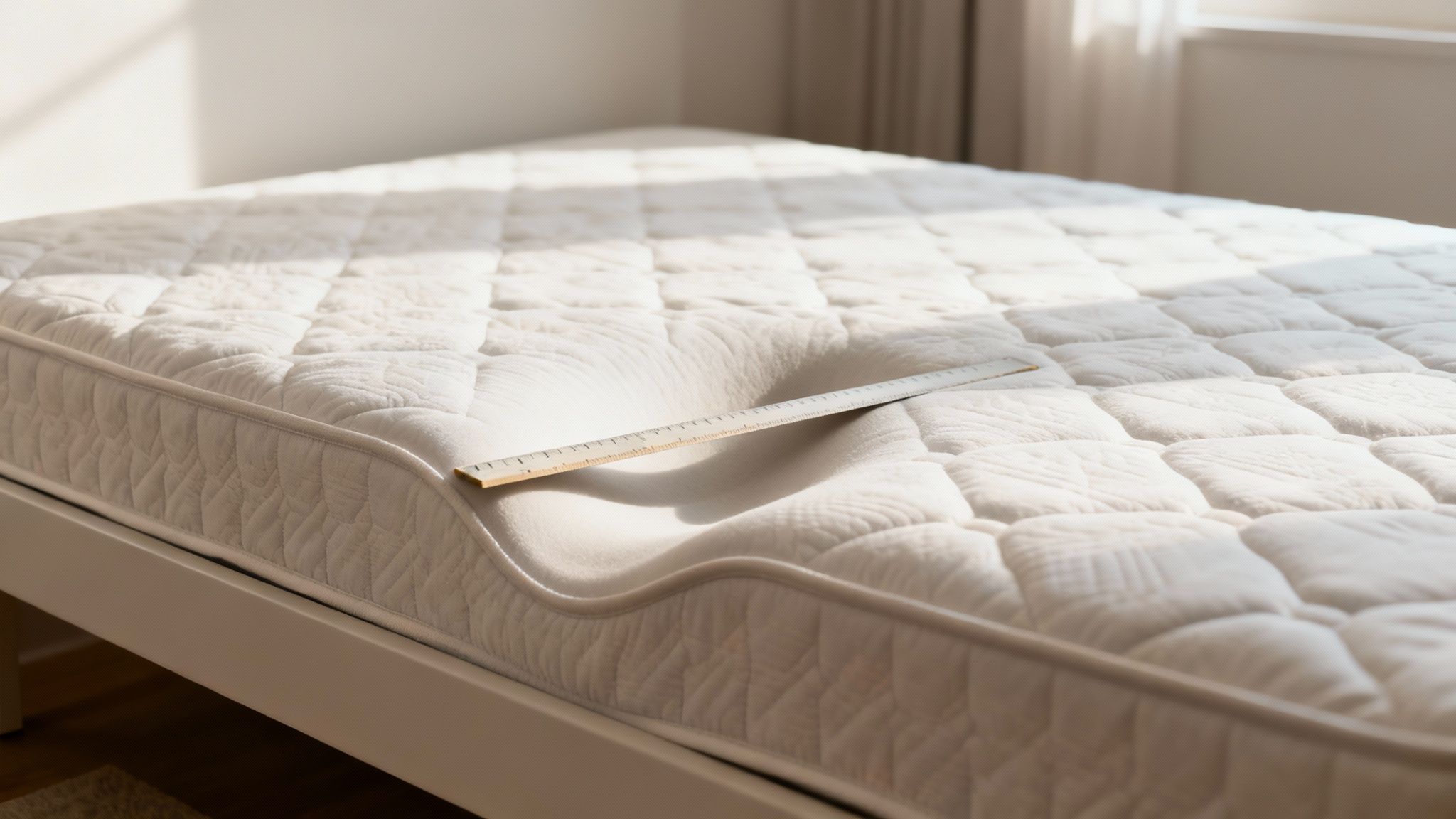
This loss of structural integrity is not just a cosmetic issue. A sagging mattress cannot distribute your body weight evenly, forcing your spine into an unnatural curve and creating severe pressure points. An indentation deeper than 1.5 inches is a structural failure, a surefire sign the bed can no longer provide the orthopedic support necessary for restorative sleep. This directly leads to the aches and stiffness discussed in our first point. Hand-tufted, two-sided mattresses crafted with natural materials resist these impressions far longer than their mass-market counterparts.
Why This Sign Matters
A mattress with visible sagging has failed its primary function: to provide a consistently flat and supportive surface. For couples, this can create a "roll-together" effect, where both partners gravitate toward the center dip, disrupting sleep. For an individual, it means the heaviest parts of the body, like the hips and torso, are sinking into an unsupportive hammock. This misalignment forces muscles to remain engaged all night, preventing deep rest and recovery. Ignoring this physical sign means you are actively sleeping on a surface detrimental to your spinal health.
Actionable Steps to Address Sagging
You can objectively measure whether your mattress has lost its shape and determine if a replacement is necessary.
The Straightedge Test: Remove all bedding and place a broom handle, yardstick, or other long, straight object across the mattress surface. Slide a ruler into the gap between the straightedge and the mattress to measure the depth of the indentation.
Document and Compare: Take photos of any visible sags or depressions, especially if your mattress is still under warranty. Most warranties specify an acceptable sag depth, and photographic evidence is crucial for a claim.
Rotate and Evaluate: If your mattress is a premium two-sided design and you haven't been flipping it, do so now. If the sagging is less severe, it confirms wear is the culprit. However, this is only a temporary fix for a failing mattress. High-density natural latex is far more resistant to sagging than conventional memory foams.
3. Allergies, Asthma Flare-ups, or Respiratory Issues During Sleep
If you find yourself sneezing, coughing, or dealing with congestion primarily at night, your mattress could be harboring unseen irritants. Over years of use, a mattress can become a reservoir for allergens like dust mites, dead skin cells, mold, and mildew. When these symptoms consistently worsen in the bedroom or improve when you sleep elsewhere, it's one of the clearest signs you need a new mattress.
Older mattresses, especially those made with synthetic foams, can trap moisture and provide an ideal breeding ground for these microscopic triggers. As you sleep, your movement and body heat can aerosolize these particles, leading to direct inhalation. This constant exposure can trigger nightly allergy and asthma attacks, disrupting restorative sleep and compromising your respiratory health.
Why This Sign Matters
Ignoring these nightly respiratory issues can lead to chronic sinus problems, poor sleep quality, and daytime fatigue. Your bedroom should be a sanctuary for clean air and deep rest, not a source of allergic reactions. A client with seasonal allergies might discover their symptoms have become a year-round problem, only to find relief after switching to a mattress made with natural, hypoallergenic materials like organic latex or wool, which are naturally resistant to dust mites and mold.
"A mattress that breathes is essential for a healthy sleep environment. Natural materials like wool and latex don't just provide comfort; they actively manage moisture and resist allergens, creating a cleaner, healthier space for you to rest and recover each night."Nate Cangemi, Certified Sleep Coach
Actionable Steps to Address Sleep-Related Allergies
Before replacing your mattress, take steps to diagnose the issue and improve your sleep hygiene.
Test Your Environment: Notice if your symptoms improve after a night away from home, such as in a hotel. If they do, your bedroom environment is the likely culprit.
Implement a Strict Cleaning Routine: Wash all bedding, including sheets and pillowcases, weekly in hot water (at least 130°F) to kill dust mites. Use allergen-proof mattress and pillow encasements as a barrier.
Manage Your Air Quality: Maintain bedroom humidity between 30-50% to inhibit mold and dust mite growth. Beyond just your mattress, overall air quality is critical. Learn more about HVAC technology that helps reduce indoor air pollution to create a healthier home.
If these steps do not resolve your symptoms, your mattress's internal environment is likely compromised. Investing in a new mattress made from naturally hypoallergenic and breathable materials like organic cotton, wool, and natural latex is a direct investment in your long-term respiratory health.
4. Excessive Heat Retention and Night Sweats
If you consistently wake up damp or overheated despite maintaining a cool bedroom, your mattress may be trapping body heat. A mattress isn't just a support system; it's a microclimate that should promote stable, comfortable temperatures. When materials degrade or are poorly designed, this thermal regulation fails, leading to one of the most disruptive signs you need a new mattress.
Many mass-produced mattresses, especially those made with dense, closed-cell memory foams and synthetic fibers, lack breathability. They absorb and retain body heat, creating a stifling sleep environment. As these materials age, they can also compress, further reducing airflow and compounding the problem. Instead of dispersing heat, the mattress insulates you, forcing your body to sweat to cool down, which severely fragments your sleep cycles.
Why This Sign Matters
Consistent overheating is more than an inconvenience; it disrupts the natural drop in core body temperature required to initiate and maintain deep, restorative sleep. A woman experiencing menopausal night sweats, for example, will find her sleep quality drastically improved by a mattress made with moisture-wicking organic wool and breathable natural latex. Similarly, a couple with different temperature preferences can resolve nightly conflicts with a mattress designed for superior airflow. A truly premium mattress facilitates temperature neutrality, a key pillar of uninterrupted rest.
"Your sleep environment should actively work to keep you cool and dry. If you're fighting your mattress for temperature control, it has become a barrier to quality sleep. Breathable, natural materials are not a luxury feature; they are essential for proper thermal regulation."Nate Cangemi, Certified Sleep Coach
Actionable Steps to Address Overheating
Before replacing your mattress, isolate the variable to ensure it is the root cause of your night sweats.
Track Your Temperature: For one week, note when you wake up overheated. Record the room's thermostat setting and the type of bedding you’re using (e.g., flannel sheets, down comforter).
Isolate the Mattress: Test your mattress's heat retention by lying on it for 15-20 minutes during the day. If you feel heat radiating back at you, the materials lack breathability.
Assess Your Full Sleep System: Breathable sheets (like linen or organic cotton), a lightweight duvet, and cooling pillows can help. However, these are supportive measures; they cannot fix a mattress that is fundamentally trapping heat.
If your tracking reveals consistent overheating unrelated to bedding or room temperature, it's a clear signal your mattress is failing. Exploring premium options with natural, breathable materials like GOLS-certified organic latex and wool is the most effective solution for achieving cool, comfortable sleep.
5. Mattress Age Approaching or Exceeding 7-10 Years
While visible sagging or persistent pain are clear indicators, one of the most important signs you need a new mattress is often invisible: its age. Most quality mattresses are engineered for a lifespan of 7 to 10 years. Beyond this timeframe, even a mattress that looks fine has likely experienced significant internal material degradation.
The foams, fibers, and coils that provide essential support break down at a molecular level over thousands of hours of use. This gradual loss of resilience is a proactive replacement indicator. Addressing it before symptoms like pain or poor sleep arise is key to maintaining consistent sleep health. Waiting until the mattress fails completely means you have already compromised your rest for months, or even years.
Why This Sign Matters
Ignoring a mattress's age is a gamble with your wellness. An executive sleeping on an 8-year-old memory foam mattress may not notice a gradual dip, but a professional pressure mapping could reveal a 40% loss of lumbar support, leading to subconscious strain. A mattress over seven years old is no longer providing the same level of alignment or pressure relief it did when new. This slow erosion of support forces your body to compensate, which can lead to the very issues you seek to avoid, from back pain to restless nights. Proactive replacement is a cornerstone of a well-managed sleep environment.
"A mattress is an investment in your health that has an expiration date. We recommend clients begin evaluating their options around year seven, not because the mattress has failed, but to ensure they never experience a single night on a system that no longer serves their body's needs."Nate Cangemi, Certified Sleep Coach
Actionable Steps to Address Mattress Age
Use your mattress’s age as a strategic planning tool to maintain optimal sleep quality.
Mark Your Calendar: When you purchase a new mattress, immediately note the date in your digital calendar with a reminder set for seven years in the future. This simple step prevents guesswork.
Budget for Replacement: Treat a new mattress as a predictable home maintenance expense. Factoring its replacement cost into your long-term financial planning removes the stress of an unexpected purchase.
Schedule a Proactive Consultation: Plan a professional fitting 6 to 12 months before the 8-year mark. This allows ample time to explore new materials, technologies, and custom options without the pressure of a failing mattress.
Understanding the expected lifespan of your mattress is crucial for long-term health. To explore this topic in greater detail, you can learn more about how often you should replace your mattress and plan for a seamless transition to a better sleep system.
6. Reduced Support for Pressure-Sensitive Areas (Hips, Shoulders, Lower Back)
If you find yourself constantly shifting to relieve pressure on your hips, shoulders, or lower back, your mattress has likely lost its ability to provide targeted support. A high-quality mattress is engineered to distribute body weight evenly, but as its core materials break down, it begins to sag in high-pressure zones. This loss of integrity is a clear sign you need a new mattress.
This degradation is particularly problematic for side sleepers, as their hips and shoulders bear the majority of their weight. When a mattress can no longer cushion and support these joints, it forces the spine into an unnatural curve, leading to pain and restless nights. The sophisticated zoned support systems in premium mattresses are designed to prevent this, but even the best materials have a lifespan.
Why This Sign Matters
Consistent, unalleviated pressure does more than cause discomfort; it actively hinders your body’s nightly repair process. For instance, a side sleeper on a worn-out mattress may wake with sharp shoulder pain because the joint has been compressed all night. A premium mattress, however, should offer a buoyant, pressure-free environment where your muscles can fully relax and recover. The best mattress for side sleepers with hip pain, for example, will have a dedicated zone of softer support to cradle the joint while maintaining firm lumbar alignment.
"A mattress isn't just one uniform surface; it's a dynamic support system. When the zones designed to cushion your shoulders and support your hips fail, the entire system collapses, compromising your alignment and sleep quality."Nate Cangemi, Certified Sleep Coach
Actionable Steps to Address Pressure Points
Before replacing your mattress, objectively assess its support capabilities and identify where it is failing.
Test Your Key Pressure Points: Lie down in your usual sleeping position for at least 15 minutes. Pay close attention to how your shoulders, hips, and lower back feel. Do you notice numbness, tingling, or a need to shift?
Evaluate Your Mattress Profile: Consider if your mattress ever had zoned support. Many mass-market models use a single-firmness foam slab, which cannot adequately support different body parts. Luxury mattresses often use layered or zoned coils and latex to provide firmer support for the lumbar region and softer cushioning for the shoulders.
Seek Objective Measurement: The most precise way to diagnose support failure is with professional pressure mapping. This technology creates a color-coded map of your body's pressure points, revealing exactly where your current mattress is causing strain and what kind of support you need for optimal alignment.
If your evaluation reveals uneven support and persistent pressure, it’s a definitive signal that your mattress is no longer performing its essential function. To see how a scientifically tailored sleep surface can eliminate pressure, you can learn more about our private, pressure-mapping-driven mattress fittings in Carlsbad.
7. Sleep Quality Decline: Poor Sleep Continuity, Frequent Waking, or Unrefreshing Sleep
Sometimes, the most telling sign you need a new mattress is not pain, but a subtle yet persistent decline in sleep quality. If you find yourself waking frequently, struggling to stay asleep, or feeling unrefreshed despite getting enough hours in bed, your mattress may be quietly disrupting your sleep cycles.
As a mattress ages, it loses its ability to regulate temperature, absorb motion, and provide consistent support. This can lead to micro-awakenings that pull you out of the deep, restorative stages of sleep (like REM and deep sleep) without you fully realizing it. Your body is constantly shifting to find a comfortable position, preventing your brain from fully recharging. The result is daytime fatigue, brain fog, and irritability, even after a full eight hours.
Why This Sign Matters
Consistent, high-quality sleep is foundational to cognitive function, immune health, and emotional regulation. When your mattress undermines sleep continuity, it robs your body of the chance to perform critical overnight repairs. A professional who feels their focus slipping during the day may not connect it to their mattress, yet an upgrade could lead to a significant reduction in nighttime waking and a marked improvement in daytime performance. This is one of the clearest signs you need a new mattress because it directly impacts your overall well-being.
"Deep, uninterrupted sleep isn't a luxury; it's a biological necessity. If your sleep is fragmented, your body never reaches the most restorative phases of the sleep cycle. Your mattress's job is to create an environment so comfortable and supportive that your body can remain still and fully recharge."Nate Cangemi, Certified Sleep Coach
Actionable Steps to Address Sleep Quality Decline
Before you attribute poor sleep solely to stress or lifestyle, assess your sleep environment.
Track Your Sleep: For two weeks, use a journal or a sleep-tracking app to note how many times you wake up, your total sleep duration, and how you feel upon waking on a scale of 1 to 10. This creates objective data.
Isolate the Variable: If possible, try sleeping on a different bed, like a high-quality guest mattress or a hotel bed, for a night or two. A noticeable improvement in sleep continuity can quickly confirm your mattress is the problem.
Evaluate Your Entire Sleep System: Your pillow, sheets, and foundation are just as crucial. A pillow that causes neck strain or sheets that trap heat can also lead to fragmented sleep, independent of the mattress itself.
If your tracking reveals a pattern of poor sleep continuity that improves when you sleep elsewhere, it's a strong indicator that your mattress is failing. To understand how a fully optimized sleep system can transform your rest, consider a professional consultation.
8. Incompatible Comfort Needs Between Sleep Partners
When sleep becomes a nightly negotiation over comfort, your mattress is often at the center of the conflict. One partner may need firm support while the other requires soft pressure relief; one may sleep hot while the other is always cold. A standard, one-size-fits-all mattress cannot resolve these opposing needs, making it one of the most significant signs you need a new mattress.
This incompatibility often worsens as a mattress ages. The lighter partner may feel every movement from the heavier partner, while different body types create uneven wear, leading to sagging on one side and firmness on the other. Instead of a shared sanctuary, the bed becomes a source of compromise where neither person achieves truly restorative sleep.
Why This Sign Matters
Compromising on sleep quality can strain a relationship and negatively impact both partners' health. Forcing a side sleeper who needs pressure relief onto a firm surface can cause hip and shoulder pain, while a back sleeper on a mattress that's too soft will lack essential lumbar support. Modern sleep systems offer sophisticated solutions, such as dual-firmness designs, split-comfort mattresses, and adjustable bases that allow each partner to customize their side. A mattress should be an investment in shared well-being, not a nightly battleground.
"A shared bed shouldn't require a sacrificed night's sleep. The goal is to create two perfect, individual sleep environments that exist on one mattress. When that is achieved, both partners can experience deep, uninterrupted rest."Nate Cangemi, Certified Sleep Coach
Actionable Steps to Address Partner Incompatibility
Finding a harmonious solution requires identifying each partner's unique needs and exploring modern mattress technology.
Identify Individual Needs: Have each partner independently note their ideal firmness, temperature preference, and any specific pain points. This creates a clear picture of the core conflict.
Explore Split-Comfort Solutions: Look for mattresses with dual-firmness options, where each side is tailored to individual preferences. This is a common feature in the luxury market.
Consider an Adjustable Base: A split king adjustable base allows each person to independently control their head and foot elevation. This can resolve issues like snoring, acid reflux, or circulation problems without disturbing the other partner.
When your mattress fails to serve both of you, it has outlived its purpose. To learn more about how to find the perfect shared sleep surface, discover our guide on the best mattress for couples with different preferences and see how a personalized fitting can resolve long-standing sleep conflicts.
8 Signs You Need a New Mattress — Comparison
Item | Implementation complexity | Resource requirements | Expected outcomes | Ideal use cases | Key advantages |
|---|---|---|---|---|---|
Persistent Morning Pain and Stiffness | Moderate — assessment (pressure mapping) and targeted mattress/pillow change | Professional fitting or mapping, new mattress or supportive topper, moderate cost/time | Reduced morning pain within 1–2 weeks; improved spinal alignment | Sleepers waking with consistent back/neck/hip pain | Direct, measurable symptom guiding targeted solution |
Visible Sagging, Indentations, or Loss of Shape | High — usually requires mattress replacement or warranty claim | New mattress purchase or warranty/repair documentation, photos/measurements | Immediate restoration of structural support after replacement | Mattresses with permanent impressions >1–1.5" or center sag | Objective, undeniable justification for replacement; warranty eligible |
Allergies, Asthma Flare-ups, or Respiratory Issues During Sleep | Moderate — testing and material change plus ongoing maintenance | Allergen testing, hypoallergenic mattress/protector, HEPA filters, humidity control | Reduced nighttime allergy/asthma symptoms over 1–2 weeks | Allergy- or asthma-prone sleepers, high-humidity homes | Health-focused improvement; better indoor air quality and long-term allergen reduction |
Excessive Heat Retention and Night Sweats | Moderate — change to breathable/cooling construction and bedding | Cooling or latex mattress, moisture-wicking covers and sheets, climate control | Improved temperature regulation and fewer night sweats, better sleep continuity | Hot sleepers, couples with differing temperatures, athletes, menopausal individuals | Immediate comfort gains; reduces moisture-related wear; supports dual-zone solutions |
Mattress Age Approaching or Exceeding 7–10 Years | Low–Moderate — proactive evaluation and planned replacement | Budgeting for new mattress, possible consultation, time to select | Preventive restoration of support and comfort when replaced | Mattresses ≥7 years old or with expiring warranties | Avoids sudden failure; opportunity to upgrade to newer technology |
Reduced Support for Pressure-Sensitive Areas | Moderate — pressure mapping and selection of zoned support or topper | Pressure-mapping consultation, zoned mattress or targeted topper, moderate cost | Targeted pressure relief and restored alignment; pain reduction | Side sleepers and those with hip, shoulder, or lower-back sensitivity | Precise, customizable relief; measurable improvement with mapping |
Sleep Quality Decline: Poor Sleep Continuity, Frequent Waking, or Unrefreshing Sleep | Moderate–High — holistic evaluation (mattress + system + hygiene) | Sleep tracking, comprehensive consultation, possible mattress/pillow/base changes | Improved sleep continuity and daytime function within 1–4 weeks | People with fragmented sleep unexplained by other causes | Broad restorative benefits; system-level optimization improves outcomes |
Incompatible Comfort Needs Between Sleep Partners | High — split-comfort or dual-zone customization and possible adjustable base | Split/dual-firmness mattress, adjustable base, joint consultation; higher cost and setup | Both partners achieve individualized comfort and fewer disturbances | Couples with different firmness, weight, or temperature preferences | Enables individualized optimization while preserving a shared bed; reduces compromise |
Your Next Step Toward Uncompromised Sleep
Recognizing the subtle yet persistent signals your body and bedroom are sending is the first, most crucial step toward reclaiming restorative sleep. If the signs we've explored—from persistent morning aches and visible sagging to declining sleep quality and partner disturbance—resonate with your experience, it’s clear your current sleep surface is no longer a sanctuary for rest. It has become a barrier to it. These are not minor inconveniences; they are direct indicators that your mattress is failing to provide the essential support and comfort your body requires for nightly repair and rejuvenation.
Ignoring these signs you need a new mattress invites compromised health, diminished daytime performance, and chronic discomfort. The journey to better sleep, however, is not about simply buying another mattress. It is about making a deliberate, informed investment in your well-being. A truly exceptional sleep system is meticulously tailored to your unique physiology, pressure points, and sleep preferences—something mass-produced models simply cannot achieve.
From Recognition to Resolution
The transition from a worn-out mattress to a bespoke sleep solution involves understanding the interplay of materials, support, and personal comfort. Consider these actionable next steps:
Document Your Sleep Experience: For one week, keep a simple journal. Note when you wake up, how you feel (stiff, refreshed, tired), and any specific pain points. This data will be invaluable when you seek professional guidance.
Evaluate Your Entire Sleep System: Remember, your mattress does not work in isolation. Are your pillows providing proper neck alignment? Is your foundation solid and supportive? A new mattress on a worn-out base is a compromised investment.
Prioritize Material Integrity: Instead of focusing on marketing terms like "ultra-plush," investigate the materials. Natural latex offers responsive support and durability, while hand-tufted wool wicks away moisture for superior temperature regulation. Once you've recognized these critical signs, the next step is to invest in a better night's rest; consider exploring options like a new Rainey Street™ mattress designed for superior comfort.
The Value of Expert Guidance
Ultimately, selecting the right mattress is a science. It requires an expert who can translate your unique needs into the perfect combination of support, comfort, and material science. A private, data-driven fitting process removes the guesswork, ensuring your new mattress is not just a purchase but a prescription for unparalleled sleep. By taking decisive action now, you are choosing to prioritize your health, enhance your daily energy, and transform your relationship with rest for years to come.
At Golden Dreams Mattress in Carlsbad, every guest enjoys a private concierge fitting with a Certified Sleep Coach. Book your complimentary 20-minute virtual consultation today and discover what luxury sleep really feels like.

Comments